Fan the Flame of Courage from 2 Timothy 1:7 with Remind, Rehearse, Act

Paul tells Timothy that God did not give him a spirit of timidity, but one marked by power, love, and self-control. That “spirit” describes the character the Holy Spirit produces in a believer, not raw human courage manufactured on demand. Crossway and BibleHub both tie the verse to Romans 8:15 and 1 John 4:18, framing courage as something a believer receives and then must actively use, echoed in scripture collections on this theme.
TL;DR:
- The Greek term for fear in 2 Timothy 1:7 specifically refers to cowardice or timidity, not reverent awe or emotional response.
- The qualities of power, love, and self-control come from the Holy Spirit as internal character gifts, not personal traits to generate independently.
- Fear in this verse is a moral and volitional problem, indicating a character flaw that believers are called to actively oppose through Spirit-led obedience.
- The verse emphasizes that believers already possess the Spirit’s empowering qualities; their role is to fan into flame what is already given.
- Practical application involves memorizing the verse, preparing mentally for pressure points, and consistently reinforcing these truths through topical scripture resources.
Table of Contents
- The Context Behind 2 Timothy 1:7
- What the Original Greek Actually Says
- How Commentators Read This Verse
- Living Out 2 Timothy 1:7 This Week
- First-Century Fear and Why Paul’s Words Cut Deeper Than We Think
- Why This Verse Matters for the Doctrine of the Holy Spirit
- How This Fear Compares to Other Biblical Uses of the Word
- Common Misreadings of 2 Timothy 1:7
- 2 Timothy 1:7 in Christian Encouragement and Pastoral Care
- A Pastoral Reflection on Fear and Faithful Action
- Build a Daily Practice Around This Verse
- Sources
- FAQ
The Context Behind 2 Timothy 1:7
Paul wrote this letter from a Roman prison, likely his last piece of correspondence before execution. He knew he would not see Timothy again in this life, and that weight shapes every line of chapter one. Timothy, meanwhile, was young, apparently prone to anxiety, and leading a church in Ephesus surrounded by false teachers and social pressure to distance himself from a jailed apostle.
That backdrop matters because verse 7 does not stand alone. It follows directly from verse 6, where Paul urges Timothy to “fan into flame” the gift God gave him through the laying on of hands. The image is deliberate: a fire that is not maintained dies down, but it is not gone. Timothy’s gift had not disappeared. It needed tending.
Verse 7 explains why fanning that flame is even possible. Paul is not telling Timothy to grit his teeth and try harder. He is reminding him what kind of Spirit he already carries.
A few cross-references sharpen this reading:
- Acts 1:8 connects the Spirit’s arrival directly to power for witness, the same word Paul uses here.
- Romans 8:15 contrasts “a spirit of slavery” that produces fear with “the Spirit of adoption,” the same fear-versus-Spirit pairing found in 2 Timothy 1:7.
- 2 Timothy 1:8 immediately applies the principle: “do not be ashamed of the testimony about our Lord,” a call that only makes sense if fear is not the believer’s default identity.
Read this way, the verse functions less as a stand-alone motivational line and more as the theological engine driving Paul’s entire charge to Timothy.
What the Original Greek Actually Says
English translations agree on the substance of this verse, but the Greek behind it carries sharper edges than most readers realize. The word Paul uses for “fear” is deilia, and it never describes reverent awe or wise caution anywhere else in the New Testament. Precept Austin’s word study defines it plainly as timidity or cowardice, the kind of fear that shrinks a person back from duty rather than sharpens their judgment.
The three qualities Paul contrasts against that fear each carry their own weight:
- Dunamis (power): not physical strength but divine capability, the same root behind “dynamite,” describing enablement that comes from outside the person.
- Agape (love): sacrificial, others-focused love rather than affection or sentiment.
- Sophronismos (translated “self-control” or “sound mind”): closer to disciplined judgment and sober-mindedness than mere sanity.
Quick fact: among major English translations, only the Amplified Bible expands “sound mind” into a fuller phrase (“calm and well-balanced mind”), while the ESV, NIV, NASB, and NLT each render it as “self-control,” reflecting a modern translation consensus around discipline rather than intellect.
Here is how the main translations handle the verse:
| Translation | Rendering of key phrase |
|---|---|
| ESV | “spirit of fear… but of power and love and self-control” |
| NIV | “spirit of fear… but of power, love and self-discipline” |
| NASB | “spirit of timidity… but of power, love, and discipline” |
| NLT | “timid and fearful spirit… but of power and love and self-discipline” |
| Amplified | “spirit of timidity, of cowardice… but of power and of love and of calm and well-balanced mind” |
NASB’s choice of “timidity” rather than “fear” gets closest to the Greek’s actual sense, since deilia describes a character flaw, not a natural emotional response. That distinction changes how the verse should be preached and applied: this is not about eliminating adrenaline before a hard conversation, it is about refusing to let cowardice run the show.
How Commentators Read This Verse
Commentators land on remarkably consistent ground here, even when they phrase it differently. The mainstream reading treats “spirit” in verse 7 as either the Holy Spirit himself or the Spirit-produced disposition he creates in a believer, rather than a vague reference to human temperament.
Crossway’s Brian J. Tabb notes that Paul unpacks the Spirit’s work as fearlessness paired with power, love, and self-control, directly tying it to the capacity to endure suffering for the gospel rather than avoid it. Older exegetical works, including D. Edmond Hiebert’s commentary in the Everyman’s Bible Commentary series, take a similar line: the Spirit given at conversion is inherently a Spirit of boldness, so a believer living in constant timidity is not expressing their true spiritual identity.
A short list of the recurring emphases across commentators:
- Divine enablement comes first; human responsibility to act on it comes second, never the reverse.
- “Fear” in this verse is a moral and volitional problem, not simply an emotional state.
- The three positive qualities work together rather than separately, forming one integrated Spirit-produced character.
Canonical cross-references reinforce the same picture. 1 John 4:18 states that perfect love casts out fear, and Galatians 5:22 to 23 lists love and self-control among the fruit of the Spirit, the exact pairing Paul names in Timothy’s letter.
Living Out 2 Timothy 1:7 This Week
Understanding the verse is one thing. Actually replacing timidity with Spirit-shaped courage under real pressure is another. Paul’s language of “fanning into flame” suggests a process, not a single decision, so a workable routine helps more than a one-time resolution.
- Remind. Before a hard conversation, decision, or task, say the verse out loud. Naming the truth that fear is not your assigned identity interrupts the automatic spiral into avoidance.
- Rehearse. Picture the specific moment of pressure and mentally walk through responding with power, love, and self-control instead of withdrawal. This is not positive thinking, it is preparation.
- Act. Take the smallest concrete next step, whether that is sending the email, making the call, or showing up to the meeting you wanted to skip.
Short memorized verses make this routine stick. Pairing 2 Timothy 1:7 with a handful of related passages from Biblemanna’s Bible verses about courage collection or its Bible verses about fear page gives you material to pray through in the exact moment fear shows up, rather than searching for the right verse under pressure.
Pro Tip: Not every hesitation is cowardice. Ask whether your reluctance comes from timidity (deilia) or from wise discernment about genuine risk. Scripture never asks you to be reckless, only to stop letting fear make your decisions for you.
First-Century Fear and Why Paul’s Words Cut Deeper Than We Think
Timidity in the Greco-Roman world Timothy inhabited was not just a private feeling. Public reputation, honor, and shame governed nearly every social interaction, and associating with a condemned prisoner like Paul carried real social and legal risk. Ephesian believers who openly identified with an imprisoned apostle could face harassment, loss of standing, or worse.
Timothy’s temperament compounded the pressure. Paul’s earlier letters hint that Timothy struggled with confidence, needing explicit encouragement to let no one look down on him for his youth. Set against that backdrop, “spirit of timidity” was not an abstract theological category. It described a live temptation for a young leader watching his mentor face execution while opposition in his own church grew louder.
Roman culture also prized self-mastery as a civic virtue, which makes Paul’s use of sophronismos strategically pointed. He was not asking Timothy to abandon a respected cultural ideal but to receive it as a Spirit-given gift rather than a self-generated achievement. The contrast Paul draws is not between fear and bravado. It is between a cowardice that caves to social pressure and a Spirit-formed steadiness that holds its ground regardless of the cost.
Why This Verse Matters for the Doctrine of the Holy Spirit
2 Timothy 1:7 quietly makes a significant theological claim: the Holy Spirit does not just comfort or convict, he actively reshapes character. Power, love, and self-control are not personality traits some Christians happen to have and others lack. Paul presents them as standard equipment that comes with the Spirit’s presence in every believer.
This connects directly to the broader New Testament pattern where the Spirit’s work is described in terms of transformation rather than mere assistance. Galatians 5:22 to 23 lists love and self-control among the fruit the Spirit produces, matching two of the three qualities named in Timothy’s letter almost exactly. Biblemanna’s page on the fruits of the Spirit traces this same pattern across multiple passages, showing that 2 Timothy 1:7 is not an isolated promise but part of a consistent scriptural picture.
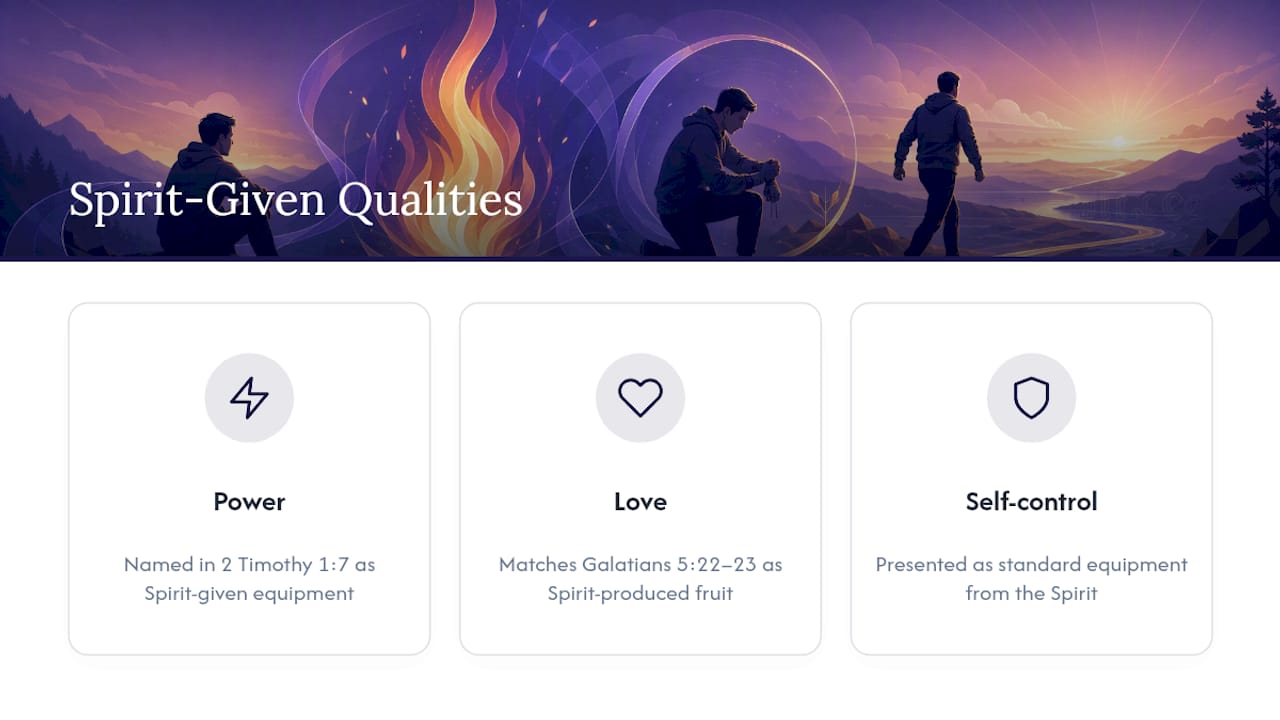
The theological weight here lands on a simple but easily missed point: a believer who feels perpetually gripped by cowardice is not necessarily lacking the Spirit. They are more likely failing to draw on what the Spirit has already supplied, which is exactly the gap Paul’s “fan into flame” language addresses in verse 6. The Spirit’s role, in this reading, is less about zapping fear away and more about supplying the ongoing resource a believer must choose to use.
How This Fear Compares to Other Biblical Uses of the Word
Scripture uses “fear” in at least two distinct senses, and confusing them is where a lot of misapplication of this verse begins. The fear Paul rejects in deilia is entirely different from the reverent fear of the Lord commended throughout Proverbs and the Psalms.
Fear of the Lord describes awe, reverence, and a right-sized view of God’s holiness. Timidity describes shrinking back from duty out of self-protection. The two are not on a sliding scale of the same emotion. One orients a person toward God; the other orients a person away from obedience.
“Spirit” shows similar range across scripture, and readers benefit from noticing the pattern rather than assuming one fixed meaning every time the word appears:
- Sometimes it refers to the Holy Spirit himself, a distinct divine person.
- Sometimes it refers to a disposition or character quality the Spirit produces, as in Romans 8:15’s “spirit of adoption.”
- Sometimes it refers to a general attitude or mood, closer to how English speakers use “spirit” in phrases like “team spirit.”
2 Timothy 1:7 likely draws on the second sense primarily, describing a Spirit-shaped disposition, while still assuming the Holy Spirit as the source. That layered meaning is precisely why commentators rarely reduce this verse to a single flat definition.
Common Misreadings of 2 Timothy 1:7
The most frequent misreading treats this verse as a blanket promise that Christians should never feel afraid. Paul is not describing an emotional state at all. Deilia names a character disposition, cowardice, not the adrenaline spike everyone experiences before a hard conversation or a real threat. Feeling afraid and being timid are not the same thing, and collapsing them leads people to feel guilty for normal human responses to danger or uncertainty.
A second common error strips the verse from its context and turns it into a stand-alone motivational slogan detached from verse 6’s charge to “fan into flame” a specific spiritual gift. Paul was writing to a pastor about ministry courage in the face of persecution, not issuing a general anti-anxiety mantra for every life circumstance.
A third misreading assumes “power” here means personal strength or willpower. Dunamis describes enablement that originates outside the person, not self-generated grit, which matters because it shifts the verse’s emphasis from self-improvement to dependence on God.
Finally, some readers treat “self-control” as purely about resisting temptation, when sophronismos leans toward sober judgment and disciplined thinking more broadly. That distinction affects how the verse gets applied. It speaks to clear-headed decision making under pressure, not only moral restraint.
2 Timothy 1:7 in Christian Encouragement and Pastoral Care
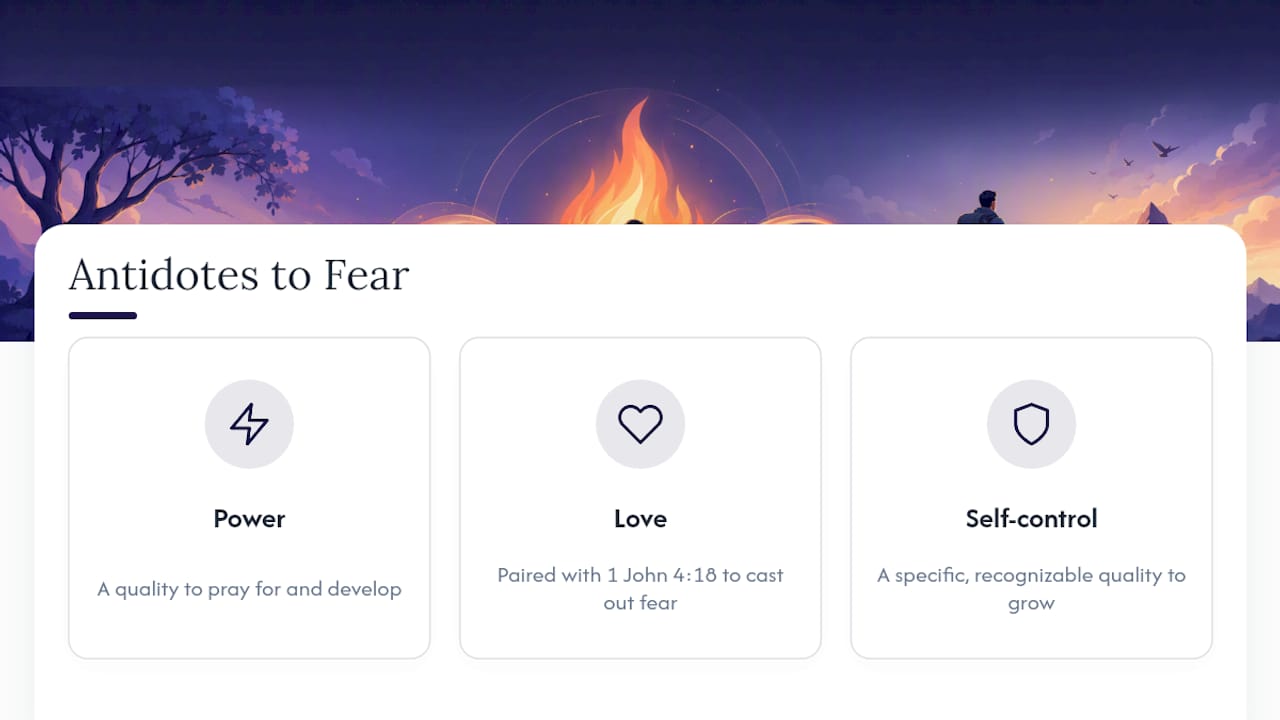
Few verses appear as often in pastoral counseling as this one, and for good reason. It gives a person facing anxiety, a difficult diagnosis, or a daunting decision a concrete alternative to fear that is not vague optimism. Power, love, and self-control name specific, recognizable qualities a person can pray for and watch develop, rather than asking them to simply “feel better.”
The verse also shows up constantly in encouragement literature aimed at people in transition: new believers stepping into ministry, missionaries facing hostile environments, and ordinary Christians navigating job loss or illness. Its usefulness comes from precision. It does not deny that fear is real or that circumstances are hard. It names a specific spiritual resource available in the middle of those circumstances.
Pastors often pair it with 1 John 4:18’s statement that perfect love casts out fear, since both passages treat fear as something displaced by a positive spiritual reality rather than simply suppressed through willpower. That pairing gives counseling conversations a scriptural anchor beyond generic reassurance, and it explains why the verse remains one of the most frequently quoted passages in devotional writing on courage, alongside resources like The Broken Seam’s Grace Notes devotionals, which take a similar approach of pairing short scripture with lived application.
A Pastoral Reflection on Fear and Faithful Action
The believers who lean on this verse most are rarely facing dramatic danger. They are facing the ordinary courage gap: the phone call they keep avoiding, the ministry opportunity they keep talking themselves out of, the honest conversation they keep postponing. Paul’s charge to Timothy speaks directly into that gap, insisting that hesitation is not the believer’s assigned identity.
What strikes me most about this passage is how little it asks readers to manufacture on their own. The Spirit supplies power, love, and self-control. The believer’s job is smaller than it feels: fan the flame that is already lit. For anyone wanting to build that into daily practice, topical scripture pages organized by theme offer a practical starting point.
— Nkosi
Build a Daily Practice Around This Verse
Understanding 2 Timothy 1:7 is the easy part. Keeping it in front of you on the days fear actually shows up is where most people fall short. This gap can be addressed with curated topical scripture collections you can return to again and again instead of hunting for the right verse mid crisis.

Collections like 48 Bible verses about courage and 25 Bible verses about fear group related scripture together with context, so you can build a short memorization list around exactly what you are facing this week. The random verse generator and study tools add a way to keep encountering fresh scripture rather than relying on memory alone. Start by browsing the full library of Bible verses by topic and build a short list of verses tied to courage and fear you can pray through daily.
Sources
- What Does 2 Timothy 1:7 Mean? | Crossway
- 2 Timothy 1:7 (Precept Austin word studies)
- 2 Timothy 1:7 Study Bible (BibleHub)
FAQ
How can I apply 2 Timothy 1:7 to my life?
Start by memorizing the verse alongside one or two related passages, like Romans 8:15 or 1 John 4:18, then use Paul’s “remind, rehearse, act” pattern before moments that trigger timidity rather than waiting for fear to pass on its own.
What is the main point of 2 Timothy 1:7?
The verse teaches that God’s Spirit produces power, love, and self-control in believers instead of the cowardice that makes people shrink back from duty, calling Timothy to actively use the gift he already received.
What does power mean in 2 Timothy 1:7?
Power translates the Greek word dunamis, describing divine enablement that comes from the Holy Spirit rather than personal willpower or natural confidence.
What is the main message of 2 Timothy 1:7?
Paul reminds Timothy that timidity has no place in a Spirit-filled life, since the same Spirit who indwells believers also equips them with power, love, and sound judgment to face ministry pressure without backing down.