Agape Love Meaning: A Biblical Guide to Selfless Love

Agape is the willful, self-giving love that seeks another’s good regardless of feeling, mood, or whether anything comes back in return. It is not a rush of emotion but a deliberate choice, and the New Testament treats it as both the defining character of God and a direct command for every believer. GotQuestions describes it as the highest, most selfless form of love, sacrificial and intentional rather than fleeting. Three passages anchor the concept immediately: 1 Corinthians 13 (“Love is patient, love is kind…”), 1 John 4:8 (“God is love”), and John 3:16, where God gives his only Son not because humanity earned it but simply because he loves. Understanding agape changes how you read Scripture and how you show up in every significant relationship you have.
“Love is patient, love is kind. It does not envy, it does not boast, it is not proud… it always protects, always trusts, always hopes, always perseveres. Love never fails.” — 1 Corinthians 13:4–8 (NIV)
Table of Contents
- What does agape love actually mean in Greek?
- Key New Testament verses that show agape in action
- How does agape compare to eros, philia, and storge?
- How theologians through history have read agape
- Can humans actually give agape love?
- What does agape look like in real life?
- Key Takeaways
- Why agape is harder and more hopeful than most people expect
- Biblemanna’s scripture collections can deepen your study of agape
- Useful sources
- FAQ
What does agape love actually mean in Greek?
The word comes from the Ancient Greek ἀγάπη (agápē), and its basic lexical sense is a generous, giving affection, one that the Cambridge Dictionary defines simply as “unselfish love.” That sounds plain enough, but the history behind it matters.
In classical Greek literature, agápē appeared far less often than eros or philia. It carried a general sense of contentment or fondness rather than passionate desire. Early Christians seized on it precisely because it was relatively neutral, a blank canvas they could fill with a specific theological meaning: the love that gives without calculating a return.
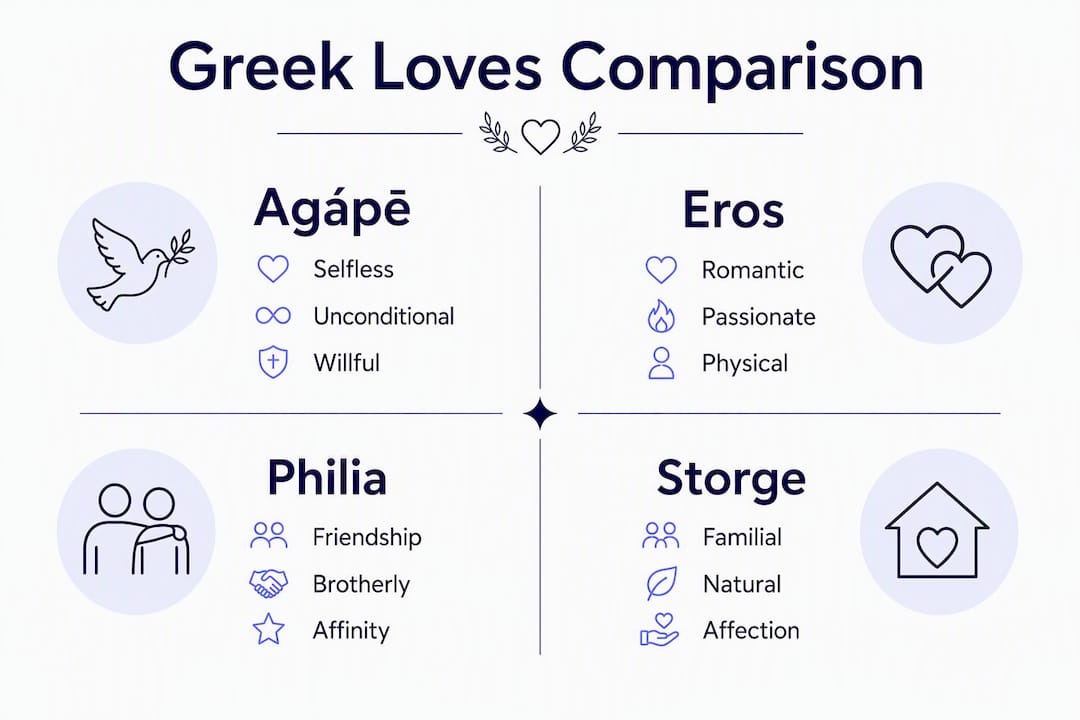
The English word “love” collapses at least four distinct Greek concepts into one, which is where confusion starts. When a modern reader sees “love” in a Bible translation, they often import romantic or sentimental associations that the original Greek did not intend. The early church also used agape as the name for a communal meal, the “love feast,” where believers shared food across social barriers, a practice that itself embodied the word’s meaning.
A few distinctions worth keeping in mind:
- Agápē is other-centered, willful, and morally commanded; it does not depend on the worthiness of the recipient.
- Eros is desire-driven love, typically romantic or passionate, oriented toward what the lover wants or finds beautiful.
- Philia is the warm affection of friendship and mutual loyalty, built on shared experience.
- Storge is the natural bond of family, the instinctive care a parent feels for a child.
Key New Testament verses that show agape in action
The New Testament does not just define agape; it demonstrates it through specific passages that each add a different dimension.
1 Corinthians 13:4–8 is the most quoted passage on love in the Bible, and it describes agape entirely in behavioral terms: patience, kindness, absence of envy, endurance. Paul is not describing a feeling; he is describing a practice.

1 John 4:7–8 makes the theological claim explicit: “God is love.” Agape is not merely something God does; it is what God is. The passage commands believers to love one another on that same basis.
John 3:16 presents agape as the motive behind the Incarnation. God’s love for the world is not conditional on the world’s response; it precedes and drives the gift.
Romans 5:8 sharpens that point: “While we were still sinners, Christ died for us.” The timing is the argument. Agape acts toward the undeserving.
John 15:13 defines its upper limit: “Greater love has no one than this: to lay down one’s life for one’s friends.” Sacrifice is not the exception; it is the measure.
Matthew 5:44 extends the command to its most demanding application: “Love your enemies.” This is where agape parts company with every other love concept, because enemies, by definition, offer nothing back.
“But God demonstrates his own love for us in this: While we were still sinners, Christ died for us.” — Romans 5:8 (NIV)
Read together, these passages form a coherent picture. Some show agape as God’s character (1 John 4:8, John 3:16); others present it as a direct command for humans (Matthew 5:44, John 15:12). BibleProject emphasizes that this is not accidental: the NT writers want readers to see God’s agape as both the source and the model for human agape.
How does agape compare to eros, philia, and storge?
The four Greek loves are genuinely distinct, but the differences are subtler than popular Christian teaching often suggests.
| Dimension | Agápē | Eros | Philia | Storge |
|---|---|---|---|---|
| Primary motivation | The other’s good, regardless of return | Desire; the beloved’s beauty or appeal | Mutual affection and shared loyalty | Natural kinship bond |
| Typical trigger | A moral command or spiritual formation | Attraction | Shared history or values | Family relationship |
| Reciprocity expected? | No | Often yes | Usually yes | Instinctive, not calculated |
| Biblical examples | Romans 5:8; Matthew 5:44 | Song of Solomon (desire) | John 11:3 (friendship) | Luke 15 (father and son) |
One popular misconception deserves direct correction: agape is not “purely unemotional.” The idea that agape is cold, duty-driven, and stripped of feeling is a modern overreaction to the equally wrong idea that love is only a feeling. BibleGateway’s Encyclopedia of the Bible argues that treating agape and eros as mutually exclusive misreads the biblical data. Jesus wept (John 11:35). Paul wrote with evident passion. Agape is chosen and commanded, yes, but it is not emotionless.
Logos adds a useful scholarly caution: in John 21, Jesus and Peter alternate between agapao and phileo in a way that many preachers treat as theologically loaded, but the variation is likely stylistic. Exegesis built on word-study distinctions alone can mislead; context always does more work than the lexicon.
How theologians through history have read agape
The theological tradition on agape is rich and sometimes contentious.
Augustine framed agape as caritas, the rightly ordered love that directs the soul toward God above all else. For him, disordered love (loving lesser things as ultimate) was the root of sin. Thomas Aquinas built on this, treating agape as the form of all virtues, the love that gives every other virtue its direction and worth.
The Reformation shifted emphasis. Luther stressed that agape flows from grace received, not from moral effort. You love others because you have been loved first, not to earn anything. This “gift-love” framing became central to Protestant spirituality.
Karl Barth, in the twentieth century, argued that agape is the definitive revelation of who God is in Jesus Christ. It is not a general human capacity that Scripture elevates; it is something disclosed from outside, in the Incarnation and Cross.
C. S. Lewis, in The Four Loves, treated agape (which he called “Gift-love”) as the love most like God’s own love, the love that gives without needing anything back. He was careful to note, though, that humans need both gift-love and “need-love,” and that pretending otherwise produces a distorted spirituality.
“Divine Gift-love in the man enables him to love what is not naturally lovable: lepers, criminals, enemies, morons, the sulky, the superior and the sneering.” — C. S. Lewis, The Four Loves
The BibleGateway Encyclopedia also traces agape’s roots to the Hebrew concept of chesed, the steadfast lovingkindness of God in the Old Testament, captured movingly in Jesus embracing a boy in a field artwork that reflects this divine love. Early Christians did not invent the idea from scratch; they inherited a covenantal framework and gave it a new center in Christ.
Can humans actually give agape love?
The short answer is yes, with real limits. Humans can choose agape-like actions; making it a stable habit typically requires spiritual formation and, in Christian teaching, the work of the Holy Spirit.
Verywell Mind frames agape, from a clinical perspective, as a “felt sense of loving responsibility” rather than a spontaneous emotion. Therapists note that this reframe is practically useful: you do not wait to feel loving before acting lovingly. You act, and the feeling often follows. The same source reports that practicing agape correlates with improved relational and emotional well-being, though practitioners must maintain boundaries because other-centered giving can become exhausting without deliberate self-care.
That last point matters. Agape is not self-erasure. A person who gives without any limit, without rest, without healthy boundaries, eventually has nothing left to give. The command to love your neighbor “as yourself” implies that self-regard is part of the equation, not its opposite.
Pro Tip: Before practicing agape with others, identify one realistic limit for the week, a time you will stop, rest, or say no. Sustainable giving requires a replenished giver.
Practices that build agape as a habit:
- Meditate on Romans 5:8 or 1 Corinthians 13 before a difficult interaction; reorienting the mind before the moment changes the response.
- Perform one anonymous act of service weekly, something where no credit is possible, to train the motivation away from reciprocity.
- Practice listening without preparing a response, giving full attention as an act of will rather than waiting for your turn.
- Name one person you find difficult to love and pray specifically for their flourishing, not their change.
- Schedule rest deliberately, treating it as part of the practice rather than a failure of commitment.
What does agape look like in real life?
Scripture gives the clearest pictures. The Good Samaritan (Luke 10:25–37) crosses ethnic and social lines to help a stranger at personal cost, with no expectation of thanks. Jesus washing his disciples’ feet (John 13) is a deliberate act of service by the person with the most status in the room. Christ’s sacrifice on the Cross is the defining example: love given at maximum cost to the giver, for people who were actively hostile.

Everyday agape looks less dramatic but follows the same logic. Listening to a friend without redirecting the conversation to yourself. Showing up for someone who cannot repay the favor. Paying for a stranger’s meal anonymously. Staying patient with a difficult family member when impatience would be easier. These acts share one feature: they are chosen, not compelled by feeling or the expectation of return.
For love thy neighbor in practice, the Good Samaritan model is the clearest template Scripture offers: proximity plus action plus cost, regardless of category.
In marriage specifically, agape shows up as the decision to serve your spouse on the days when affection is low. Focus on the Family frames this as sacrificial love that supports long-term relational flourishing, not a romantic feeling but a daily practice of choosing the other’s good. The caveat from the psychological literature applies here too: sacrificial love in marriage does not mean absorbing harm without limit. Healthy boundaries protect both people.
A short practice list for cultivating agape in relationships:
- Choose one act of service for your spouse or a close friend this week that they will not know you did.
- When conflict arises, pause and ask: “What does this person actually need right now?”
- Read Bible verses about love together as a couple or small group once a week.
- Extend the same patience to yourself that you are trying to give others.
Key Takeaways
Agape is the willful, other-centered love commanded in Scripture, rooted in God’s own character, and made humanly possible through spiritual formation and deliberate practice.
| Point | Details |
|---|---|
| Agape defined | Willful, self-giving love that seeks another’s good regardless of feeling or reciprocity. |
| Scripture anchors | 1 Corinthians 13, 1 John 4:8, John 3:16, and Romans 5:8 are the core NT passages. |
| Human capacity | Humans can choose agape-like actions; making it habitual requires spiritual formation and boundaries. |
| Not emotionless | Agape is commanded and chosen, but the Bible does not strip it of feeling or warmth. |
| Biblemanna resource | Biblemanna’s curated love verse collections give you a ready scripture base for study and daily practice. |
Why agape is harder and more hopeful than most people expect
Most treatments of agape land in one of two places: either it becomes an impossible ideal that leaves people feeling guilty, or it gets flattened into a feel-good synonym for “being nice.” Both miss the point.
What strikes me about the biblical data is the specificity of the command. Jesus does not say “feel warmly toward your enemies.” He says love them, pray for them, do good to them. The command is behavioral, which is actually more hopeful than an emotional command would be. You cannot manufacture a feeling on demand, but you can choose an action. That gap between feeling and action is where agape lives, and it is where most spiritual growth happens.
The theological tradition from Augustine through Barth keeps returning to the same insight: agape is not a human achievement. It flows from having been loved first. The person who genuinely grasps Romans 5:8, that God acted toward them while they were still hostile, tends to find the command to love enemies less impossible. Not easy, but less impossible.
The psychological literature adds a layer that the church sometimes overlooks: this kind of love, practiced without boundaries, can damage the giver. That is not a secular concession; it is pastoral wisdom. Sustainable agape requires a replenished giver, and replenishment is not selfishness. It is stewardship.
Biblemanna’s scripture collections can deepen your study of agape
If you want to move from understanding agape to actually practicing it, the most direct path is regular, focused engagement with the passages that define it. Biblemanna’s Bible verses by topic gives you curated collections organized around love, kindness, encouragement, and related themes, each verse presented with context so you are not just reading words in isolation.

The Fruits of the Spirit topic page connects agape directly to spiritual formation, showing how love functions as the first and foundational fruit. Whether you are preparing a sermon, working through a difficult relationship, or simply trying to understand what the Bible actually teaches about love, Biblemanna gives you the scripture base to start from. Visit biblemanna.com to explore the full collection and find the verses that speak to where you are right now.
Useful sources
- GotQuestions — Agape Love: Clear theological summary of agape’s meaning, NT usage, and distinction from other loves; a reliable first stop for biblical definitions.
- BibleProject — Agape Love: Video and written explainer emphasizing agape as a commanded, willful practice rather than a feeling; strong on theological framing.
- BibleGateway — Encyclopedia of the Bible: Agape: Encyclopedic treatment of agape in biblical theology, including its Hebrew roots in chesed and its NT range.
- Logos — What Does Agape Love Mean?: Scholarly perspective on the limits of word-study approaches; useful for understanding why agapao/phileo distinctions can mislead.
- Verywell Mind — Agape Love: Clinical and psychological framing of agape as a practice, with guidance on benefits and the importance of boundaries.
- Cambridge Dictionary — Agape: Concise lexical definition confirming the “unselfish love” sense in modern English usage.
- Focus on the Family — Sacrificial Love in Marriage: Pastoral application of agape to marriage, framing it as a daily practice of sacrificial service.
FAQ
What are the four types of love in the Bible?
The four Greek words for love found in or around biblical literature are agápē (selfless, willful love), eros (romantic desire), philia (friendship and mutual affection), and storge (natural family bond). The New Testament uses agápē most frequently for the love God commands and demonstrates.
Can humans give agape love?
Yes, though not perfectly or effortlessly. Humans can choose agape-like actions, and clinical research links that practice to better relational well-being; Christian teaching adds that making it habitual typically requires spiritual formation and the work of the Holy Spirit.
What is a clear example of agape love?
Romans 5:8 is the clearest biblical example: Christ died for humanity while people were still sinners, meaning the love preceded and required no worthiness from the recipient. In everyday life, anonymous acts of service with no expectation of thanks follow the same logic.
Is agape love appropriate for marriage?
Agape is especially relevant in marriage because long-term relationships inevitably pass through seasons when romantic feeling is low. Pastoral teaching, including guidance from Focus on the Family, frames agape as the daily choice to serve a spouse’s good, the foundation that sustains a marriage when eros alone cannot.
Does agape mean love has no emotion?
No. Agape is commanded and chosen rather than triggered by feeling, but the Bible does not present it as cold or mechanical. Jesus wept, Paul wrote with passion, and the NT consistently pairs agape with warmth and genuine care. The distinction is that agape does not depend on emotion to act.