Amen Meaning: What It Means, Where It Comes From

“Amen” means “so be it,” “truly,” or “verily.” It’s an affirmation, a way of saying “I agree” or “let this stand,” and it traces back to the Hebrew triconsonantal root א־מ־נ (a-m-n), a set of consonants tied to ideas of firmness, reliability, and trustworthiness. The word moved from Hebrew into Greek, Latin, and eventually English, picking up the same shape in Arabic (“Amin”) along the way. In everyday use, “amen” shows up in three main places:
- Closing a prayer, as a final word of assent
- Punctuating a hymn, sermon, or liturgical reading
- Standing alone in conversation, as in “Amen to that!”
Key Takeaways
“Amen” means “so be it” or “truly,” derived from the Hebrew root a-m-n, and functions as an affirmation across Jewish, Christian, and Islamic prayer as well as everyday English speech.
| Point | Details |
|---|---|
| Core meaning | “Amen” translates to “firm,” “truly,” or “so be it,” rooted in the Hebrew triconsonantal root a-m-n. |
| Linguistic path | The word moved from Hebrew into Greek (ἀμήν), Late Latin, Old English, and modern languages largely unchanged. |
| Cross-faith presence | Judaism, Christianity, and Islam (as “Amin”) all use the word to ratify prayers, blessings, or supplications. |
| Two functions in Christianity | It closes most prayers but also opens statements in the Gospels, as in Jesus’ “truly, truly” construction. |
| Secular use | In casual English, “amen” works as an emphatic agreement, as in “Amen to that!” |
Table of Contents
- What Does “Amen” Actually Mean and Where Did It Come From?
- How Do Judaism, Christianity, and Islam Use “Amen”?
- What Does “Amen” Mean in Everyday Speech?
- Why Do People Actually Say “Amen”?
- What Are Some Scripture Examples Using “Amen”?
- How Do Christian Denominations Differ in Using “Amen”?
- How Is “Amen” Pronounced Across Languages and Traditions?
- What Is the Theological Significance of Saying “Amen”?
- How Has “Amen” Evolved Beyond Religious Use Over Time?
- A Word Worth Slowing Down For
- Ready to Go Deeper Into Scripture?
- Sources
- FAQ
What Does “Amen” Actually Mean and Where Did It Come From?
The Hebrew root behind “amen” carries a cluster of related meanings: firm, fixed, sure, faithful. That’s not a coincidence. When someone says “amen,” they’re linguistically saying “this is solid” or “this is true,” not just “I heard you.” Standard etymological references trace the word’s core sense to reliability rather than mere approval, which is a sharper meaning than most casual users realize.
Here’s how the word traveled:
- Early Hebrew Bible: “Amen” appears as a response to blessings and curses, sometimes opening a statement and sometimes closing it.
- Greek adoption: The Septuagint and later the New Testament carried the word over untranslated as ἀμήν (amen), rather than substituting a Greek equivalent.
- Late Latin and Old English: Christian liturgy in the Latin West kept the transliterated form, and it passed into Old English largely unchanged.
- Modern languages: English, Spanish, French, German, and dozens of others still use a recognizable version of the same word.
A few things worth flagging along the way:
- The initial use of “amen” (opening a statement, as Jesus does in the Gospels) is distinct from the later, more familiar closing use.
- Etymological histories document the semantic drift from “trustworthy, firm” to “so be it” and “truly,” which is a shift that happened gradually as the word moved between languages.
- Popular claims linking “amen” to the Egyptian god Amun or the Sanskrit “Aum” don’t hold up. The consonant structures don’t match, and standard sources reject the connection outright.
That last point matters because the Amun theory circulates constantly online. It’s a coincidence of sound, not a shared root.
How Do Judaism, Christianity, and Islam Use “Amen”?
Judaism
In Jewish practice, “amen” is a congregational response, said after hearing a blessing to affirm it as one’s own. Rabbinic tradition treats the word seriously enough that responding “amen” to a blessing is considered almost as meritorious as reciting the blessing yourself. It also appears in oath contexts in the Hebrew Bible, where affirming “amen” carries legal or covenantal weight, not just polite agreement.
Christianity
Christian use splits into two patterns. The familiar one closes prayers, hymns, and creeds, a verbal seal on what came before. The less familiar one, documented in the Gospels, has Jesus using “amen” to open a statement, the “verily, verily I say to you” construction found repeatedly in John and the Synoptic Gospels. That’s a rhetorical device unique enough that scholars treat it as a hallmark of Jesus’ speech pattern, distinct from earlier Jewish liturgical habits.
“Amen” functions as a concluding word to prayers, blessings, and creeds in Judaism, Christianity, and Islam, ratifying or confirming the statement that came before it.
Denominational emphasis varies. Some traditions expect a spoken or shouted “amen” throughout a service; others reserve it for specific liturgical moments. BibleManna’s collection of Bible verses about prayer includes several passages where this affirming role plays out in context.
Islam
Muslims say “Amin” (آمين), the Arabic form of the same word, to close a du’a (personal supplication) and after reciting Al-Fatiha during formal prayer (salah). Arabic lexicons give it an almost imperative flavor, closer to “grant this” or “answer this” than a passive nod of agreement. The word entered Arabic religious vocabulary from the same Semitic family that produced the Hebrew original, so its presence across three major faiths isn’t a borrowing accident. It’s a shared linguistic inheritance.

What Does “Amen” Mean in Everyday Speech?
Outside church, mosque, or synagogue, “amen” does real work as an interjection. Say “Amen to that!” after someone complains about traffic or praises a good meal, and you’re not invoking anything religious. You’re signaling strong agreement, the same function words like “absolutely” or “exactly” serve, but with a little more weight behind it.
That extra weight is the interesting part. Linguists note that “amen” carries a layer of solemn or communal force that plainer agreement words lack, a residue of its liturgical history that survives even in casual use. You hear it in idioms too, like the “amen corner,” a term for the section of a church (or, by extension, any group) known for vocal, enthusiastic agreement.
If you’re choosing what to say instead of “amen” in a secular setting, consider:
- “So be it”
- “Absolutely”
- “I agree”
- “Hear, hear”
- “Exactly right”
Pro Tip: Save “amen” for moments that call for genuine conviction. Dropping it into every mildly agreeable sentence dilutes the word’s punch, the same way overusing “literally” wears out its meaning.
Pronunciation splits along two common lines in English: “ah-MEN” (favored in many liturgical and British contexts) and “ay-MEN” (common in American gospel and evangelical traditions). Neither is wrong. Context and community usually decide which one fits.
Why Do People Actually Say “Amen”?
Saying “amen” does several jobs at once:
- Ratification: It confirms you mean what was just said or prayed.
- Communal assent: In a group setting, it signals shared belief without requiring everyone to speak the whole prayer.
- Personal commitment: Saying it aloud, even alone, marks a private decision to stand behind the words.
- Rhetorical emphasis: In preaching or speech, it underlines a point as true or important.
- A pause marker: It closes one thought before moving to the next, verbally and psychologically.
Critics sometimes call “amen” formulaic, a reflexive tic rather than a meaningful act. That criticism misses the sociolinguistic function at work. Saying “amen” in a group is what linguists call a performative speech act. The word doesn’t just describe agreement, it enacts it, the same way saying “I do” at a wedding does more than report a feeling. Repetition doesn’t drain that function. It reinforces it, the same way saying “thank you” stays meaningful even though you say it constantly.
Pro Tip: If “amen” starts to feel automatic in your own prayer life, try pausing half a second before you say it. That small gap turns a habit back into a decision.
What Are Some Scripture Examples Using “Amen”?
A handful of passages show the range of how “amen” gets used across the Bible:
- Deuteronomy 27:15-26: The people respond “amen” after each curse pronounced from Mount Ebal, an early example of communal ratification.
- Nehemiah 8:6: The assembly answers “Amen, Amen” while lifting their hands, a public affirmation during Ezra’s reading of the Law.
- Matthew 6:13 (in many translations): The Lord’s Prayer closes with “amen,” the pattern most readers know best.
- John 3:3: Jesus opens with “Truly, truly, I say to you,” the emphatic initial-amen construction that appears repeatedly in John’s Gospel.
- Revelation 22:20-21: The book ends on “amen,” sealing the entire text’s final prayer.
The initial “amen, amen” construction in John’s Gospel is historically distinctive, a rhetorical pattern that sets Jesus’ speech apart from the concluding-amen habits of earlier Jewish liturgical practice.
If you’re using “amen” in personal prayer, timing matters less than sincerity. Some traditions repeat it for emphasis; others say it once, quietly, at the close. There’s no single correct rhythm. What matters is that the word reflects genuine assent rather than habit. For readers who want to explore how affirmation and trust show up across scripture more broadly, BibleManna’s verses on faith and trusting God offer a deeper look at the same underlying theme.
How Do Christian Denominations Differ in Using “Amen”?
Catholic and Orthodox liturgies tend to place “amen” at fixed structural points, closing specific prayers within the Mass or Divine Liturgy, often spoken quietly by the congregation in unison. Mainline Protestant services (Lutheran, Methodist, Presbyterian) follow a similar pattern, reserving “amen” for the end of formal prayers and hymns.
Pentecostal, Baptist, and many nondenominational evangelical congregations treat “amen” far more freely. It’s common to hear it called out spontaneously during a sermon, not just at the end, functioning as real time agreement rather than a closing formality. Black church traditions in particular have developed “amen” into an active, call and response element of worship, woven throughout the sermon rather than saved for the finish.
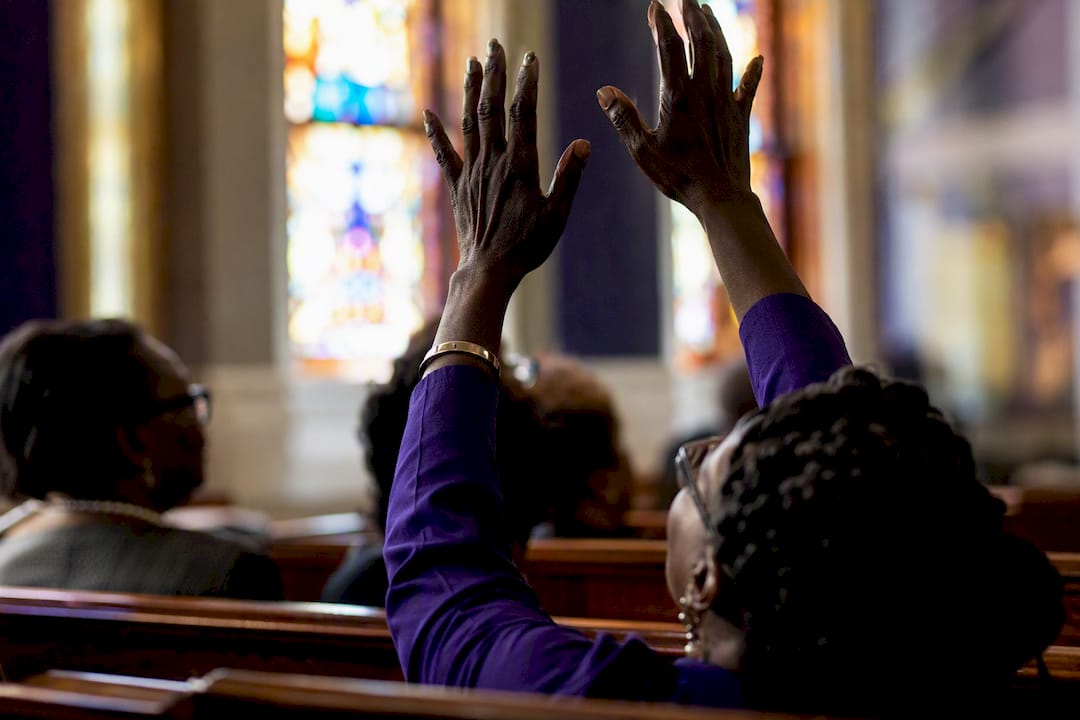
Quaker meetings sit at the opposite end. Many Friends’ gatherings are largely silent, and vocal “amen” responses are rare, reflecting a broader emphasis on quiet, individual discernment over spoken group affirmation.
None of these differences change what “amen” means. They reflect different theories of how worship should sound, whether that’s reverent restraint or vocal participation. A congregation that shouts “amen” every few sentences isn’t using the word more correctly than one that whispers it once at the end. They’re just expressing the same affirmation through different traditions of communal worship.
How Is “Amen” Pronounced Across Languages and Traditions?
English speakers mainly use two pronunciations: “ah-MEN,” common in liturgical, British, and many mainline Protestant settings, and “ay-MEN,” dominant in American gospel, Baptist, and evangelical traditions. Both descend from the same Hebrew word; the vowel shift happened gradually as English speech patterns diverged on either side of the Atlantic and across denominational lines.
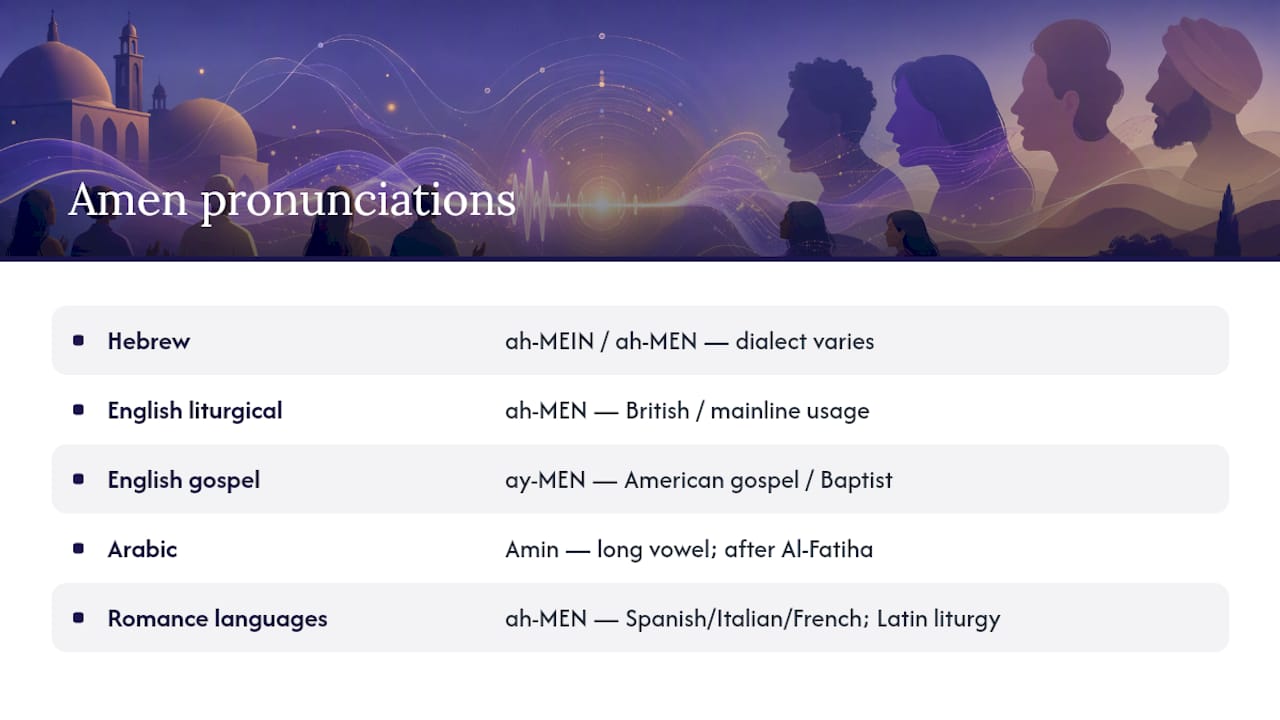
Other languages keep the pronunciation closer to the original Hebrew and Greek vowel sounds. Spanish, Italian, and French speakers generally say something close to “ah-MEN,” matching the Latin liturgical tradition those languages inherited. Arabic speakers say “Amin,” with a long vowel, the form used after Al-Fatiha in Muslim prayer. Hebrew speakers today pronounce it “ah-MEIN” or “ah-MEN,” depending on dialect and region.
The differences are cosmetic. Every version descends from the same three-consonant Hebrew root, and the meaning, firm affirmation, hasn’t shifted across any of these linguistic paths. What has shifted is cultural association. Hearing “ay-MEN” might call to mind a Southern gospel choir, while “ah-MEN” reads as more formal or traditionally liturgical to the same American ear, even though neither pronunciation is more historically “correct” than the other.
If you’re reading scripture aloud or praying in a group you’re not familiar with, it’s worth listening first. Matching the room’s pronunciation isn’t about being right. It’s about participating naturally in whatever tradition you’re standing in.
What Is the Theological Significance of Saying “Amen”?
Saying “amen” isn’t a verbal formality tacked onto the end of a prayer. Theologically, it functions as a seal, a way of taking ownership of words that might have been spoken by someone else. When a congregation says “amen” after a pastor’s prayer, each person is individually affirming that the prayer represents their own heart, not just approving of what they heard.
That idea runs through Jewish tradition especially clearly: answering “amen” to someone else’s blessing carries enough weight that rabbinic sources treat it as nearly equivalent to reciting the blessing yourself. The word transforms a listener into a participant.
In Christian theology, “amen” also points toward God’s faithfulness, not just human agreement. Some interpreters connect the word’s root meaning, firmness and reliability, to the character of God being invoked, so that saying “amen” affirms both the prayer and the trustworthiness of the one being prayed to. That’s a subtle but important distinction: the word isn’t only “I agree,” it’s closer to “this is true because God is true.”
Ritually, “amen” also marks a threshold. It closes one spiritual moment and opens the next, whether that’s the end of grace before a meal or the final word of a formal liturgy. Removing it doesn’t break a rule, but it does remove the verbal marker that tells everyone present the moment has ended and ownership of the words has been formally accepted.
How Has “Amen” Evolved Beyond Religious Use Over Time?
“Amen” spent most of its early history strictly inside religious contexts, Hebrew worship, then Greek Christian liturgy, then Latin and vernacular church services across Europe. Its jump into fully secular English speech happened gradually, riding alongside the broader cultural presence of the Bible in English-speaking societies from the medieval period onward.
By the time English literature was flourishing, “amen” had already picked up a rhetorical, non-liturgical use, a way to punctuate any statement someone wanted to mark as final or true. That pattern accelerated through the 19th and 20th centuries as American religious culture, especially gospel and revivalist traditions, pushed “amen” into music, oratory, and eventually mainstream media. Phrases like the “amen corner” (originally referring to a section of a church where the most vocal worshippers sat) migrated into general English as a term for any group known for enthusiastic, vocal agreement.
Today “amen” shows up in film dialogue, political speeches, casual text messages, and social media captions, almost always stripped of explicit religious content but retaining its original emphatic force. That’s a fairly unusual linguistic path: most words that start in specialized religious vocabulary either stay there or lose their meaning entirely once secularized. “Amen” did neither. It kept its emotional weight while shedding its requirement of religious context, which is part of why it still lands with force even in a throwaway sentence like “Amen to Friday.”
A Word Worth Slowing Down For
What strikes me most about “amen” is how much gets lost when we treat it as a verbal reflex, something you say because the prayer is over, not because you mean it. The linguistic history backs up what a lot of worshippers already sense intuitively: this word was never meant to be filler. It’s a commitment dressed up as a single syllable.
I’d encourage you to notice the next time you say it, or hear it said. What are you actually affirming? If you want to sit with that question a little longer, BibleManna’s collection of scripture by topic is a good place to see the word in its native habitat.
Ready to Go Deeper Into Scripture?
Understanding what “amen” means is one thing. Seeing it in action across scripture, in prayers of praise, declarations of trust, and moments of covenant, is another. BibleManna organizes verses by the exact themes readers search for most: faith, trust, encouragement, and dozens of other emotional and spiritual categories, each with context that explains why a passage matters and how it connects to real life.
If this article sent you looking for scripture that speaks to a specific season you’re in, start with Bible verses by topic and search from there.
Sources
- Amen
- Amen | Thanksgiving, Blessing & Praise | Britannica
- Amen - Etymology, Origin & Meaning — Etymonline
- What does amen mean? — Aish
FAQ
Is “Amen” a Yes?
Not exactly. “Amen” is closer to “this is true” or “so be it” than a simple yes, carrying an added sense of affirmation and commitment rather than casual agreement.
What Can I Say Instead of Amen?
In secular contexts, “so be it,” “absolutely,” “I agree,” or “hear, hear” all work as alternatives, though none carries quite the same solemn weight.
Why Do Christians Say Amen?
Christians say “amen” to affirm a prayer, hymn, or statement as true and to personally take ownership of words spoken aloud, a practice rooted in both Jewish liturgical tradition and the Gospels.
Why Is Jesus Called Amen?
Revelation refers to Jesus as “the Amen,” a title pointing to his role as the faithful and true witness, connecting the word’s root meaning of firmness and reliability directly to his character.