Beatitudes Meaning: What Jesus Really Said and Why It Matters

The Beatitudes are a series of blessing pronouncements Jesus delivered in Matthew 5:3–12, at the opening of the Sermon on the Mount. Each one follows the same two-part pattern: a condition describing a person’s character or circumstance, and a divine promise attached to it. The Greek word behind “blessed” is makarios, which carries far more weight than simple happiness. It points to a deep, durable spiritual well-being rooted in a favored relationship with God. The Beatitudes, then, are not a self-improvement checklist. They identify the character and condition of those who already belong to God’s Kingdom, and they promise both a present reality and a future reward. Biblemanna’s topical verse collections are a natural companion for anyone studying these passages in depth.
Table of Contents
- What is the beatitudes meaning in its original context?
- How are the Beatitudes structured, and what does makarios actually mean?
- What does each beatitude mean, verse by verse?
- What are the three central themes that run through the Beatitudes?
- How do scholars interpret the Beatitudes differently?
- How can you live the Beatitudes in daily practice?
- Common questions about the Beatitudes, answered clearly
- Biblemanna study resources for the Beatitudes
- Key Takeaways
- Why the Beatitudes still cut against the grain
- The Beatitudes come alive when you study them with the right Scripture alongside
- Useful sources for further study
- FAQ
What is the beatitudes meaning in its original context?
The Beatitudes land in the middle of first-century Galilee, where most of Jesus’ listeners were poor, politically powerless, and living under Roman occupation. Matthew places the Sermon on the Mount at the start of Jesus’ public teaching ministry, and the Beatitudes open that sermon like a thesis statement. They were not abstract philosophy. They were good news for the marginalized, words that would have sounded like a social and spiritual revolution to people who had been told, implicitly and explicitly, that God’s favor belonged to the powerful and the religiously accomplished.
Matthew’s editorial intention matters here. He frames the Beatitudes as a preamble to the entire Sermon, a compressed summary of what kingdom ethics look like before Jesus unpacks them in detail across Matthew 5–7. Zondervan scholars describe the Beatitudes as functioning simultaneously as invitation and implicit condemnation: an invitation to the lowly and a quiet rebuke of the self-righteous religious leaders who assumed they had already arrived.
Key contextual points worth holding onto:
- Jesus likely taught a crowd that included the poor, the sick, and the socially excluded, not a gathering of theological elites.
- The Beatitudes echo language from Isaiah 61, which Jesus had already cited as his mission statement (Luke 4:18–19).
- Matthew’s placement of the Beatitudes at the start of the Sermon signals they are the foundation, not a footnote.
How are the Beatitudes structured, and what does makarios actually mean?
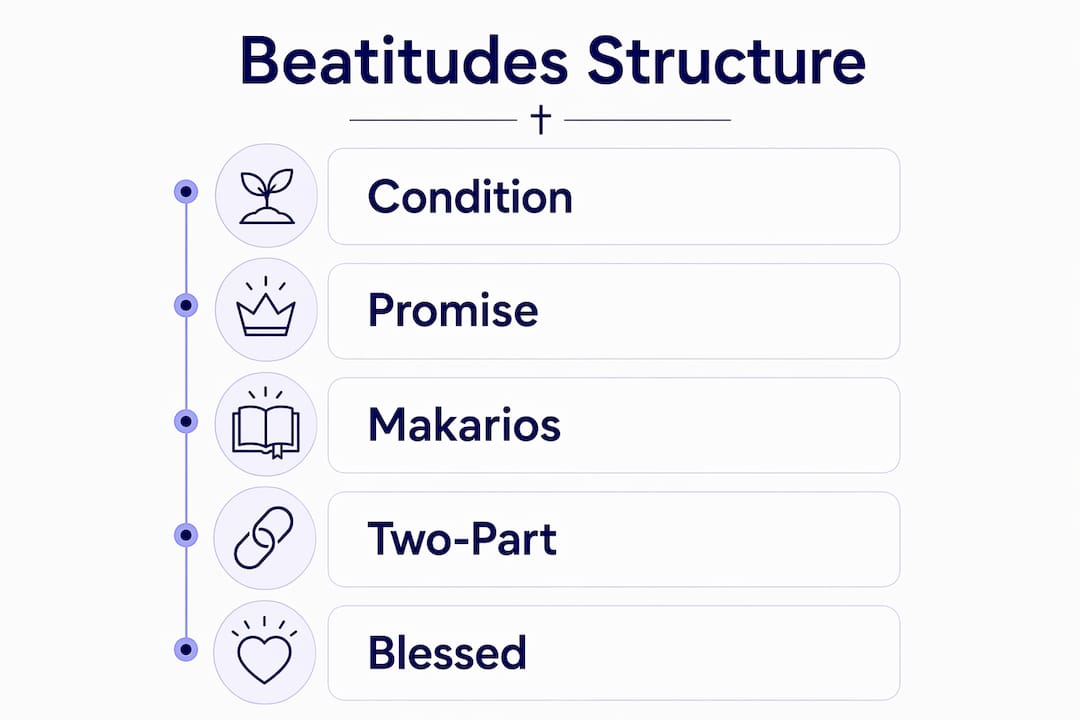
The Greek word makarios and its Latin root
Makarios (μακάριοι) is the word Matthew uses at the start of every beatitude. It is often translated “blessed,” sometimes “happy” or “fortunate,” but study Bibles caution that “happy” trivializes what Matthew intends. The NIV Application Commentary describes makarios as “a state of existence in relationship to God,” something durable and God-granted, not a mood that shifts with circumstances. The Latin noun beatitudo, coined by Cicero to describe a state of blessedness, was later used in the Vulgate’s chapter headings for Matthew 5, and eventually anglicized to “beatitudes” in the Great Bible of 1540.
The two-part pattern
Each beatitude consists of exactly two phrases: the condition (who is described) and the result (what God promises). The phrases draw heavily from Old Testament imagery, but Jesus elevates them to new levels in the Sermon on the Mount.

| Beatitude | Condition | Promise |
|---|---|---|
| Matthew 5:3 | Poor in spirit | Kingdom of Heaven |
| Matthew 5:4 | Those who mourn | They will be comforted |
| Matthew 5:5 | The meek | They will inherit the earth |
| Matthew 5:6 | Hunger and thirst for righteousness | They will be satisfied |
| Matthew 5:7 | The merciful | They will be shown mercy |
| Matthew 5:8 | Pure in heart | They will see God |
| Matthew 5:9 | Peacemakers | Called sons of God |
| Matthew 5:10 | Persecuted for righteousness | Kingdom of Heaven |
| Matthew 5:11–12 | Insulted and persecuted for Jesus | Great reward in heaven |
How many beatitudes are there?
Most scholars count eight primary beatitudes in Matthew 5:3–10, with verses 11–12 functioning as a personalized extension addressed directly to the disciples, shifting from third person (“blessed are those”) to second person (“blessed are you”). Scholars debate whether to count nine or ten, but the practical consensus treats Matthew’s sequence as thematic rather than mathematically fixed.
What follows the Beatitudes
Immediately after the eight beatitudes, Jesus introduces the salt, light, and city-on-a-hill images in Matthew 5:13–16. These are not decorative. They connect the inward character described in the Beatitudes to visible, public kingdom witness. Salt preserves, light guides, and a city on a hill cannot be hidden.
Luke’s parallel version (Luke 6:20–23) contains four beatitudes focused on literal poverty, hunger, grief, and rejection, followed immediately by four woes that mirror the blessings. Matthew’s version spiritualizes some of these (“poor in spirit” rather than simply “poor”), aligning with Isaiah 61 and broadening the ethical scope.
What does each beatitude mean, verse by verse?
-
Matthew 5:3 — “Blessed are the poor in spirit, for theirs is the Kingdom of Heaven.” Condition: Recognizing your complete dependence on God, not material poverty. Promise: The Kingdom belongs to you now. Application: Approach God today with nothing to prove and everything to receive.
-
Matthew 5:4 — “Blessed are those who mourn, for they will be comforted.” Condition: Genuine grief over sin, loss, or the brokenness of the world. Promise: God’s comfort, both present and eschatological. Application: Bring your grief to God honestly rather than performing spiritual composure.
-
Matthew 5:5 — “Blessed are the meek, for they will inherit the earth.” Condition: Strength held under God’s authority, not weakness or passivity. Promise: Eventual inheritance of the renewed creation. Application: Choose restraint in conflict this week as an act of trust, not defeat.
-
Matthew 5:6 — “Blessed are those who hunger and thirst for righteousness, for they will be satisfied.” Condition: A deep, persistent longing for God’s justice and moral order. Promise: Full satisfaction, a promise that echoes Isaiah 55. Application: Name one injustice you feel deeply and pray specifically about it.
-
Matthew 5:7 — “Blessed are the merciful, for they will be shown mercy.” Condition: Active compassion extended to others, especially those who do not deserve it. Promise: Mercy received in return. Application: Identify one person you have withheld forgiveness from and take one concrete step toward mercy.
-
Matthew 5:8 — “Blessed are the pure in heart, for they will see God.” Condition: Undivided loyalty to God, a heart not split between competing allegiances. Promise: The direct experience of God’s presence. Application: Ask yourself what competes with God for your deepest loyalty and address it in prayer.
-
Matthew 5:9 — “Blessed are the peacemakers, for they will be called sons of God.” Condition: Active work to reconcile people to God and to one another. Promise: The identity of God’s own children. Application: Initiate one reconciling conversation you have been avoiding.
-
Matthew 5:10 — “Blessed are those who are persecuted because of righteousness, for theirs is the Kingdom of Heaven.” Condition: Suffering specifically because of allegiance to God’s justice. Promise: The same Kingdom promised to the poor in spirit in verse 3, forming a deliberate bracket. Application: Reflect on whether any cost you bear is genuinely for righteousness or for personal preference.
-
Matthew 5:11–12 — The extended application. Jesus shifts to second person and addresses the disciples directly, connecting their experience of insult and slander to the long line of persecuted prophets. The promise is a great reward in heaven, and the call is to rejoice. Application: When criticism comes because of your faith, locate yourself in that prophetic tradition rather than isolating in the pain.
What are the three central themes that run through the Beatitudes?
Scholars, including those at BibleProject, identify three moral and theological threads that hold the Beatitudes together as a unified teaching.
-
Reversal of worldly values. The people Jesus pronounces blessed are exactly the ones the ancient world (and most modern cultures) would call unfortunate: the spiritually bankrupt, the grieving, the meek, the persecuted. The Beatitudes flip the social and religious script entirely. Power, wealth, and public honor are not the markers of God’s favor. Dependence, humility, and suffering for righteousness are.
-
Inward transformation before outward conduct. The Beatitudes prioritize the interior life: spirit, heart, hunger, purity. This connects directly to what Zondervan scholars describe as the Beatitudes’ function as an ethic of discipleship that links inner transformation to outward behavior, a theme that runs through 1 Peter and the broader New Testament teaching on regeneration and sanctification. You cannot manufacture the Beatitudes from the outside in.
-
Active peacemaking and community-level justice. The Beatitudes are not a private spirituality. Peacemakers are called sons of God because they do the work of God in the world. Those who hunger for righteousness are longing for something bigger than personal virtue. The Beatitudes push outward into community, society, and public witness, which is exactly what the salt and light images in Matthew 5:13–16 reinforce. Biblemanna’s collection of Bible verses about peace is worth reading alongside Matthew 5:9 for a fuller picture of what peacemaking looks like across Scripture.
How do scholars interpret the Beatitudes differently?
Three main interpretive frames have shaped how Christians read these verses, and knowing them helps you navigate the disagreements you will encounter in commentaries and sermons.
-
The pronouncement reading. This is the view that the Beatitudes are declarations about who already belongs to the Kingdom, not conditions to meet. Philosopher and theologian Dallas Willard (1935–2013) argued that Jesus was pronouncing blessing on people considered “unblessable” by their culture, announcing that the Kingdom of Heaven is now available even to them. Zondervan frames this similarly: the Beatitudes function as a preamble that announces God’s kingdom has arrived and contrasts God’s values with those of the religious elite. This reading guards against legalism.
-
The instructional or ethical reading. Many teachers read the Beatitudes as character traits to cultivate through discipleship. On this view, “blessed are the meek” is a call to become meek, not just a description of those who already are. This reading has practical appeal but risks turning the Beatitudes into a performance standard.
-
The poetic summary or preamble view. Some scholars treat the Beatitudes as Matthew’s compressed introduction to the entire Sermon on the Mount, a poetic overview of kingdom ethics that the rest of the Sermon unpacks in detail. This view is compatible with both the pronouncement and instructional readings.
A short hermeneutical tip: read the Beatitudes as descriptive first, then instructional. Ask “Who does Jesus say is blessed?” before asking “What must I do?” That sequence prevents the legalistic reading that reliable scholarship warns against and keeps grace at the center.
How can you live the Beatitudes in daily practice?
The Beatitudes are not abstract theology. Here are six concrete practices, with reflection prompts and prayer starters, that you can use alone or in a small group.
-
Practice lament. Set aside ten minutes to write honestly about something you grieve, whether personal loss, sin, or injustice in the world. Reflection: What am I afraid to bring to God? Prayer: “God, I bring you this grief without pretending it is resolved.”
-
Practice dependence. Start each morning by naming one area where you have no capacity on your own. Reflection: Where am I relying on my own strength instead of God’s? Prayer: “I come to you with nothing to offer. Fill what is empty.”
-
Practice mercy. Choose one person this week who has wronged you and extend one concrete act of kindness toward them. Biblemanna’s Bible verses about kindness can ground this practice in Scripture. Reflection: What does mercy cost me here, and what does it cost God to show it to me? Prayer: “Give me the will to show what I have already received.”
-
Practice peacemaking. Identify one broken relationship or community conflict and take one step toward reconciliation, even if it is only a letter you do not send yet. Reflection: Am I a peacemaker or a peace-keeper? There is a difference. Prayer: “Make me an instrument of your reconciliation, not just my own comfort.”
-
Practice purity of focus. For one week, audit what competes most for your attention and loyalty. Reflection: What do I want more than I want God? Prayer: “Purify my desires so that seeing you becomes my deepest aim.”
-
Practice public witness. Connect your inner formation to one visible act of justice or service in your community. Reflection: How does my faith show up where people can see it? Prayer: “Let the salt and light in me be real, not decorative.”
Pro Tip: In a small group, assign one beatitude per session and pair it with a partner accountability question. Ask each other the reflection prompt at the end of the week, not just at the beginning. Accountability after the fact is more honest than intention-setting before it.
For additional spiritual discipline ideas, the practical guidance at Jeffrey Sean McDonnell’s blog on deepening your connection with God pairs well with this kind of daily practice.
Common questions about the Beatitudes, answered clearly
-
How many beatitudes are there? Most scholars count eight in Matthew 5:3–10, with verses 11–12 as a personalized extension. The count ranges from eight to ten depending on how scholars divide the text, but the thematic reading of eight primary beatitudes is the dominant scholarly consensus.
-
How does Luke’s version differ from Matthew’s? Luke 6:20–23 contains four beatitudes, not eight, and they are followed immediately by four woes. Luke’s version emphasizes literal poverty, hunger, and weeping, reflecting the actual social conditions of the poor. Matthew’s version spiritualizes some of these (“poor in spirit”), aligning with Isaiah 61 and broadening the ethical application. The Beatitudes unique to Matthew are the meek, the merciful, the pure in heart, and the peacemakers.
-
Why does “blessed” work better than “happy”? Makarios describes a condition granted by God, not a feeling produced by circumstances. “Happy” implies an emotional state that can shift. “Blessed” points to a durable spiritual reality. Many translations use “happy” or “fortunate,” but study Bible notes consistently caution that these renderings can strip the theological depth from the word.
Biblemanna study resources for the Beatitudes
Biblemanna’s topical verse collections map directly onto the themes of the Beatitudes, making them a practical companion for personal or group study.
- Peace: The Bible verses about peace collection pairs with Matthew 5:9 on peacemaking.
- Happiness and blessedness: The Bible verses about happiness collection explores makarios themes across Scripture.
- Faith: The Bible verses about faith collection supports the trust and dependence themes in Matthew 5:3 and 5:6.
- Encouragement: For readers sitting with the mourning or persecution beatitudes, the encouragement collection offers scriptural comfort.
A simple four-session reflection plan using Biblemanna:
- Session 1 (Read): Read Matthew 5:3–12 in two translations using Biblemanna’s translation comparison tool. Note where the wording differs.
- Session 2 (Reflect): Choose two beatitudes that feel most challenging. Read the corresponding Biblemanna topical collection and journal your response.
- Session 3 (Apply): Select one practice from the application section above and commit to it for one week.
- Session 4 (Pray): Use the prayer prompts from the application section. Share your experience with a study partner or small group.
Biblemanna’s verse finder and translation comparison tools are available at biblemanna.com, where you can also browse all 50 topical collections to continue your study beyond the Beatitudes.
Key Takeaways
The Beatitudes are descriptive pronouncements of divine blessing, not a performance checklist, and reading them that way changes everything about how you apply them.
| Point | Details |
|---|---|
| Makarios means more than happy | The Greek term points to a durable, God-granted spiritual condition, not a mood or emotion. |
| Eight primary beatitudes | Matthew 5:3–10 contains eight, with 5:11–12 as a personalized extension addressed to disciples. |
| Two-part structure | Each beatitude pairs a condition (who is described) with a divine promise (what God grants). |
| Three unifying themes | Reversal of worldly values, inward transformation, and active peacemaking shape the whole list. |
| Biblemanna for study | Topical collections on peace, faith, happiness, and encouragement map directly onto Beatitudes themes. |
Why the Beatitudes still cut against the grain
The conventional reading of the Beatitudes treats them as a spiritual ladder: climb the rungs of meekness and purity and arrive at blessing. That reading is understandable, but it misses the point almost entirely. Jesus was not describing a program. He was announcing a reality that had already arrived with him.
What strikes me most is how the Beatitudes function as a kind of anti-resume. Every quality Jesus names, poverty of spirit, mourning, meekness, hunger, would have disqualified a person from religious status in the first century. And in most social contexts today, they still would. The Beatitudes do not just reverse the world’s values; they expose how deeply those values have shaped the way we read Scripture itself. We want the Beatitudes to be about becoming better. Jesus seems more interested in describing people who have stopped pretending they already are.
The peacemaking beatitude is the one that tends to get the most comfortable treatment in sermons, reduced to being nice and avoiding conflict. But the Greek word eirenopoioi is active and costly. It describes someone who makes peace, which in a first-century context meant crossing social, ethnic, and religious lines at personal risk. That is not a personality trait. It is a vocation. And it is the one Jesus says marks you as a child of God.
The Beatitudes come alive when you study them with the right Scripture alongside
The Beatitudes are dense enough that a single reading rarely does them justice. What helps is reading Matthew 5:3–12 alongside the broader scriptural themes it draws from: peace, mercy, faith, and encouragement. Biblemanna’s curated topical verse collections give you exactly that, organized by theme, with full text and context for each verse so you are never reading a passage in isolation.

Whether you are studying alone or leading a small group, the practical next step is to pick one beatitude, find its corresponding Biblemanna collection, and read the two together. Start with Bible verses about faith if Matthew 5:3 on poverty of spirit is where you want to begin. The collections are free, searchable, and available in English, Spanish, and Italian, so you can share them with anyone in your community regardless of language. Visit biblemanna.com/bible-verses to browse all topical collections and begin your study today.
Useful sources for further study
-
Matthew 5:3–12 (primary source): The text itself, read in multiple translations, is the starting point. The New American Standard Bible and the NIV are both reliable for word-level study.
-
BibleProject — The Beatitudes: A visually rich, theologically careful guide that covers the social context, literary structure, and communal implications of the Beatitudes. Excellent for first-time readers and group leaders alike.
-
Zondervan Academic — What Are the Beatitudes?: Covers the pronouncement vs. instruction debate, the preamble function, and the discipleship ethic. Best for readers who want exegetical depth without a full commentary.
-
GotQuestions — What are the Beatitudes?: A concise, accessible explanation of makarios, the two-part structure, and common interpretive questions. Good for quick reference and for answering the most frequent misunderstandings.
-
Bible Gateway Blog — What Are the Beatitudes?: Addresses the translation debate around makarios and why “happy” falls short. Useful for anyone who has encountered a translation that uses “fortunate” and wants to understand the difference.
-
Wikipedia — Beatitudes: A thorough reference entry covering the Latin and Greek etymology, the scholarly count debate, Dallas Willard’s minority interpretation, and the Luke vs. Matthew comparison. Useful as a cross-reference for historical and linguistic details.
FAQ
What do the Beatitudes mean in simple terms?
The Beatitudes are eight blessing statements Jesus made in Matthew 5:3–12, each identifying a type of person and promising them a specific gift from God. They describe who belongs to God’s Kingdom, not what someone must do to earn it.
What are the 8 Beatitudes?
The eight are: poor in spirit, those who mourn, the meek, those who hunger and thirst for righteousness, the merciful, the pure in heart, peacemakers, and those persecuted for righteousness, drawn from Matthew 5:3–10, with verses 11–12 serving as a personalized extension.
What is the real meaning of the word “beatitude”?
The word comes from the Latin beatitudo, coined by Cicero to describe a state of blessedness. It translates the Greek makarios, which points to a durable spiritual well-being rooted in God’s favor, not a temporary feeling of happiness.
What are three moral lessons from the Beatitudes?
Scholars identify three: the reversal of worldly values (the humble are exalted), the priority of inward transformation over outward performance, and the call to active peacemaking and justice as a community-level kingdom ethic.
Where can I study the Beatitudes with supporting Scripture?
Biblemanna’s topical collections on peace, faith, and encouragement map directly onto the Beatitudes’ themes and include full verse text with context, making them a practical companion for personal or group study.