Best Bible Translation for Study, Worship, and Daily Reading

There is no single best bible translation — and any guide that tells you otherwise is selling you something. The honest answer: pick a readable, balanced version for daily use and a more literal one for serious study. For many English-speaking readers, that means the NIV as your everyday Bible and the ESV or NASB when you need to dig into the text. Scholars consistently emphasize that translating Hebrew, Greek, and Aramaic always involves trade-offs between literal accuracy and natural readability — no translation escapes that tension.
Here is a quick shortlist by task:
- Best for study: ESV or NASB — both stay close to original sentence structure, which matters when you are tracing an argument through Paul’s letters or analyzing a Hebrew poem.
- Best for everyday reading and devotion: NIV — widely used, genuinely readable, and balanced enough that you are not losing significant meaning.
- Best for public reading and worship: NIV or CSB — both read well aloud without sounding archaic or overly colloquial.
- Best for liturgy and canon-sensitive use: NRSV — the ecumenical standard used by many mainline Protestant, Catholic, and Orthodox communities; includes the Apocrypha in some editions.
- Best for easy language and memorization: NLT — clear, contemporary phrasing that sticks; also the friendliest option for reading with children.
- Paraphrase for fresh perspective: The Message — not a study Bible, but useful for reading familiar passages with new eyes.
Biblemanna’s topical verse collections let you pull the same passage across multiple translations side by side, which is one of the fastest ways to feel the difference between these versions in practice.
Table of Contents
- How the translation spectrum actually works
- Comparing the nine major translations at a glance
- Which translation should you actually use?
- How to choose the right translation for you
- Why translations differ: manuscripts, committees, and revisions
- Key Takeaways
- The translation question most readers get wrong
- Biblemanna makes comparing translations practical
- Useful sources for further reading
- FAQ
How the translation spectrum actually works
Every Bible translation sits somewhere on a spectrum, and knowing where a version lands tells you almost everything about how to use it.
Formal equivalence (also called “word-for-word”) tries to mirror the original grammar and sentence structure as closely as English allows. The goal is to let you see the shape of the original text. The trade-off: some passages read stiffly, because ancient Hebrew and Greek do not map cleanly onto English syntax.
Dynamic equivalence (or “thought-for-thought”) translates the meaning of a phrase rather than its literal words. The result is more natural English, but you are reading the translator’s interpretation of the meaning, not the raw structure. That is not a flaw — it is a design choice.
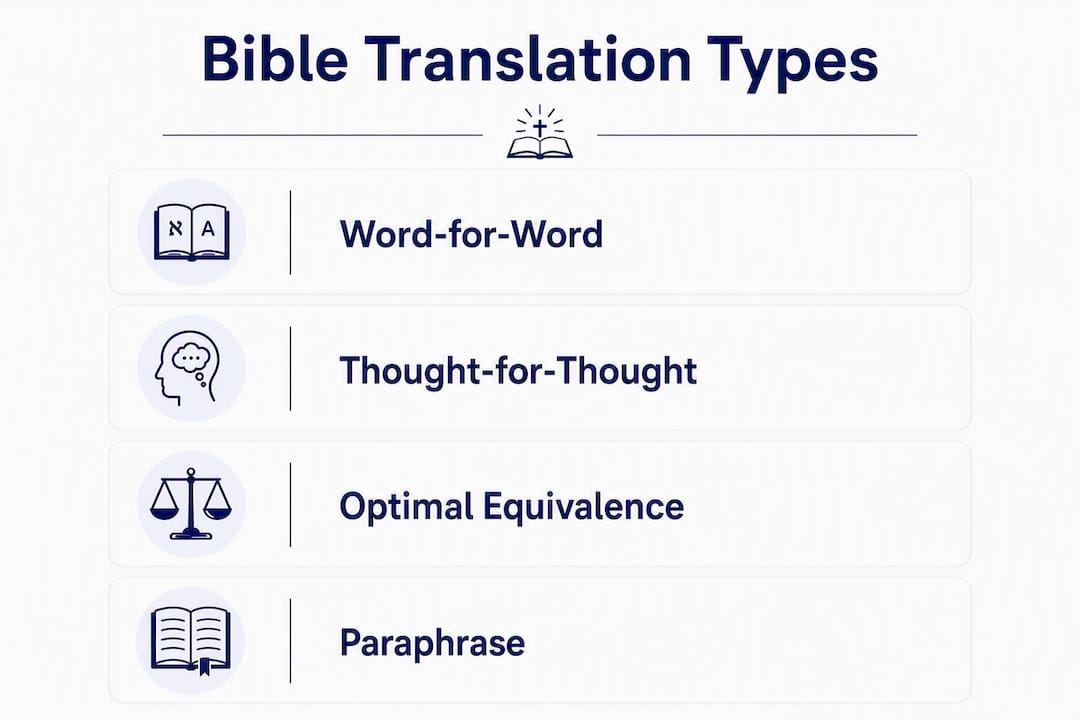
Paraphrase goes further still, prioritizing contemporary idiom and emotional resonance over either structure or precise meaning. Paraphrases are not designed for study; they are designed to make you feel the text.
Here is where the nine major translations land:
- NASB — formal equivalence; the most literal of the widely used versions; updated in 2020
- ESV — formal equivalence, slightly more readable than NASB; popular in Reformed and evangelical circles
- NKJV — formal equivalence; updates KJV language while retaining the Textus Receptus manuscript tradition
- KJV — formal equivalence; the 1611 standard; majestic but requires adjustment to Early Modern English
- NRSV — formal equivalence with ecumenical committee input; uses gender-inclusive language
- NIV — dynamic equivalence leaning toward the formal side; the most widely read modern translation
- CSB — sits between formal and dynamic; describes its own approach as “optimal equivalence”
- NLT — dynamic equivalence; prioritizes clarity and contemporary phrasing
- The Message — paraphrase; Eugene Peterson’s idiomatic rendering for devotional reading
Pro Tip: Pair a formal version (ESV or NASB) with a dynamic one (NIV or NLT) when working through a difficult passage. Reading the same text in two translations often surfaces nuances that neither version alone makes visible.
Comparing the nine major translations at a glance
| Translation | Philosophy | Best for | Reading level | Notable features | Typical audience |
|---|---|---|---|---|---|
| NIV | Dynamic (balanced) | Everyday reading, study | Grade 7–8 | Gender-inclusive updates (2011); broad ecumenical committee | General readers, evangelicals |
| ESV | Formal equivalence | Study, preaching | Grade 8–10 | Essentially Literal approach; widely used in Reformed churches | Scholars, seminarians, Reformed evangelicals |
| NRSV | Formal equivalence | Liturgy, academic study | Grade 8–10 | Gender-inclusive language; includes Apocrypha editions; ecumenical | Mainline Protestants, Catholics, academics |
| NASB | Formal equivalence | Close study | Grade 11 | Most literal major translation; updated 2020 (NASB 2020) | Serious students, scholars |
| CSB | Optimal equivalence | Study, public reading | Grade 7–8 | Balances accuracy and readability; recent 2017 revision | Southern Baptist, broad evangelical |
| NLT | Dynamic equivalence | Devotional, new readers | Grade 6 | Very readable; strong narrative flow; 2015 revision | Beginners, devotional readers, children |
| KJV | Formal equivalence | Liturgy, memorization | Grade 12+ | 1611 text; public domain; literary and liturgical heritage | Traditional Protestants, liturgical use |
| NKJV | Formal equivalence | Study, traditional worship | Grade 8–9 | Retains KJV style; updates archaic words; Textus Receptus basis | Those transitioning from KJV |
| The Message | Paraphrase | Devotional, fresh reading | Grade 4–6 | Contemporary idiom; not for study; single-author translation | Casual readers, devotional use |
A few things the table cannot fully capture: the NRSV is the translation most commonly required in university theology courses. The KJV is the most printed book in history and remains the liturgical standard in many traditional congregations. The Message was written by one person, Eugene Peterson, which makes it a personal interpretation rather than a committee translation — useful context when you reach for it.
Which translation should you actually use?
The table gives you the overview. Here is what to do with it.
For serious study, reach for the NASB or ESV. Formal-equivalence translations keep more of the original wording and syntax, which matters when you are tracing a theological argument or comparing how a word is used across different books. The NASB 2020 revision improved readability without sacrificing its clause-level precision. The ESV is slightly more readable and has a large ecosystem of study Bibles and commentaries built around it.

For daily devotion and personal reading, the NIV remains the most practical choice for most readers. It is balanced enough to be trusted, readable enough to sustain a daily habit, and widely available in every format. The NLT is worth considering if you find the NIV still feels like work — its narrative flow is genuinely easier, and for reading through the Gospels or the Psalms, that matters.
For worship and public reading, the NIV and CSB both perform well aloud. The CSB’s “optimal equivalence” approach means it reads naturally without losing the weight of key theological terms. If your congregation uses a specific version for liturgical consistency, stick with it — familiarity in corporate worship is not a small thing.

For liturgy and canon-sensitive contexts, the NRSV is the standard. Canon differences mean that a Protestant Bible omits the Deuterocanonical books that Catholic and Orthodox traditions use in worship — if that matters for your community, verify which edition you are buying.
For memorization and reading with children, the NLT’s plain phrasing makes verses easier to retain. The KJV, despite its archaic language, has a rhythmic quality that also aids memorization — many people who learned scripture as children in KJV churches find those verses are still the ones that surface under pressure.
How to choose the right translation for you
Work through these questions before you buy:
- What is my primary use? Study, devotion, public reading, or a mix? Your answer narrows the field immediately.
- Do I need literal wording? If you plan to cross-reference with commentaries or do word studies, a formal-equivalence version is worth the extra reading effort.
- Am I reading with a community? If your church, study group, or seminary uses a specific version, match it — following along in a different translation during a sermon or class creates unnecessary friction.
- Do I need inclusive language? The NIV (2011), NRSV, and NLT use gender-inclusive language for generic references. The ESV and NASB generally do not.
- Does canon matter? If you are Catholic or Orthodox, or studying in an ecumenical context, confirm whether the edition includes the Apocrypha.
Red flags to watch for: any translation that removes footnotes indicating manuscript variants, versions with no named translation committee or editorial board, and paraphrases marketed as study Bibles. The Message is a valuable devotional tool — it is not a study text, and editions that blur that line do readers a disservice.
A three-step reading test: Pick a passage you know well — John 3:16, Psalm 23, or Romans 8:28 work well. Read it in a formal version (ESV or NASB), then in a dynamic version (NIV or NLT). Note where the wording differs and ask which version makes the meaning clearer for your purpose. That gap is the translation philosophy in action.
Pro Tip: Once you have a primary translation, compare passages side by side using a parallel Bible tool or Biblemanna’s topical collections before committing to a long-term study plan.
Why translations differ: manuscripts, committees, and revisions
The differences between translations are not random — they trace back to specific decisions about source texts, committee composition, and update cycles.
Manuscript families are the starting point. Old Testament translators work primarily from the Masoretic Text, the authoritative Hebrew manuscript tradition. Some passages, however, differ between the Masoretic Text and the Septuagint (the ancient Greek translation of the Hebrew scriptures), and those divergences produce different readings in the finished English text. For the New Testament, translators draw on major Greek manuscript traditions — the differences between them are documented in footnotes, which is one reason footnotes matter.
The Dead Sea Scrolls added another layer of complexity: discovered in the mid-20th century, they provided Hebrew manuscripts roughly 1,000 years older than the Masoretic texts previously available, and they occasionally support readings found in the Septuagint rather than the standard Hebrew tradition.
Translation committees shape the result in ways readers rarely see. An ecumenical committee (scholars from multiple denominations) tends to produce more neutral language choices. A denominationally homogeneous committee may favor wording that aligns with that tradition’s theological emphases. Checking a translation’s preface — which names the committee and explains its methodology — takes five minutes and tells you a great deal about what you are reading.
Update cycles matter more than most readers realize. The NASB moved from its 1995 edition to the 2020 revision, changing wording in hundreds of verses to improve readability and reflect updated scholarship. The NIV’s 2011 revision introduced gender-inclusive language that its 1984 edition did not use — a change that generated significant debate. If you are committing a translation to long-term study or memorization, check the revision history before you start, so you are not working from an edition that has since been substantially updated.
| Factor | What it affects | Where to check |
|---|---|---|
| Manuscript tradition (OT) | Specific verse readings, especially in Psalms and Isaiah | Preface and footnotes |
| Greek manuscript tradition (NT) | Presence or absence of certain verses (e.g., Mark 16:9–20) | Footnotes |
| Committee composition | Inclusive language, theological wording | Preface |
| Revision cycle | Wording of key verses, inclusive-language policy | Publisher’s edition notes |
Key Takeaways
No single translation is best for every reader — the right version depends entirely on how you plan to use it, and pairing a formal version with a dynamic one covers most situations better than any single Bible can.
| Point | Details |
|---|---|
| Choose by use-case | Use ESV or NASB for study; NIV or NLT for devotional reading; NRSV for liturgy. |
| Pair two translations | A formal version plus a dynamic one reveals nuance that neither shows alone. |
| Check the preface | Committee composition and manuscript choices explain most wording differences. |
| Watch revision history | A newer edition can change key verses — verify before committing to long-term study. |
| Use Biblemanna | Biblemanna’s topical verse collections let you compare translations by theme and apply scripture to specific life situations. |
The translation question most readers get wrong
The debate over which translation is “most accurate” tends to assume that accuracy is a single, measurable thing. It is not. No translation perfectly represents ancient Hebrew and Greek because the languages differ fundamentally in syntax and vocabulary — a word-for-word rendering is not automatically more faithful to the original meaning than a thought-for-thought one. Sometimes it is less faithful, because a literal rendering produces an English sentence that carries a different connotation than the original.
What actually matters is fit for purpose. The NASB is more literal than the NIV, but that does not make it better for someone reading through the Gospels for the first time. The Message is a paraphrase, but Peterson’s rendering of the Psalms has helped readers who had grown numb to familiar passages hear them again. Treating the translation spectrum as a hierarchy — literal at the top, paraphrase at the bottom — misses the point entirely.
The more useful question is not “which is most accurate?” but “accurate to what?” Accurate to the original word order? The original thought? The original rhetorical effect on its first audience? Different translations answer that question differently, and many of those differences are stylistic choices rather than substantive theological ones. For most passages, the translations agree far more than they differ. Where they diverge, the divergence is usually informative — it points to a place where the original text is genuinely ambiguous, or where a theological tradition has shaped a wording choice. That is worth knowing, not worrying about.
Biblemanna makes comparing translations practical
Reading about translation philosophy is useful. Actually comparing how John 1:1 reads in the ESV versus the NLT — on the same screen, with context — is where the choice becomes real.

Biblemanna organizes scripture by topic across more than 50 themes, from encouragement and wisdom to hard times and self-worth. Each collection includes the full verse text with contextual background, so you can see how different translations handle the same passage in a subject area you actually care about. That is a faster way to feel the difference between a formal and a dynamic version than any abstract comparison chart.
If you are still deciding which translation fits your reading life, start with the Bible Verses by Topic collection. Pick a theme that matters to you right now, read a few passages, and notice which rendering lands. That is your translation.
Useful sources for further reading
- Biblical Archaeology Society: What Is the Best Bible Translation? — covers manuscript traditions, canon differences, and denominational considerations.
- Tyndale House: How Do We Choose Which Bible Translation to Read? — scholarly perspective on committee processes, revision cycles, and textual decisions.
- Wikipedia: New International Version — history, committee composition, and the 2011 revision controversy.
- Wikipedia: English Standard Version — background on the ESV’s origins, textual basis, and reception.
- Spirit of His Mouth: Best Bible Study Websites — curated list of online tools for scripture study and translation comparison.
FAQ
Is there a most accurate Bible translation?
No single translation is definitively most accurate. Translators must choose between preserving original word structure and conveying original meaning — and those goals sometimes conflict, so “accuracy” depends on what you are measuring.
Is the NIV or ESV better?
It depends on your purpose. The ESV stays closer to original sentence structure, making it stronger for detailed study; the NIV reads more naturally for daily use. Many readers keep both.
What are the top three Bible translations?
The NIV, ESV, and KJV are consistently the most widely used English translations. For study specifically, the NASB and NRSV are also frequently recommended by scholars.
Which Bible version should you avoid?
Avoid using a paraphrase like The Message as your primary study Bible — it reflects one author’s interpretation rather than a committee’s careful translation. For study, you want a version with transparent footnotes and a named editorial committee.
Does the translation matter for Catholic or Orthodox readers?
Yes. Canon differences mean standard Protestant Bibles omit the Deuterocanonical books used in Catholic and Orthodox liturgy. The NRSV with Apocrypha is the most common ecumenical option.