5 Minute Bible Meditation Methods for Busy Beginners

Biblical meditation is the practice of slowly, prayerfully turning a passage of Scripture over in your mind until it shapes your heart, not just your knowledge. Three methods make this approachable for beginners: Lectio Divina, TASTE (Think, Ask, Seek Jesus, Take away truth, Enjoy God), and Meditation Mapping. Each gives you a repeatable sequence of steps, and each one aims at the same goal: drawing you closer to Jesus, rather than just collecting facts about the Bible.
TL;DR:
- Short, structured methods like TASTE and Lectio Divina suit busy mornings, with TASTE offering quick prompts and Lectio providing a deep, prayerful rhythm.
- Keeping sessions limited to five to ten minutes and focusing on a single verse helps build consistency and prevents fatigue or distraction.
- Writing down stray thoughts or speaking verses aloud can anchor your attention and reduce wandering during meditation.
- Using topical verse collections and tools like a Random Verse Generator supports engagement with relevant Scripture, especially during stressful or transitional times.
- Avoid turning meditation into an information hunt; focus on listening to God and dwelling on His character rather than research or mental distraction.
Table of Contents
- What Is Bible Meditation, and How Is It Different from Bible Study?
- The Main Bible Meditation Methods at a Glance
- How Do You Practice Each Bible Meditation Method Step by Step?
- Why Do People Give Up on Bible Meditation, and What Actually Fixes It?
- How Do You Turn Bible Meditation into a Daily Habit?
- A Worked Example: Meditating on Psalm 23:1
- What Resources Help You Keep the Habit Going?
- What Beginners Get Wrong About Bible Meditation
- Find Your Next Verse to Meditate On
- Sources
- FAQ
What Is Bible Meditation, and How Is It Different from Bible Study?
Meditating on Scripture means dwelling on a passage long enough that it moves from your head into your affections, decisions, and prayers. The Psalmist describes the person who “meditates day and night” on God’s law as one who flourishes “like a tree planted by streams of water” (Psalm 1:2-3), and God tells Joshua to keep the Book of the Law “in your mouth” so he can meditate on it constantly and act on what he finds (Joshua 1:8). Both passages tie meditation directly to a changed life, not merely a filled notebook.
Bible study asks, “What does this passage mean?” It cross-references, checks original languages, and builds arguments. Meditation asks a quieter question: “What is God saying to me, right now, through this?” You need study to meditate well. You do not need meditation to study well. They serve different ends.
Biblical meditation also differs sharply from the emptying techniques common in Eastern-style or generic mindfulness meditation. Desiring God frames the practice as rigorous engagement with God’s Word rather than a technique for clearing the mind or focusing on the breath. You are not trying to become a blank slate. You are trying to fill your thoughts with something specific: the words, character, and works of God as revealed in a text.
A few distinctions worth holding onto:
- Bible study is primarily analytical; meditation is primarily relational.
- Secular mindfulness often aims at detachment from thought; biblical meditation aims at deeper attachment to a particular truth.
- Study can happen quickly with a commentary open; meditation resists rushing by design.
- Both practices work best together, not as substitutes for each other.
Older writers used the image of “chewing” to capture what this actually feels like. Bible Gateway’s overview of biblical meditation describes it as slow, thorough engagement, closer to a cow working through cud than to skimming a paragraph. The goal underneath every method in this article is the same: seeing and savoring Jesus more clearly than you did five minutes earlier.
The Main Bible Meditation Methods at a Glance
Four approaches cover almost everything a beginner needs, and none of them require special training or equipment beyond a Bible and maybe a notebook.
Lectio Divina is a four-step prayerful reading practice with roots in monastic communities. It moves through lectio (reading), meditatio (meditation), oratio (prayer), and contemplatio (contemplation), and the USCCB’s guide to the practice explains each step with sample questions you can ask yourself along the way. It works best when you have 15 to 20 minutes and want a structured rhythm that moves naturally from reading into prayer.
TASTE is a five-step acronym built for people who want something quick and memorable: Think, Ask, Seek Jesus, Take away truth, Enjoy God. Crossway’s explanation of TASTE walks through practical prompts for each letter. It suits mornings when you have ten minutes and a single verse, and its built-in “Seek Jesus” step keeps the exercise from turning into pure self-improvement.
Meditation Mapping, taught by Don Whitney, is a visual method. You write a verse in the center of a page and branch out with keywords, questions, and cross-references, using color or symbols to track different kinds of insight. The Center for Biblical Spirituality’s guide to this technique recommends keeping the map simple. It fits visual thinkers, longer sessions, and passages dense enough to reward branching out.
Scripture aloud (sometimes called “muttering” Scripture) simply means speaking the verse instead of only reading it silently. This has real historical footing. The C.S. Lewis Institute’s overview of biblical meditation points out that the Hebrew vocabulary behind “meditate” carries connotations of muttering or speaking low, which suggests ancient readers meditated with their mouths moving, not just their eyes. This method suits distracted minds, commutes, and anyone who thinks better out loud.
A few signals for choosing among them:
- Short on time and need structure fast: TASTE.
- Want a centuries-old rhythm that pairs naturally with prayer: Lectio Divina.
- Visual thinker or working with a dense, image-rich passage: Meditation Mapping.
- Mind keeps wandering during silent reading: Scripture aloud.
None of these methods is more “spiritual” than the others. They are different doors into the same room.
How Do You Practice Each Bible Meditation Method Step by Step?
Reading about a method and actually doing it are two different things. Here is how to run each one, with rough timing so you know what to expect the first time through.
Lectio Divina, step by step
- Lectio (read). Read a short passage slowly, once through, out loud if possible. Two to three minutes.
- Meditatio (meditate). Read it again. This time, notice which word or phrase catches your attention and stay with it. Three to five minutes.
- Oratio (pray). Respond to God in prayer based on what surfaced. Talk to him about it directly rather than about the passage in the abstract. Three to five minutes.
- Contemplatio (contemplate). Sit quietly, resting in God’s presence without needing new words or insights. Five minutes or more if you have it.
A full cycle takes about the better part of a quarter hour once you know the rhythm, though beginners often need longer the first few times because the pace feels unfamiliar.
TASTE, step by step
- Think about what the passage says on its own terms. What is actually being claimed or described?
- Ask questions of the text: Why did the author say this? What problem does it solve? What does it reveal about God?
- Seek Jesus. Ask directly how this passage points to Christ, whether through promise, pattern, contrast, or direct statement.
- Take away truth. Name one specific truth you are walking away with, in a single sentence.
- Enjoy God. Pause and let that truth produce actual delight, not just agreement. This step is often skipped, and it is the one that keeps TASTE from becoming a Bible trivia exercise.
TASTE fits comfortably into a short window, which makes it a strong choice for weekday mornings.
Meditation Mapping, step by step
- Write your chosen verse in the center of a blank page.
- Draw four to six branches outward, each holding a single keyword, question, or cross-reference tied to a phrase in the verse.
- Use color or simple symbols to mark categories: a promise, a command, a warning, a description of God’s character.
- Add a short prayer or application note at the bottom once the map feels reasonably full.
Keep branches to roughly six or eight at most. Guidance on this technique recommends limiting nodes and using concise keywords so the finished map stays readable weeks later, since the point is recall, not artistic complexity. Expect 20 to 30 minutes for a full map.
Scripture aloud, step by step
- Choose a phrase, not a whole passage. Something like “The Lord is my shepherd” works better than an entire psalm.
- Say it quietly, low, almost muttering, and repeat it five or six times.
- Change emphasis on a different word each time you repeat it: “The Lord is my shepherd,” then “The Lord is my shepherd,” and so on.
- Let the repetition surface a question or response, then pray it.
This method takes as little as five minutes and pairs well with commutes, dish washing, or walks.
Pro Tip: Pick one method and stick with it for a full week before trying another. Switching methods daily teaches you nothing about which one actually fits your rhythm and attention span.
If you are brand new to this, start with sessions of five to ten minutes rather than the 20 to 30 minute versions described above. The C.S. Lewis Institute’s guidance recommends beginning small and expanding gradually, since consistency does more for spiritual formation than any single long session.
Why Do People Give Up on Bible Meditation, and What Actually Fixes It?
Drowsiness is the most common complaint, and it usually has nothing to do with spiritual dullness. It has to do with sitting on a bed with your eyes closed at 11 p.m. The Navigators’ guide to meditating day and night recommends sitting upright in a chair rather than lying down, and keeping early sessions short enough that fatigue does not have time to set in.
A wandering mind is the second obstacle, and it is close to universal. Writing down stray thoughts on an index card the moment they appear, rather than fighting them, tends to work better than sheer willpower. Speaking the verse aloud, or lightly muttering it, also gives your mind a physical anchor to return to when it drifts, since the sound of your own voice is harder to tune out than silent words on a page.
The third pitfall is subtler: turning meditation into either a self-help session or an information hunt. Meditation is not the same as troubleshooting your week with Bible verses attached, and it is not the same as cross-referencing commentaries until you feel intellectually satisfied. Teachers warn specifically against letting meditation drift into pure intellectual exercise, since the aim is communion with God, not merely correct interpretation or emotional relief.
Practical fixes for these three problems are:
- Sit upright in a chair, not in bed, and keep early sessions to 10 minutes or less.
- Keep an index card or notebook nearby to catch distracting thoughts without abandoning the passage.
- Ask “What does this show me about God?” before asking “What does this fix in my life?”
- Save commentaries for later study sessions; use meditation time for listening and responding, not research.
Pro Tip: If you catch yourself reaching for a commentary mid-meditation, that is usually a sign you have shifted into study mode. Finish the meditation first, then go study if questions remain.
How Do You Turn Bible Meditation into a Daily Habit?
Consistency beats duration for almost everyone starting out. A five-minute session done daily for a month will shape you more than one 45-minute session done once and never repeated.
- Start with one verse, not one chapter. Live with a single verse or short passage for three to five days before moving to the next one. This mirrors the Psalm 1 model of meditating “day and night” on the same truth rather than sampling widely.
- Build a three-minute pre-sleep scan. Read your chosen verse slowly before bed, pick one phrase as your focus, and let it be the last thing you think about before sleep. The Navigators recommend this exact night-and-morning cadence: read at night, then repeat the same phrase upon waking.
- Keep the verse physically near you. An index card by the bathroom mirror, a note on your phone’s lock screen, or a card in your wallet all work. The point is repeated exposure across ordinary moments, not just during a formal session.
- Use a notebook to track insights across the week. Writing down what surfaces each day, even one line, turns scattered thoughts into a record you can look back on. Tools like BibleManna’s free Bible resources can help you locate a fresh verse to carry into the next week once you finish with the current one.
The habit is less about willpower and more about designing your environment so the verse keeps resurfacing without extra effort.
A Worked Example: Meditating on Psalm 23:1
Take a single line: “The Lord is my shepherd; I shall not want” (Psalm 23:1). Here is what applying two different methods to the exact same verse looks like in practice.
Lectio Divina approach: Read the verse slowly three times. On the second pass, the word “shepherd” catches your attention. You sit with the image: a shepherd who knows each sheep, protects it, and provides for it without being asked. In prayer, you tell God honestly where you have been trying to provide for yourself instead of trusting his provision. In contemplation, you simply rest in the claim that he is your shepherd, specifically, not shepherds in general.
TASTE approach: You think through what the verse claims: total, sufficient provision under God’s care. You ask why David uses shepherd imagery rather than king or judge. You seek Jesus, who names himself the Good Shepherd in John 10. You take away one truth: “I do not have to want because he already knows what I need.” You enjoy God by simply sitting in gratitude for that provision rather than rushing to apply it somewhere.
Sample reflection questions for either method:
- Where in my life have I been acting like I lack a shepherd?
- What would change if I actually believed “I shall not want” today?
- How does Jesus fulfill this image more fully than David could have imagined?
A short prayer to close: “Lord, thank you for shepherding me even in the details I try to manage alone. Teach me to trust your provision today.” BibleManna’s page on Psalm 23 offers more background on the psalm’s context if you want to return to it later in the week, and a simple return plan is to revisit the same verse each morning for the next six days, noticing a different phrase each time.
What Resources Help You Keep the Habit Going?
Finding the right verse for the right moment is often the hardest part of getting started, especially when you are meditating on a specific need like grief, anxiety, or gratitude rather than working straight through a book of the Bible. Curated Bible verses organized across various topics covering emotions, relationships, and major life events can help you find a passage suited to what you are actually facing that day rather than starting from a blank page.
Each topical collection includes context and background on the verse, which gives your meditation session a head start before you even open your notebook. For readers who want something lighter to build the habit, free tools including a Random Verse Generator and a Bible Quiz can be useful for warming up before a longer session. If you are meditating through a season of illness or physical struggle, a guide like Bible Verses for Healing (KJV) gives you a ready-made starting point instead of searching blindly.
What Beginners Get Wrong About Bible Meditation
Most advice on this topic treats meditation methods like recipes: follow the steps, get the spiritual result. That is not quite how it works, and treating it that way is where a lot of people quietly give up after a week.
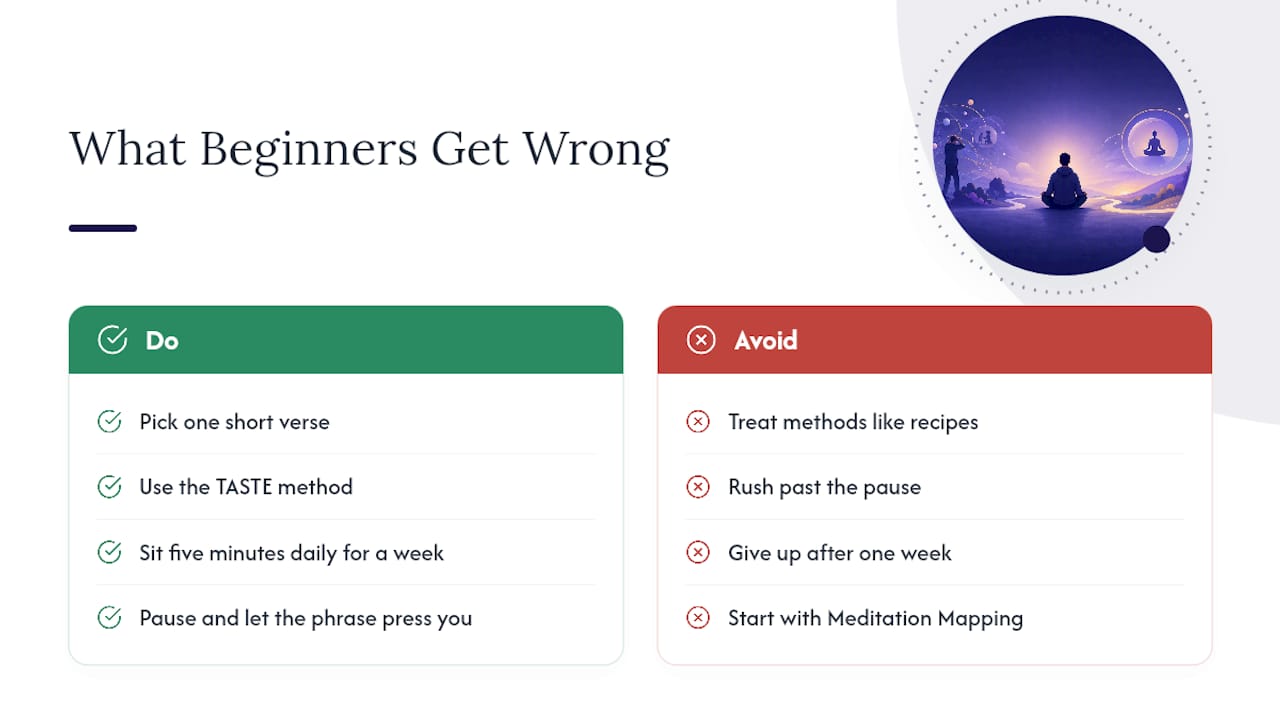
The bigger issue isn’t which method you pick. It’s whether you are willing to sit with a single verse longer than feels productive. Lectio Divina, TASTE, and Meditation Mapping are all good scaffolding, but scaffolding does not build the building. The actual work happens in the pause between reading a phrase and letting it press on you, and that pause is exactly what most people rush past because it feels unproductive by the standards of a to do list.
Here is what I would prioritize first if you are starting from zero: pick one short verse, use TASTE because it is fast and forces you to name Jesus explicitly, and commit to five minutes a day for one week before judging whether “meditation” works for you. Skip Meditation Mapping until you already know what holds your attention. It is the method most likely to turn into a hobby about note taking rather than a practice of communion with God, unless you have already built the underlying habit of sitting still with a text.
— Nkosi
Find Your Next Verse to Meditate On
Every method in this article depends on one thing: having the right verse in front of you when you sit down to meditate. That is the exact gap BibleManna closes. Instead of scrolling through a concordance hoping something fits your situation, you get curated Bible verses organized by topic, with context included so you are not meditating on a phrase you do not fully understand.
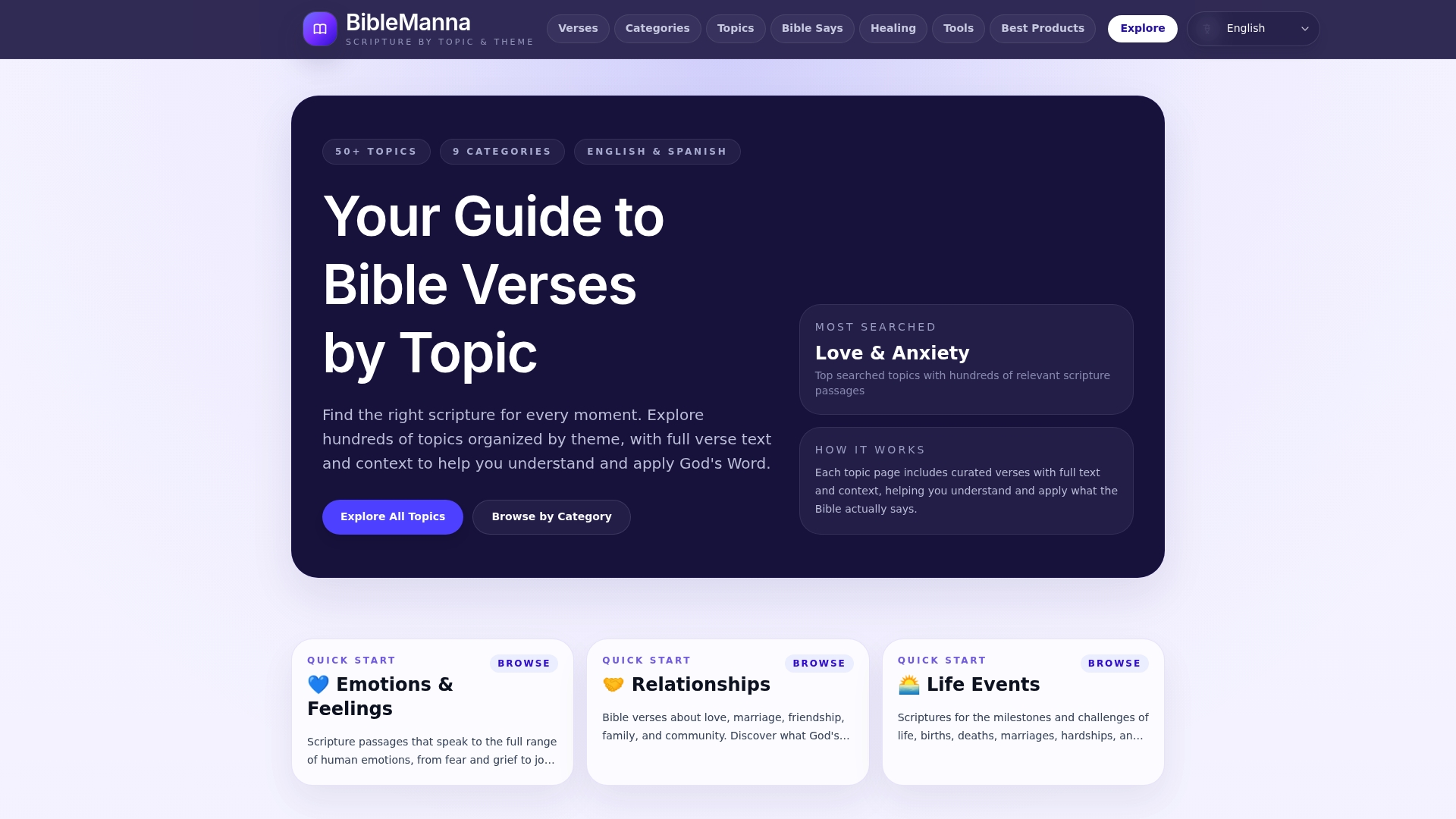
If you are working through grief, discouragement, or a season that needs strength, BibleManna’s topical pages on subjects like encouragement and strength give you a ready set of verses to carry into your Lectio Divina or TASTE practice this week. Pair that with the free Random Verse Generator and Bible Quiz to keep the habit fresh once you have worked through your first few passages. Open a topic that matches what you are facing right now, pick one verse, and start your first five-minute session today.
Sources
- When My Heart Is Cold: Bible Meditation for Beginners | Desiring God
- Lectio Divina (USCCB PDF)
- Methods of Meditation on Scripture - Center for Biblical Spirituality
FAQ
What is the biblical method of meditation?
Biblical meditation means slowly and prayerfully engaging a passage of Scripture, often through structured approaches like Lectio Divina’s four steps (reading, meditation, prayer, contemplation) or the five-step TASTE method, with the goal of communion with God rather than information gathering.
What are the different types of meditation, and how does biblical meditation differ?
Secular and Eastern-style meditation practices generally aim to empty or quiet the mind, while biblical meditation intentionally fills the mind with a specific truth from Scripture and directs it toward God, as Desiring God explains.
Did Jesus tell us to meditate on Scripture?
Jesus did not use the word “meditate” directly in the Gospels, but he modeled deep engagement with Scripture, quoting it in moments of temptation and teaching, and the Old Testament command to meditate “day and night” (Psalm 1:2) shaped the devotional life he and his disciples inherited.
Which generation will not pass away, according to Scripture?
This phrase comes from Jesus’s teaching in Matthew 24:34, where he says “this generation will not pass away until all these things take place,” a verse debated among scholars regarding its reference to either his immediate audience or a future generation witnessing end-times events; it is not directly connected to meditation methods.
How long should a beginner meditate on Scripture each day?
Start with five to ten minute sessions and prioritize daily consistency over length, since teachers like the C.S. Lewis Institute note that regular short sessions shape spiritual habits more effectively than occasional long ones.
Can I use BibleManna to find a verse for meditation?
Yes. BibleManna organizes verses across many topics covering emotions, relationships, and life events, which gives you a specific, contextualized passage to meditate on instead of searching blindly through Scripture.