Bible Reading Plans for Every Emotion and Life Situation

For short-term emotional support, a short topical plan is your best starting point. Match your goal to the structure, and you’ll actually finish it.
- Emotional support (grief, anxiety, fear): a short topical plan, a few minutes per day
- Daily habit formation: 5x5x5 plan with short daily sessions several days a week, covers the New Testament in a year
- Deep study or narrative flow: Chronological or book-specific plan, about a quarter-hour daily
The 5x5x5 approach reads the New Testament in a year at just five minutes a day, five days a week. That’s a realistic entry point for anyone who has tried and abandoned a 365-day plan before.
Table of Contents
- What type of bible reading plan fits your goal?
- How do the main plan formats compare?
- Ready-to-use topical mini-plans by emotion and life situation
- How to keep your plan going past the first week
- Four steps to move from reading to real life
- Where to find curated plans, daily readings, and study tools
- Key Takeaways
- A note on how these plans were selected
- Biblemanna’s topical verse collections are ready when you are
- Useful sources
- FAQ
What type of bible reading plan fits your goal?
The fastest way to pick a plan is to answer one question: Why am I opening the Bible right now?
- Emotional comfort or crisis support: Choose a short topical plan (7–14 days). You need specific, relevant verses fast, not a reading calendar. Expect a few minutes per day.
- Building a daily reading habit: The habit-building plans with flexible monthly structures from The Navigators give you built-in catch-up days each month, around five to seven minutes daily.
- One-time focused study: A single-book plan (Psalms, James, Philippians) runs a few weeks and suits readers who want depth without a year-long commitment.
- Liturgical or seasonal alignment: A lectionary plan from USCCB or the American Bible Society ties your reading to the church calendar, usually roughly ten to fifteen minutes daily with a short reflection.
Ligonier Ministries makes the point plainly: there is no one-size-fits-all plan. Chronological plans work well for narrative flow; short topical plans work better when you need scripture that speaks to where you are right now.
Pro Tip: Pick a translation that matches your plan’s pace. A formal-equivalence translation like the ESV or NASB rewards slow, careful study. For daily reading at speed, a dynamic-equivalence translation like the NLT or NIV keeps comprehension high. When in doubt, read a passage in both and choose the one you actually understand.
How do the main plan formats compare?
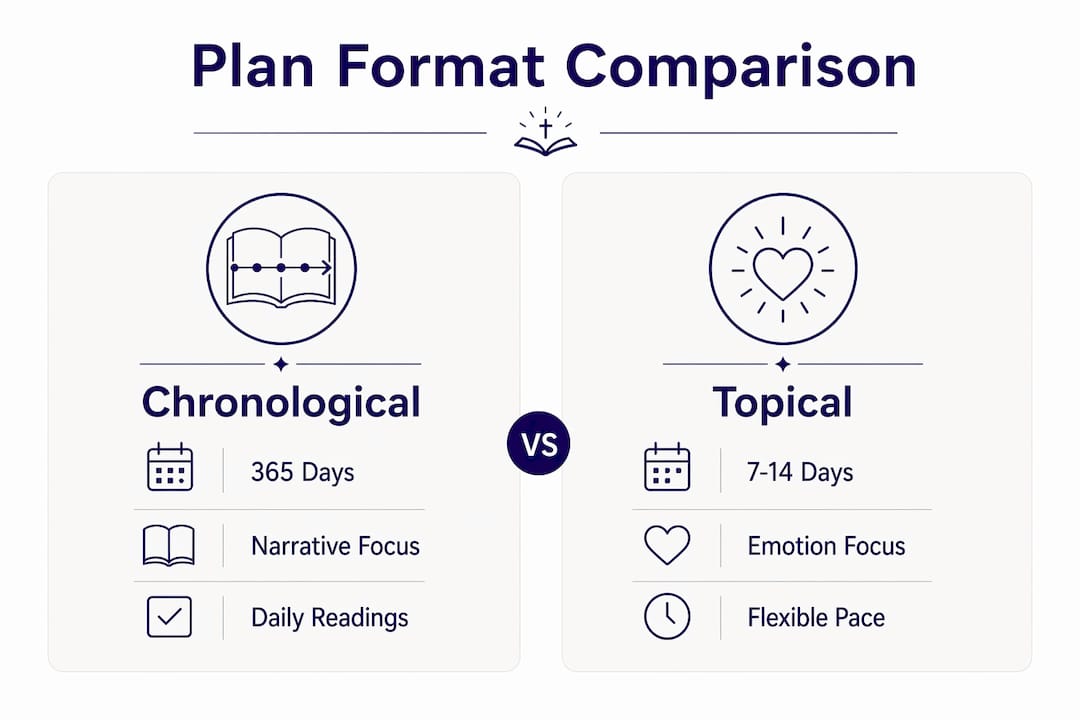
Bible reading plans range from five-day sprints to year-long programs. Here’s how the major formats stack up:
| Plan Type | Typical Length | Minutes/Day | Best For |
|---|---|---|---|
| Topical short-study | a period of several days to a month | 5–10 | Emotional support, immediate need |
| 5x5x5 (New Testament) | approximately a year | about five minutes | Habit building, busy schedules |
| 365-day / one-year | a full year | 15–20 | Full Bible coverage |
| Chronological | a full year | 15–20 | Narrative flow, historical context |
| Book-at-a-time | several weeks | ten to fifteen | Depth, thematic immersion |
| Accelerated full-Bible plan | a few months | 25–30 | Full Bible coverage at a faster pace |
| Lectionary / daily readings | Ongoing | ten to fifteen | Seasonal, communal, liturgical |
The Navigators’ monthly reading plans with catch-up flexibility model is worth noting specifically because it’s designed around human failure. Miss a few days? You still have catch-up room built in. That structural flexibility is what separates plans people finish from plans people abandon in February.
Ready-to-use topical mini-plans by emotion and life situation
These seven mini-plans are plug-and-play. Each runs about a week. Extend any of them by repeating the cycle with a second translation, or compress to 3 days by selecting one verse per day.

Find expanded verse lists for each theme on Biblemanna’s topical collections.
1. Grief and loss (about a week)
Translation recommendation: NLT or NIV for accessibility during emotional pain.
- Psalm 34:18 — Reflect: Where do you feel God’s nearness today?
- John 11:35; Revelation 21:4 — Reflect: What does it mean that Jesus wept?
- Psalm 23:1–6 — Reflect: Which phrase brings the most comfort right now?
- 2 Corinthians 1:3–4 — Reflect: How has comfort come to you through others?
- Isaiah 41:10 — Reflect: Write one fear you’re handing over today.
- Romans 8:38–39 — Reflect: What cannot separate you from love?
- Psalm 30:5 — Reflect: What are you hoping for on the other side of grief?
2. Anxiety and worry (about a week)
Translation recommendation: ESV or NIV.
- Philippians 4:6–7 — Reflect: What specific worry can you name in prayer today?
- Matthew 6:25–27 — Reflect: What are you trying to control that you can release?
- Psalm 46:1–3 — Reflect: What does “God is our refuge” look like practically?
- Isaiah 26:3 — Reflect: Where is your mind fixed right now?
- 1 Peter 5:7 — Reflect: Write one sentence casting a care onto God.
- Psalm 94:19 — Reflect: When has God’s comfort interrupted your anxious thoughts?
- John 14:27 — Reflect: How does Christ’s peace differ from what the world offers?
3. Encouragement and strength (about a week)
Translation recommendation: NLT or The Message for motivational tone.
- Isaiah 40:31 — Reflect: What does “renewing strength” look like in your situation?
- Joshua 1:9 — Reflect: Where do you need courage this week?
- Psalm 27:1 — Reflect: What are you afraid of that God’s light could address?
- Romans 8:28 — Reflect: What hard thing are you trusting God to work through?
- 2 Corinthians 12:9 — Reflect: Where is weakness actually an opportunity?
- Philippians 4:13 — Reflect: What task feels impossible without God’s strength?
- Deuteronomy 31:6 — Reflect: Who in your life needs to hear this verse today?
For a deeper encouragement verse list, Biblemanna’s curated collection includes 39 passages with context notes.
4. Decision-making and wisdom (about a week)
Translation recommendation: ESV or NASB for precision.
- Proverbs 3:5–6 — Reflect: What decision are you leaning on your own understanding for?
- James 1:5 — Reflect: Have you asked God directly for wisdom on this?
- Psalm 119:105 — Reflect: What step is immediately clear, even if the full path isn’t?
- Proverbs 11:14 — Reflect: Who is a wise counselor you can consult?
- Romans 12:2 — Reflect: What would a renewed mind choose differently?
- Isaiah 30:21 — Reflect: What is the quiet voice saying?
- Colossians 3:15–17 — Reflect: Does this decision bring peace or unease?
Biblemanna’s wisdom verse collection covers 72 passages organized by subtopic.
5. Forgiveness (several days)
- Colossians 3:13 — Reflect: Who are you finding hardest to forgive?
- Matthew 18:21–22 — Reflect: What does “seventy times seven” mean for your situation?
- Ephesians 4:31–32 — Reflect: What bitterness are you ready to release?
- Luke 6:37 — Reflect: How does receiving forgiveness change how you give it?
- Psalm 103:12 — Reflect: How far has God removed your own failures?
6. Gratitude (several days)
- Psalm 100:1–5 — Reflect: Name three specific things you’re grateful for today.
- 1 Thessalonians 5:18 — Reflect: What is one hard circumstance you can thank God in?
- Psalm 136:1 — Reflect: Where has God’s steadfast love shown up this week?
- Philippians 4:8 — Reflect: What is true and good that you’ve been overlooking?
- James 1:17 — Reflect: What good gift have you received that you didn’t earn?
7. Relationships and conflict (about a week)
- Romans 12:18 — Reflect: What is your part in making peace?
- 1 Corinthians 13:4–7 — Reflect: Which quality of love is hardest for you right now?
- Proverbs 15:1 — Reflect: What would a gentle answer look like in your conflict?
- Matthew 5:23–24 — Reflect: Is there someone you need to reconcile with first?
- Ephesians 4:29 — Reflect: What words are you choosing to build up or tear down?
- James 1:19 — Reflect: Are you listening more than you’re speaking?
- John 15:12 — Reflect: How can you love someone the way Christ has loved you?
How to keep your plan going past the first week
Most people don’t quit because they lose faith. They quit because they miss three days and feel too far behind to restart.
The Navigators’ monthly reading plans with catch-up flexibility structure solves this directly: it builds some catch-up days into every month, and the plans are non-dated, so you can start any day of the year without feeling off-schedule.
A few practical anchors that work:
- Pair reading with an existing habit — morning coffee, lunch break, or the ten minutes before bed. The trigger is already there; attach the reading to it.
- Micro-commitment first: Five minutes is enough to start. Finishing a chapter is a bonus, not the goal.
- Keep a simple log: A checkmark on a sticky note beats a complicated app. Visible progress is motivating.
- Schedule free days explicitly. Two days off per week isn’t failure; it’s the structure that makes the other five days sustainable.
When you fall behind, don’t try to catch up by doubling your reading. Just pick up where you left off. The goal is a lifelong relationship with Scripture, not a perfect record. Missing days is part of the process, not evidence that you’ve failed.
Pro Tip: If a plan feels like a chore after two weeks, switch formats rather than quitting entirely. Move from a 365-day plan to a short topical plan for a month, then return. Variety prevents the kind of reading fatigue that ends habits permanently.
Four steps to move from reading to real life
Reading a verse and living it are two different things. This four-step method takes five to ten minutes after any daily reading and works for any passage.
- Observe: What does the text actually say? Read it twice. Note one word or phrase that stands out.
- Interpret: What did this mean to the original audience? A single-sentence study Bible note or a quick context check is enough.
- Apply: What does this mean for your life today? Be specific: name a person, a decision, or a situation.
- Pray/record: Write one sentence. It can be a prayer, a question, or a commitment.
Journal prompt template: “Today I read [passage]. What struck me was [observation]. For my life, this means [application]. My response: [one-line prayer or commitment].”
Completed example (anxiety theme): “Today I read Philippians 4:6–7. What struck me was ‘with thanksgiving’ — gratitude is part of the prayer, not just the request. For my life, this means I need to thank God before I see the answer. My response: God, I’m grateful for what you’ve already done, and I’m handing this worry to you now.”
The American Bible Society’s daily reading format models this well: each entry includes an introduction, a key verse, and a short reflection prompt, keeping the whole practice under ten minutes.
Where to find curated plans, daily readings, and study tools
Biblemanna is the strongest starting point for theme-based reading. The topical verse index organizes hundreds of passages by emotion, life event, and biblical concept, with context notes and related topics for each entry. If you know what you’re feeling but not where to look in the Bible, that’s the page to bookmark.
For lectionary-based daily readings:
- USCCB (daily readings) publishes the full Catholic lectionary with podcast and video reflections, aligned to the liturgical calendar.
- American Bible Society (daily reading guide) offers a daily key verse and short devotional, available in print and online.
- PC(USA) provides both a two-year and three-year lectionary option with a daily prayer app, useful for readers who want denominational structure.
For deeper study tools and devotional material, Spirit of His Mouth offers scriptural studies and devotional resources that complement any reading plan.
Key Takeaways
Consistency over volume is the single most reliable predictor of long-term Bible engagement. A five-minute daily plan you actually finish beats a 30-minute plan you abandon.
| Point | Details |
|---|---|
| Match plan to goal | Short topical plans (7–14 days) for emotional support; 5x5x5 or 25/month for habit building; chronological for narrative depth. |
| Build in flexibility | Use non-dated, modular plans with some catch-up days per month to stay on track without guilt. |
| Anchor the habit | Pair reading with an existing daily trigger and start with just 5 minutes — length follows consistency. |
| Study, don’t just read | Apply the four-step method (observe, interpret, apply, pray) to move scripture from the page into daily life. |
| Start with Biblemanna | For immediate topical needs, Biblemanna’s curated verse collections organize scripture by emotion and life situation. |
A note on how these plans were selected
The mini-plans and format guidance in this article reflect how topical verse collections actually get used, not how they look on paper. Readers in grief don’t need a reading calendar; they need Psalm 34:18 on day one and a reason to come back on day two. That’s the editorial principle behind Biblemanna’s topical pages: verses are grouped by what the reader is experiencing, not by canonical order, and each passage carries enough context to be meaningful without a seminary background.
Sources and translations are chosen for clarity and authority. The USCCB lectionary, The Navigators’ plan catalog, and the American Bible Society’s daily reading guide represent the most widely used and editorially vetted resources in the U.S. context. Topical groupings on Biblemanna are reviewed for theological accuracy and emotional relevance, with related topics linked so readers can follow their own thread through Scripture.
If there’s a topic or life situation you’d like to see covered, the feedback is genuinely welcome. The goal is a resource that meets you where you are.
Biblemanna’s topical verse collections are ready when you are
Reading through a generic Bible-in-a-year plan when you’re grieving, anxious, or facing a hard decision is like searching a library with no index. Biblemanna organizes scripture the way you actually need it: by what you’re going through.
Three things you get free on Biblemanna:
- Curated topical verse lists across 50+ themes covering emotions, relationships, life events, and biblical concepts, each with full text and context notes.
- Day-by-day mini-plan templates you can start today for grief, anxiety, wisdom, encouragement, and more.
- Translation comparison and study tools including a random verse generator and multilingual access in English, Spanish, and Italian.
Biblemanna is an editorially independent resource. All scripture collections, thematic explainers, and study tools are free. Browse the full verse library by topic and start the mini-plan that fits where you are right now.
Useful sources
- Bible Reading Plans and Studies — The Navigators: Catalog of modular reading plans including the 5x5x5 and 25-readings/month formats, with guidance on catch-up strategies and plan selection.
- Daily Bible Reading — USCCB: Full Catholic lectionary with daily readings, podcast reflections, and video content aligned to the liturgical calendar.
- Daily Bible Reading — American Bible Society: Daily key verse, introduction, and short reflection; the printed 2026 Daily Bible Reading Guide follows a monthly thematic structure.
- Bible Reading Plans — Ligonier Ministries: Editorial guidance on matching plan type to study goals, with a clear warning against one-size-fits-all approaches.
- Biblical Topics and Verse Collections — Biblemanna: Curated topical verse lists organized by emotion, life event, and biblical concept, with context notes and related topics for each theme.
- Daily Devotion — Presbyterian Church (U.S.A.): Two-year and three-year lectionary options with a daily prayer app for denominational structure.
The American Bible Society’s 2026 Daily Bible Reading Guide organizes readings by monthly theme (for example, January: “Heeding Jesus’s Call”; September: “Growing in God’s Wisdom”), making it one of the few free print resources that combines a reading calendar with thematic framing.
FAQ
What is the easiest bible reading plan for beginners?
The 5x5x5 plan from The Navigators reads the New Testament in a year at five minutes a day, five days a week, with built-in rest days that make it sustainable for new readers.
How do I choose a topical plan for grief or anxiety?
Pick a short topical plan focused on your specific emotion and start with day one’s verse today. Biblemanna’s topical collections organize verses by emotion and life situation so you can find relevant scripture immediately.
What is a lectionary, and how does it differ from a topical plan?
A lectionary is a calendar-based schedule of scripture readings tied to the church year, published by bodies like the USCCB and the American Bible Society. A topical plan groups verses by theme or emotion rather than by date or canonical order.
How many days per week should I read to build a habit?
Five days per week is the standard recommendation for habit-building plans like the 5x5x5. Building in two free or catch-up days prevents the discouragement that causes most readers to quit.
Can I start a reading plan in the middle of the year?
Yes. Modular, non-dated plans from The Navigators and topical mini-plans on Biblemanna can start any day of the year without any sense of being behind.