Bible Themes List: The Major Themes of Scripture Explained

The major themes of the Bible are creation, fall, covenant, redemption, kingdom, God dwelling with his people, and new creation, all centered on Jesus Christ. Scholars phrase the list differently, but they agree that Scripture is one connected story and not a pile of unrelated sayings. This guide gives you the list, shows where each theme begins, and explains how it develops from Genesis to Revelation.
TL;DR
- The Bible’s storyline moves through four stages: creation, fall, redemption and new creation.
- Covenant, kingdom, exodus, temple and God’s presence are the threads that carry that story forward.
- A theme runs across many books. A topic, such as anxiety or work, is a subject you can look up in a handful of verses.
- Start with Genesis 1 to 3, Exodus 3 and 19, Jeremiah 31, Matthew 6 and Revelation 21 and 22, then branch out.
Table of Contents
- What a Bible theme is, and how it differs from a topic
- The big picture: creation, fall, redemption, new creation
- A list of the major Bible themes
- Creation and humanity’s calling
- Covenant: how God binds himself to his people
- Kingdom: God’s saving reign
- Exodus, temple and God’s presence
- Jesus as the center that holds it together
- Faithfulness: the theme readers need most in hard seasons
- Perspective
- Browse the themes in verse form on BibleManna
- How to trace a theme yourself
- FAQ
- Sources
What a Bible theme is, and how it differs from a topic
A theme is an idea that keeps returning across many authors, centuries and genres, and that grows each time it appears. A topic is narrower. “Fear” or “forgiveness” is a topic: you can gather verses on it and read them side by side. “Covenant” is a theme: it starts in Genesis, shapes the law and the prophets, and arrives at a new covenant in the New Testament.
That difference matters for how you read. Crossway’s Douglas Sean O’Donnell notes that biblical themes such as the kingdom, exodus and exile, priest and temple, and covenant develop progressively through history, through types, and through connections between earlier and later passages. A single verse on a theme is a snapshot. Following the theme gives you the film.

There is also a humble note worth keeping in mind. Jonty Rhodes, writing in Tabletalk, argues that hunting for one single theme of the Bible misses the point: Scripture is a weave of many threads that together sound like a symphony centered on Christ. So any list of themes, including this one, is a map and not the territory.
The big picture: creation, fall, redemption, new creation
The simplest way to hold the themes together is a four-part arc. Zondervan’s Trace the Themes guide describes it this way: God makes a good world, humanity breaks fellowship with God through sin, God acts to reconcile and redeem, and Scripture ends with renewed creation. Reconciliation with God is the heart of that story.
Every other theme on the list sits somewhere inside this arc:
- Creation: the world as God’s good gift, and humans as image-bearers.
- Fall: the break in relationship, with consequences for people and for the world.
- Redemption: God’s rescue, worked out through covenants, the exodus, the sacrifices and finally Christ.
- New creation: the renewed heavens and earth where God lives with his people.
If you only have time to learn one frame for the Bible, learn this one. When a passage confuses you, ask where it sits on the arc.
A list of the major Bible themes
Here is a working list, with the place to begin reading each theme. Different teachers group these differently, and some merge several into one, which is normal.
| Theme | In one sentence | Good places to start |
|---|---|---|
| Creation | God makes a good world and gives humanity a calling within it | Genesis 1 to 2, Psalm 8 |
| Fall and sin | Humanity breaks fellowship with God | Genesis 3, Romans 5 |
| Covenant | God binds himself to his people with promises | Genesis 15, Exodus 19, Jeremiah 31 |
| Exodus and redemption | God rescues his people so that he can live among them | Exodus 3, 12 to 15 |
| Kingdom | God’s saving reign comes to earth | Psalm 145, Matthew 6, Mark 1 |
| Law and prophets | God’s instruction and his call back to faithfulness | Deuteronomy 6, Isaiah 1, Micah 6 |
| Temple and presence | God dwells with his people | Exodus 25 to 40, John 1, Revelation 21 |
| Christ and fulfillment | Every promise finds its answer in Jesus | Luke 24, Hebrews 1 |
| New creation | Death and sin are removed, creation is renewed | Isaiah 65, Revelation 21 to 22 |
Zondervan Academic’s summary of the story lines up closely with this table: creation and fall, covenant and redemption, law and prophets, image-bearing rule, God as King with his kingdom fulfilled in Jesus, and history moving toward new heavens and a new earth.
Creation and humanity’s calling
The Bible opens with creation, and the theme never fully leaves. Genesis presents people as made in God’s image yet formed from the ground, with a vocation to exercise dominion and to serve the earth. The St Andrews Encyclopaedia entry on creation in the Old Testament points out that disobedience leads to expulsion, but God does not abandon humanity, and creation remains a theme right through the Old Testament to the Bible’s close.
The prophets keep the theme alive in a surprising way. The same academic encyclopedia notes that prophetic theology ties the earth’s suffering to a rupture between people and God, and links justice in society with the flourishing of creation. That is a useful corrective if you think of “spiritual” and “physical” as separate worlds in Scripture.
If you want the key passages gathered with context, our page on the biblical creation walks through them verse by verse.
Covenant: how God binds himself to his people
Covenant is probably the most important structural theme on the list. Chris Bruno of Crossway names covenant, kingdom and creation as key structural themes and shows how the message centers on Jesus, the “Yes” to God’s promises.
A covenant is a chosen relationship in which two parties make binding promises, often with God as witness. The Bible’s storyline moves through several of them:
- Adam and Noah: the setting of a broken world, and God’s promise to preserve it.
- Abraham: the promise of blessing for all nations.
- Moses (Sinai): God’s law, with blessing and consequence for Israel.
- David: the promise of a royal deliverer.
- The new covenant: the fulfillment of these hopes in Christ.
That sequence follows Jason DeRouchie’s overview of the biblical covenants, which presents Jesus as fulfilling each covenant in a different way. The new covenant is promised in Jeremiah 31:31, and the surrounding passage describes a covenant written inwardly on the heart, in contrast to the one the people broke at Sinai.
Covenant is also why Scripture speaks about marriage and family in such serious terms. Faithfulness to promises is a theme of the whole Bible before it is a theme of any household. If you are looking at how to apply biblical principles to marriage conflict, covenant is the right place to start your thinking. For verses to read with your spouse or children, our collections on family and parenting are organized by situation.
Kingdom: God’s saving reign
The kingdom of God is the central theme of Jesus’s teaching in the Gospels. Scholars writing in Themelios note that the term refers primarily to God’s sovereign activity as ruler and only secondarily to the realm he rules. In other words, “kingdom” is more verb than place: it is God reigning, saving and judging.
The theme starts earlier than the Gospels. Another Themelios article explains that in Genesis 1:26 humanity is made to reign over creation as God’s vice-regents, and that God’s purpose through all history is for his reign to come on earth as in heaven, which is the request in the Lord’s Prayer (Matthew 6:9 to 10).
Stephen Dempster’s book The Return of the Kingdom makes the same point at book length: the biblical story begins and ends with God as king, and the story of his kingship fulfills a promise to restore the rightful rule of humanity over creation by defeating sin and death. Italian readers can explore the theme in our article on the regno di Dio.
Exodus, temple and God’s presence
If one event defines redemption in the Old Testament, it is the exodus. The ESV Global Study Bible says the main theme of Exodus is the Lord’s self-revelation in faithfulness, grace and power, and that God delivered Israel so that he might dwell among them, as Exodus 29:46 states. Rescue and presence belong together.
That is why the second half of Exodus is about the tabernacle. The thread continues through the temple, the incarnation, Pentecost and finally the New Jerusalem. N. T. Wright traces this path in God’s Homecoming, and a review argues that the story ends with God coming to dwell with his people in a renewed creation, not with people escaping earth.
Read the key passages with notes on our page about the exodus.
Jesus as the center that holds it together
The Bible is one book in two testaments. The Gospel Coalition describes the Old Testament’s 39 books as God’s unfolding promise to his covenant people and the 27 books of the New Testament as the fulfillment of those promises in Christ, for Jew and Gentile alike.
Vern Poythress argues that Christ is the central subject of the whole Bible, obvious in the New Testament and present in the Old, citing Luke 24:25 to 27 and 44 to 47, John 5:39 and 1 Peter 1:10 to 12. The two testaments differ because they stand on either side of the center-point of history. This is the reason every theme on our list lands in Jesus: he is the true image-bearer, the covenant keeper, the king and the temple.
The resurrection is where this becomes concrete. It is the pattern for the new creation and the reason the final chapters of Scripture speak of renewal and not escape. Read our page on the resurrection for the key verses, or, if music helps you meditate on the theme, try these Easter Christian rap songs.
Faithfulness: the theme readers need most in hard seasons
Many people come to a list of Bible themes because they are hurting and want to know what the whole Bible says to them. The theme to start with is God’s faithfulness. In Exodus 34:6, in the aftermath of Israel’s golden calf, God describes himself as merciful and gracious, slow to anger, and abounding in steadfast love and faithfulness. The ESV Global Study Bible explains that because of his grace and covenant love, his mission to bless the world keeps advancing.
The same study notes comment on the divine name in Exodus 3:10 to 15: it points to a God who will be with his people, who is unchanging, and who will be enough in their moment of crisis. You can bring that into your own situation by pairing the theme with a topical collection. Our verses on hope, strength and encouragement each show the faithfulness theme in a specific setting.
If your pain is serious or lasting, speak to your pastor and to a doctor or licensed counselor as well. Scripture and care from people work together.
Perspective
We built BibleManna on a simple conviction: people rarely arrive at the Bible asking for a theme. They arrive with a need. A parent wonders how to guide a child, a student wants to understand a book, a person in a hard season wants one verse that speaks to them.
Themes and topics answer both questions. The themes in this article give you the long view, the grand story. Our 50 topics give you the entry point, the place where your own life touches that story. A verse on anxiety makes more sense when you know it sits inside the theme of God’s faithfulness. A passage on work makes more sense inside the theme of creation and calling.
That is why each verse on our site comes with its full text and its context. We want you to see where a verse lives, not just to copy it. We think this is the surest way to a deeper connection with the Word of God in every phase of life.
Nkosi
Browse the themes in verse form on BibleManna
When you are ready to move from the overview to the text, BibleManna organizes Scripture by topic, with full verse text and background for each passage. Start with Bible verses by topic, or browse people, events and concepts if you want a theme such as creation, exodus or resurrection.
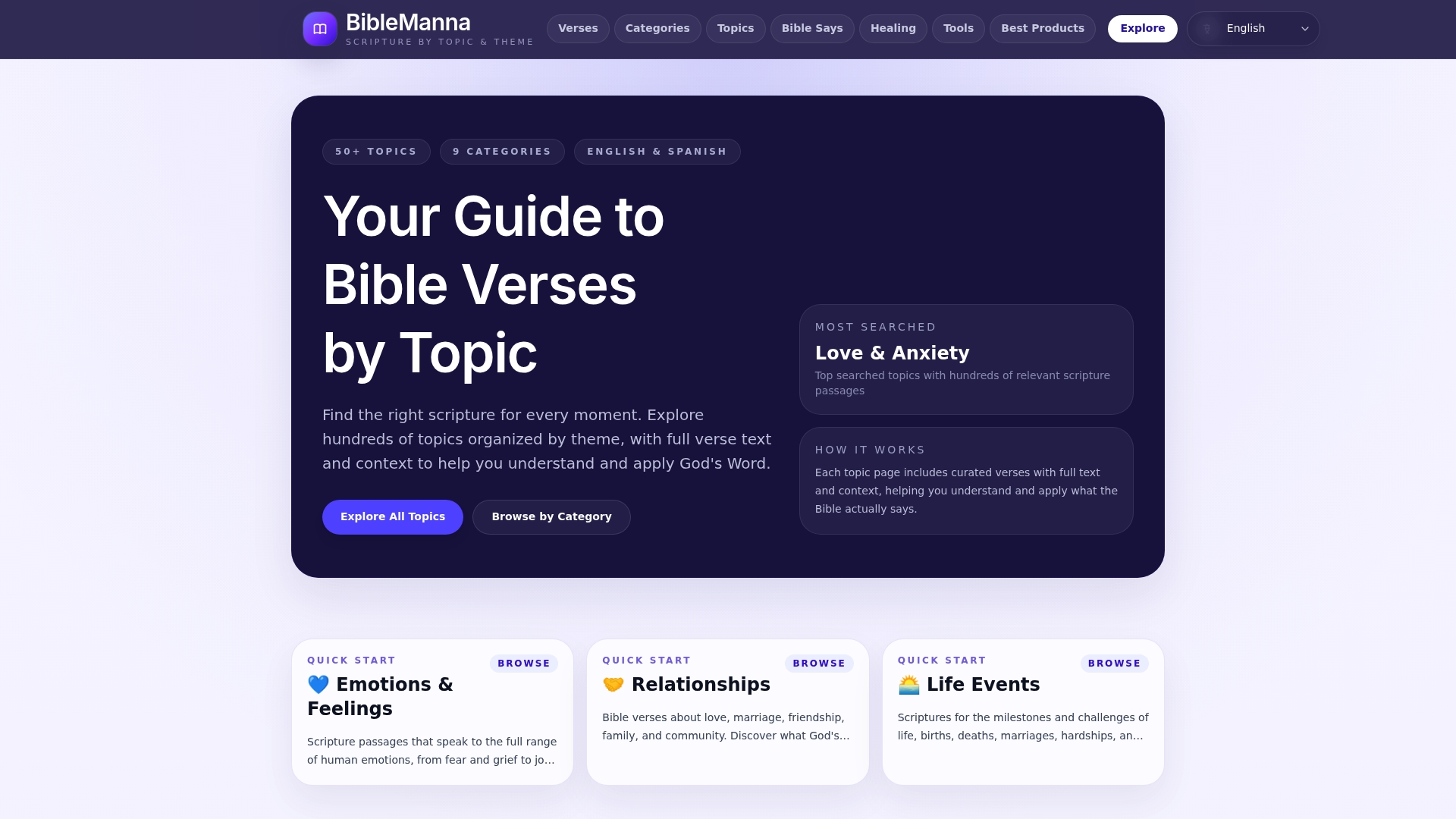
The site is free to use and available in English, Spanish and Italian, with extra tools such as a random verse generator, translation comparison and quizzes. Go to the BibleManna home page to begin.
How to trace a theme yourself
You do not need seminary training to follow a theme. A simple method works well.
- Pick the first appearance. Most themes have a clear starting passage, such as Genesis 1 for creation or Genesis 12 and 15 for the covenant with Abraham.
- Read forward in chunks. Move through the law, history, prophets and poetry, noting each time the theme returns and what changes.
- Watch for the turn in the New Testament. Ask how Jesus or the apostles pick up the theme and what they say is now fulfilled.
- End at Revelation 21 and 22. Many themes conclude here, so ask how the final vision resolves them.
- Compare translations. A key word can carry more meaning than one rendering shows. Our translation comparison tool lets you see several side by side.
A worked example: take “presence.” In Eden God walks with the first humans. In Exodus he commands a tabernacle so he can dwell among his people. In the Gospels, Jesus is the Word who lived among us. In Revelation 21, God makes his dwelling with humanity. Four stops, one theme, and the whole Bible is in view.
Keep the humility of the Tabletalk article in mind as you go. Different traditions emphasize different threads, and a good reader holds their own list loosely while staying anchored to the text itself.
FAQ
What are the main themes of the Bible?
The most common list is creation, fall, covenant, redemption, kingdom, God’s presence with his people, and new creation, all centered on Christ. Different authors group them differently. Crossway’s writers, for example, highlight covenant, kingdom and creation as structural themes.
What is the one central theme of the Bible?
Many Christian scholars say it is Christ and reconciliation with God, which is how Zondervan’s guide frames the biblical story. Others, like the Tabletalk author, caution that Scripture has many interwoven threads rather than one. Both agree the center is Jesus.
What is the difference between a Bible theme and a Bible topic?
A theme develops across the whole Bible, such as covenant or kingdom. A topic is a subject you can study through a set of verses, such as hope or family. You can browse topics in our Bible verses by topic collection.
Where should a beginner start when studying Bible themes?
Begin with Genesis 1 to 3, then read Exodus 3 and 19, Jeremiah 31, Matthew 5 to 7 and Revelation 21 to 22. These passages touch every major theme on the list. After that, follow the one that interests you most using the steps above.
Sources
- 14 Principles for Studying the Bible, Crossway
- What Are the Bible’s Key Themes?, Crossway
- The Main Themes of Scripture, Tabletalk
- Trace the Themes, Zondervan
- Introducing The Story of God Bible Commentary, Zondervan Academic
- The Biblical Covenants in Salvation History, Jason DeRouchie
- The hope of a new age: the kingdom of God in the New Testament, Themelios
- Resurrection and Reign, Themelios
- The Return of the Kingdom, InterVarsity Press
- The Global Message of Exodus, ESV.org
- Book Review: God’s Homecoming, Anglican Compass
- The Relation of the Old and New Testaments, The Gospel Coalition
- The Relation of the Old Testament to the New Testament, Vern Poythress