Bible Verses About Temptation to Memorize and Pray Right Now

When temptation hits, you need words already loaded in your memory, not a search engine. Start with these: 1 Corinthians 10:13, Psalm 119:11, and James 4:7. The one-sentence action is simple. Memorize a short verse, and the moment temptation shows up, say it out loud or in your head, pray in that same breath, and physically remove yourself from the situation if you can.
Here is why that works. Temptation is universal, not a sign that something is wrong with you. 1 Corinthians 10:13 says no temptation you face is unusual, and God always provides a way out.
- 1 Corinthians 10:13 — God is faithful; he won’t let you be tempted beyond what you can bear.
- James 1:12–15 — Endurance under trial leads to reward; sin grows from unchecked desire.
- Matthew 26:41 — “Watch and pray, so that you will not fall into temptation.”
- Psalm 119:11 — Hiding God’s word in your heart keeps you from sin.
- Hebrews 4:15–16 — Jesus understands your struggle and offers grace, not shame.
- James 4:7 — Submit to God, resist the devil, and he will flee.
- Galatians 5:16 — Walk by the Spirit and you won’t carry out the flesh’s desires.
Pro Tip: Pick one verse tonight, not seven. A single verse you actually remember at 2 a.m. beats a list of ten you can’t recall under pressure.
Key Takeaways
Resisting temptation successfully depends on memorizing a short verse in advance, praying briefly in the moment, and physically removing yourself from the situation.
| Point | Details |
|---|---|
| Memorize before you need it | Pick one or two short verses like 1 Corinthians 10:13 and review them daily, not just during a crisis. |
| Temptation isn’t sin | Acting on desire is sin; noticing temptation is the common human experience Scripture describes. |
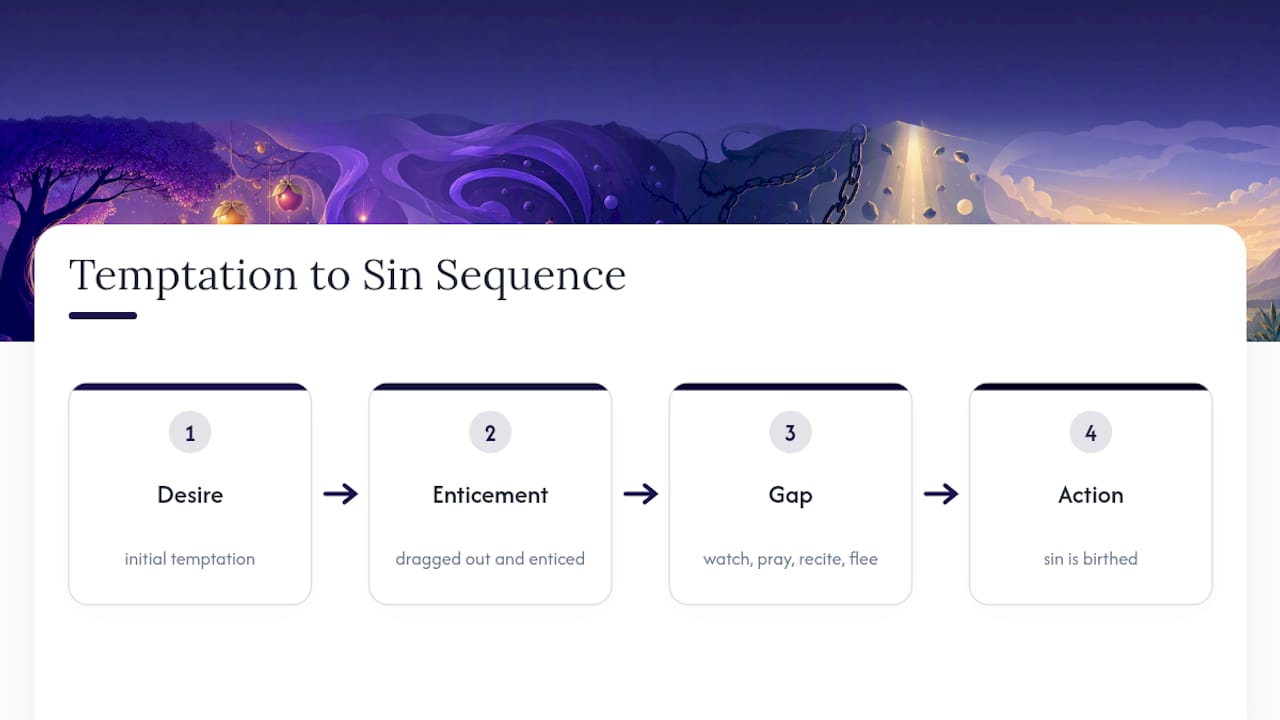
| Use the watch, pray, recite, flee routine | Notice the pull early, pray briefly, say your memorized verse, then physically leave if needed. |
| Failure has a way back | Psalm 51 and 1 John 1:9 both show confession leads to restoration, not permanent shame. |
| Explore themed collections | Biblemanna’s Bible Verses by Topic page groups scripture by struggle so you find relevant verses faster. |
Table of Contents
- Bible Verses About Temptation for Every Kind of Struggle
- What These Temptation Verses Actually Mean
- How to Actually Use These Verses When Temptation Hits
- Why You Can Trust These Verses and Their Context
- What Joseph’s Story Teaches About Resisting Temptation
- The Holy Spirit’s Part in Resisting Temptation
- Verses That Remind You God Stays Faithful
- Psalm 51 and Praying Through Temptation and Failure
- Temptation Is Not the Same Thing as Sin
- What Actually Helps When Temptation Keeps Coming Back
- Find More Verses and Tools for Your Struggle
- Sources
- FAQ
Bible Verses About Temptation for Every Kind of Struggle
Different moments call for different words. Some verses work best memorized cold, ready to fire the instant temptation appears. Others are better for slower reflection, when you’re trying to understand why you keep falling into the same pattern. And some build the kind of long-term spiritual muscle that makes temptation less frequent in the first place.
Verses to memorize for immediate use:
- 1 Corinthians 10:13 — God provides a way out the instant temptation arrives, no exceptions.
- James 4:7 — Submitting to God and resisting the devil causes him to flee, not just retreat.
- Matthew 26:41 — Watchfulness plus prayer is the two-part defense Jesus himself recommended.
- Psalm 119:11 — Scripture memorized ahead of time becomes a weapon you don’t have to search for.
- Philippians 4:13 — Strength for the moment comes from Christ, not willpower alone.
Verses for reflection when you want to understand the pattern:
- James 1:12–15 — Desire, left unchecked, is what actually gives birth to sin, not the temptation itself.
- Romans 7:15 — Paul’s own admission that he does what he hates gives permission to be honest about struggle.
- 1 Peter 5:8–9 — Staying alert matters because temptation often circles back when you’re tired or distracted.
- Proverbs 4:23 — Guarding your heart above everything else because it shapes every choice that follows.
Verses for building long-term strength:
- Hebrews 4:15–16 — Jesus faced real temptation and invites you to approach grace with confidence, not fear.
- Galatians 5:16 — Walking by the Spirit day to day, not just in crisis moments, is what actually changes the pattern.
- 2 Peter 2:9 — God knows how to rescue the godly from trials, a promise worth returning to on hard days.
Notice the shape here. Immediate-use verses are short and punchy, easy to recall under stress. Reflection verses take longer to unpack but explain the “why” behind the struggle. Strength-building verses aren’t about the crisis moment at all. They’re about the months and years of walking with God that make crisis moments less frequent.
What These Temptation Verses Actually Mean
Scripture doesn’t treat temptation as a single event. It treats it as a process, and understanding that process changes how you respond to it.
James 1:13–15 lays out the mechanism plainly: God tempts no one. Instead, each person is tempted “when they are dragged away by their own evil desire and enticed.” Desire, when it has conceived, gives birth to sin, and sin, when full grown, brings death. Temptation itself isn’t the sin. The moment you notice a pull toward something wrong, you’re not guilty yet. Sin happens in the choosing.
That distinction matters more than most people realize.
That’s 1 Corinthians 10:13, and it does two things at once. It normalizes the struggle (everyone faces this) and it promises a concrete exit, not just sympathy.
Hebrews 4:15–16 and Matthew 26:41 work together in a way explained in GOD’S GRACE: AN OVERVIEW. Jesus was “tempted in every way, just as we are, yet he did not sin,” which means he’s not judging you from a distance. He’s inviting you to “approach the throne of grace with confidence” precisely when you feel weakest. And his own instruction, “watch and pray so that you will not fall into temptation,” acknowledges something honest: “the spirit is willing, but the flesh is weak.”
Psalm 119:11 explains why memorization isn’t just a nice habit. It’s tactical. Jesus himself, tempted in the wilderness, quoted Deuteronomy from memory three separate times rather than reasoning it out in the moment. That pattern is worth copying.
- Desire precedes sin, and noticing desire isn’t the same as sinning.
- God’s faithfulness includes a specific, promised exit, not vague encouragement.
- Jesus’s own example shows memorized Scripture beats improvised reasoning under pressure.
How to Actually Use These Verses When Temptation Hits
Knowing the verses and using them in real time are two different skills. Here’s a routine that turns knowledge into reflex.
- Watch. Notice the moment temptation starts, before it gathers momentum. This is the “watch” half of Matthew 26:41, and it only works if you’re paying attention to your own patterns in the first place.
- Pray, briefly. A single breath prayer works. “Lord, help” counts. You don’t need eloquence in the moment.
- Recite the memorized verse. Say it out loud if you can. This is where Psalm 119:11 becomes practical rather than theoretical.
- Flee or call someone. Sometimes resisting means physically leaving the room. Sometimes it means texting a friend who knows your struggle. James 4:7’s promise that the devil will flee often shows up through these ordinary, unglamorous exits.
For memorization itself, keep it small. Two or three short verses, reviewed morning and evening, work better than a long list you’ll abandon by Thursday. Write your verse on your phone lock screen. Pair it with a specific breath pattern or a short tune if that helps it stick.
Long term, four disciplines matter more than any single tactic: consistent daily reading, honest community, actively replacing known triggers, and periodic confession. None of these are glamorous, and none of them work instantly. If temptation keeps returning in a pattern that feels compulsive or harmful, in addictive behavior, self-harm, or relational abuse, that’s a signal to bring in a pastor or counselor, not just another verse.
Pro Tip: Review your memorized verse at the same time you already brush your teeth. Attaching new habits to existing ones is the single easiest way to make memorization stick past the first week.
Why You Can Trust These Verses and Their Context
Biblemanna organizes verses by theme across 50 topics, covering emotions, relationships, and life events, so you’re not scrolling through unrelated scripture hoping something fits. Each verse comes with context explaining what it originally meant and how it applies now, rather than a bare reference with no explanation.
Every verse cited here traces back to recognized sources. BibleGateway provides the primary verse texts across translations, USCCB’s scripture commentary offers exposition on James 1, and BibleMemory’s memorization guidance shaped the practical recommendations here.
- Verses are grouped by theme, not scattered across generic “top verses” lists.
- Context sections explain the background behind each passage, not just the text itself.
- Sources are checked against recognized scripture databases and commentary, not paraphrased from memory.
What Joseph’s Story Teaches About Resisting Temptation
Genesis 39 tells one of Scripture’s clearest temptation narratives, and it’s worth returning to because Joseph’s response is almost entirely physical, not philosophical. Potiphar’s wife propositions him repeatedly. Joseph doesn’t negotiate or rationalize. He states plainly that betraying his master and sinning against God would be wrong, and when she grabs his cloak, he runs, leaving the garment behind.

That detail matters. Joseph didn’t out argue temptation. He left the room.
The story also shows temptation escalating rather than appearing once and vanishing. Potiphar’s wife approaches him “day after day,” and Joseph’s daily refusal, not a single dramatic stand, is what actually held the line. Consistency beat willpower in a single moment.
There’s a cost, too. Joseph gets falsely accused and imprisoned for doing the right thing. Scripture doesn’t promise that resisting temptation leads to immediate reward. Joseph spends years in prison before his circumstances turn, and the narrative treats that waiting as part of the story rather than glossing over it.
Other Old Testament figures show the opposite pattern. David’s episode with Bathsheba in 2 Samuel 11 involves the same warning signs, being idle, noticing, lingering, but without Joseph’s decisive exit. The consequences were severe and lasting. Read side by side, these two accounts make a simple point: the moment you notice temptation building is the moment to act, not the moment to keep watching. Waiting to decide is itself a decision, and it rarely goes the way you hope.
The Holy Spirit’s Part in Resisting Temptation
Willpower alone has a poor track record against temptation, which is part of why Scripture puts the Holy Spirit at the center of the fight rather than at the edges. Galatians 5:16 states the mechanism directly: “Walk by the Spirit, and you will not gratify the desires of the flesh.” The verse frames resistance as a byproduct of walking with the Spirit daily, not a standalone battle fought through sheer effort each time temptation shows up.
Galatians 5:22-23 lists self-control among the fruit of the Spirit, alongside love, patience, and gentleness. That placement is significant. Self-control isn’t presented as a personality trait some people have and others lack. It’s a fruit, meaning it grows over time through a relationship with God rather than through raw determination.
This reframes the moment-to-moment struggle. When you’re facing temptation, you’re not relying on your own reserve of discipline, which runs out. You’re asking the Spirit already present in you to do what he does. That’s part of why the “watch and pray” instruction in Matthew 26:41 pairs prayer with vigilance. Prayer in the moment of temptation is, in effect, calling on the Spirit’s help rather than trying to white knuckle through alone.
Practically, this means the daily habits that keep you connected to the Spirit, prayer, reading Scripture, honest community, matter more for resisting temptation than any single technique deployed in crisis. A person who neglects that connection all week and expects one prayer to hold the line during a moment of pressure is asking a lot from a single moment.
Verses That Remind You God Stays Faithful
Struggling with the same temptation repeatedly can feel like proof that God has given up on you. Scripture consistently pushes back against that conclusion. Temptation itself is common, not a mark of divine displeasure, and the biblical response centers on relying on God’s provision rather than spiraling into self-condemnation.
A handful of verses carry this encouragement directly:
- Lamentations 3:22–23 — God’s mercies are new every morning, which means yesterday’s failure doesn’t define today.
- Philippians 1:6 — He who began a good work in you will carry it to completion, a promise about the long arc, not just today’s outcome.
- Psalm 34:18 — The Lord is close to the brokenhearted, meaning shame after failure isn’t a reason to distance yourself from him.
- 1 John 1:9 — Confession leads to forgiveness and cleansing, framed as a reliable pattern, not a one-time exception.
- 2 Corinthians 12:9 — God’s grace is sufficient, and his power is made perfect specifically in weakness, not in spite of it.
These verses matter most on the days after a failure, when the temptation isn’t lust or anger anymore but despair itself. If you’ve read Hebrews 4:15-16 earlier, you already know Jesus approaches your weakness with sympathy rather than judgment. These verses extend that same posture across the whole of Scripture. God’s faithfulness isn’t contingent on your streak of good days. It’s a fixed commitment that outlasts your failures, which is a very different foundation than trying to earn back his approval one clean day at a time.
Psalm 51 and Praying Through Temptation and Failure
Psalm 51 is David’s prayer written after his affair with Bathsheba, and it’s one of the most direct models Scripture offers for what to pray when temptation has already won. David doesn’t minimize what happened. He opens with “have mercy on me, O God, according to your steadfast love,” and asks God to “blot out my transgressions.” That’s not a prayer for resisting future temptation. It’s a prayer for what comes after failure, and it belongs in your rotation precisely because failure happens.
The psalm also asks for something forward looking: “create in me a clean heart, O God, and renew a right spirit within me.” That request treats the problem as deeper than a single bad decision. David is asking for a changed inner orientation, not just forgiveness for one incident, which lines up with James 1:14’s point that sin grows from desire left unaddressed.
For temptation you’re currently facing rather than already fallen into, shorter prayers work better in the moment, a single line like “Lord, help me flee this” or “give me the way out you promised” draws directly on 1 Corinthians 10:13’s language. Psalm 51 is the longer prayer for the morning after, when you need to process failure honestly instead of burying it. Keeping both types ready, the quick breath prayer for the moment and the fuller confession prayer for afterward, covers more of the actual territory temptation occupies in a normal week.
Temptation Is Not the Same Thing as Sin
This distinction resolves more guilt than almost any other point in this article. Being tempted to lie, lust, steal, or lash out in anger is not itself sinful. Acting on it is. Hebrews 4:15 makes this explicit by stating that Jesus “was tempted in every way, just as we are, yet did not sin.” If temptation itself were sin, that sentence would be a contradiction. It isn’t, because Scripture treats the pull toward wrongdoing as a separate event from the choice to give in.
James 1:14–15 lays out the sequence: desire, when it’s dragged out and enticed, gives birth to sin. The word choice matters. Sin is birthed, meaning it comes after a process, not at the first flicker of desire. That gap, between noticing temptation and acting on it, is exactly where the practices in this article operate. Watching, praying, reciting Scripture, and fleeing all happen in that gap.
This distinction has a practical effect on shame. If you’ve spent years assuming that feeling tempted proves something is spiritually wrong with you, that’s worth reconsidering. Feeling drawn toward something wrong is the common human experience 1 Corinthians 10:13 describes, not a personal failing. The failing, if it happens, occurs at the point of action, and even then, Psalm 51 and 1 John 1:9 both promise a way back. Confusing temptation with sin tends to produce either paralyzing guilt over normal struggles or a false sense that you’ve already failed, so you might as well continue. Neither serves you. Scripture’s actual position sits between them: notice it, don’t act on it, and if you do act on it, confession and grace remain available.
What Actually Helps When Temptation Keeps Coming Back
Most advice on resisting temptation focuses on willpower, which is exactly backward. The research and the Scripture here point somewhere else: the people who hold up best aren’t the ones with the strongest resolve in the moment. They’re the ones who did the preparation days or weeks earlier, memorizing a verse, building community, establishing the habit of watching for the pull before it becomes overwhelming.
Where conventional advice falls short is treating temptation as a single crisis to survive rather than a recurring pattern to prepare for. Telling someone to “just pray harder” in the heat of the moment ignores that Jesus himself relied on Scripture memorized ahead of time in the wilderness, not improvised prayer under pressure.
If you take one thing from this article, let it be this: pick one verse, not ten, and actually memorize it this week. 1 Corinthians 10:13 works well because it does two things at once, it names the promise and the practical exit. Everything else, the routines, the community, the confession prayers, matters, but it builds on that one small, repeatable action. Preparation beats improvisation every time temptation actually shows up.
— Nkosi
Find More Verses and Tools for Your Struggle
Biblemanna gives you a faster path to the right verse than a general search engine ever will, because every passage sits inside a themed collection built for exactly this kind of moment, not buried in unrelated results.

The Bible Verses by Topic page organizes scripture across dozens of categories, so if temptation today is tangled up with anger, anxiety, or a relationship strain, you’re one click from verses built for that specific struggle rather than a generic list. Pair that with the site’s free tools, including a random verse generator and a translation comparison tool, when you want to see how a passage like 1 Corinthians 10:13 reads across the KJV, ESV, and NIV side by side.
If you’re building long-term resistance rather than just handling today’s moment, the perseverance collection and strength collection go deeper into the daily disciplines this article touched on. Start with one topic tonight and see which verse actually sticks.
Sources
- 1 Corinthians 10:13 - Bible Gateway
- James, CHAPTER 1 | USCCB
- Bible Verses About Temptation to Memorize (10 Verses) - BibleMemory
- Crown of life (Ligonier devotional)
FAQ
What Is the Best Bible Verse for Temptation?
1 Corinthians 10:13 is the most cited verse because it both normalizes temptation and promises a specific way of escape.
What Does the Bible Say Happens When You Resist Temptation?
James 1:12 says the person who perseveres under trial receives the crown of life promised to those who love God.
How Do I Memorize Bible Verses for Temptation Effectively?
Start with a few short verses, review them regularly, and write them on your phone lock screen so you see them throughout the day.
Is Feeling Tempted the Same as Sinning?
No. Hebrews 4:15 shows Jesus was tempted without sinning, meaning temptation itself is not sin; acting on it is.
What Should I Pray When I’m Struggling With Temptation?
A short breath prayer works in the moment, drawing on 1 Corinthians 10:13’s promise, while Psalm 51 offers a fuller prayer for after a failure.
Where Can I Find More Verses Organized by Topic?
Biblemanna’s Bible Verses by Topic page groups scripture across 50 themes, making it easier to find passages that match your specific struggle.