Caregivers: Bible Verses Matched to 7 Real Moments

When exhaustion, fear, grief, or plain physical depletion hit hard, five verses give caregivers the fastest spiritual footing: Matthew 11:28 to 30 for rest, Isaiah 40:29 to 31 for renewed strength, Psalm 23:1 to 3 for restoration, 2 Corinthians 12:9 for grace in weakness, and 1 Peter 5:7 for handing over anxiety. Read one aloud right now, save it to your phone’s lock screen, or write it on a card by the recliner. Some websites group verses like these by exact life situation, which is a fast way to find scripture that matches what you’re actually feeling today.
TL;DR:
- Caregivers should focus on specific verses like Matthew 11:28-30 and Isaiah 40:29-31 for immediate comfort and renewed strength during exhaustion.
- In moments of fear and anxiety, verses such as 1 Peter 5:7 and Philippians 4:6-7 help turn worry into actions like prayer and surrender.
- During grief or loneliness, scriptures like Psalm 34:18 and Matthew 5:4 remind caregivers of God’s closeness and comfort in sorrow.
- For long-term endurance, passages like Isaiah 40:29-31 and 2 Corinthians 4:16 acknowledge weakness while encouraging reliance on divine renewal.
- Building brief daily habits, such as reading and praying from these verses, enhances caregivers’ resilience amid fragmented schedules and emotional highs and lows.
Table of Contents
- Bible Verses for Caregivers, Grouped by What You’re Feeling Right Now
- Short Prayers and Reflections for Caregivers to Use Right Now
- How to Actually Use These Verses Every Day
- Why This List Looks the Way It Does
- Find More Scripture for the Season You’re In
- Sources
- FAQ
Bible Verses for Caregivers, Grouped by What You’re Feeling Right Now
Caregiving doesn’t produce one steady emotion. It cycles through exhaustion, fear, grief, and flashes of hope, sometimes all in the same afternoon. The fastest way to use scripture for caregivers is to match the verse to the moment instead of hunting through a whole Bible for something that fits.
1. When you’re weary and overwhelmed
Physical fatigue and mental overload hit caregivers harder than almost any other group, because the job rarely clocks out.
- Matthew 11:28 to 30: “Come to me, all you who are weary and burdened, and I will give you rest.” This is the verse most caregivers reach for first, and for good reason. Jesus directly names the weary and burdened as the exact people he’s calling, not a general audience. Why this helps: it gives permission to stop performing strength and just show up tired.
- Exodus 33:14: “My presence will go with you, and I will give you rest.” Why this helps: rest here isn’t just sleep, it’s the promise of not doing this alone.
- Psalm 127:2: “It is in vain that you rise up early and go late to rest… for God gives sleep to his beloved.” Why this helps: reframes rest as a gift, not a failure to keep pushing.
- Mark 6:31: Jesus tells his own exhausted disciples, “Come away by yourselves… and rest a while.” Why this helps: even Jesus modeled stepping back from ministry to recover.
2. When you’re fearful and anxious
Fear about diagnoses, finances, or what happens next can crowd out everything else.
- 1 Peter 5:7: “Cast all your anxiety on him because he cares for you.” Caregivers facing ongoing worry about the future commonly return to this verse because it treats anxiety as something to physically hand off, not just manage. Why this helps: it turns worry into an action, not a mood to fix alone.
- Philippians 4:6 to 7: “Do not be anxious about anything, but in everything by prayer… let your requests be known to God.” Why this helps: pairs the command with a practical response, prayer instead of spiraling.
- Isaiah 41:10: “Fear not, for I am with you… I will strengthen you, I will help you.” Why this helps: names fear directly instead of glossing over it.
- 2 Timothy 1:7: “God has not given us a spirit of fear, but of power and of love and of a sound mind.” Why this helps: reminds you that a scattered, fearful mind isn’t your permanent state.
3. When you’re lonely or grieving
Caregiving isolates people faster than almost any other role, especially when friends drift away or the person you’re caring for is slipping.
- Psalm 34:18: “The Lord is near to the brokenhearted and saves the crushed in spirit.” Why this helps: closeness, not distance, is God’s posture toward grief.
- Ruth 1:16: Ruth’s vow to Naomi, “Where you go I will go,” is the Bible’s clearest picture of loyal, sacrificial caregiving between two grieving women. Why this helps: models steady presence through someone else’s loss.
- Matthew 5:4: “Blessed are those who mourn, for they shall be comforted.” Why this helps: grief isn’t weakness here, it’s a state God promises to meet.
- John 11:35: Jesus weeps at Lazarus’s tomb even knowing the resurrection is coming. Why this helps: gives full permission to grieve even while holding onto hope.
4. When you need strength and endurance
Long-term caregiving is a marathon, and marathon verses read differently than crisis verses.
- Isaiah 40:29 to 31: “He gives power to the weak… those who wait on the Lord shall renew their strength; they shall mount up with wings like eagles.” This passage is frequently cited for the physically and emotionally exhausted precisely because it names weakness before it promises renewal. Why this helps: strength here comes from waiting, not from trying harder.
- 2 Corinthians 4:16: “Though our outer self is wasting away, our inner self is being renewed day by day.” Why this helps: acknowledges the toll on your body while pointing to a deeper source of renewal, an idea explored further in this reflection on jars of clay and divine strength.
- Habakkuk 3:19: “The Lord God is my strength; he makes my feet like the feet of a deer.” Why this helps: pictures agility and stability, not just brute endurance.
- Nehemiah 8:10: “The joy of the Lord is your strength.” Why this helps: connects endurance to joy, not gritted-teeth willpower.
5. When you need rest and restoration
- Psalm 23:1 to 3: “The Lord is my shepherd… he makes me lie down in green pastures… he restores my soul.” This passage is widely used as comfort and a picture of restoration for caregivers running on empty. Why this helps: rest is pictured as something the Shepherd initiates, not something you have to earn.
- Matthew 11:29: “Take my yoke upon you… for my yoke is easy and my burden is light.” Why this helps: contrasts God’s yoke with the heavier one caregiver often strap on themselves.
- Psalm 62:1: “My soul finds rest in God alone.” Why this helps: names God, not a schedule change, as the actual source of rest.
6. When you’re facing your own weakness or limits
Every caregiver eventually hits a wall they can’t push through with effort alone.
- 2 Corinthians 12:9: “My grace is sufficient for you, for my power is made perfect in weakness.” Desiring God frames this verse as the pivot point where caregivers stop trying to self-supply endurance and start depending on God’s strength instead. Why this helps: weakness isn’t a disqualifier here, it’s the setting where God’s power shows up clearest.
- Psalm 73:26: “My flesh and my heart may fail, but God is the strength of my heart.” Why this helps: separates your failing body from your actual source of strength.
- Philippians 4:13: “I can do all things through him who strengthens me.” Why this helps: the strength is borrowed, not manufactured.
7. When you need encouragement and hope
- Galatians 6:9: “Let us not grow weary of doing good, for in due season we will reap.” Why this helps: names the specific temptation, caregiver fatigue turning into caregiver resentment.
- Jeremiah 29:11: “For I know the plans I have for you… plans for welfare and not for evil, to give you a future and a hope.” Why this helps: reorients focus past the current hard season.
- Romans 15:13: “May the God of hope fill you with all joy and peace… so that you may abound in hope.” Why this helps: hope here is described as something that fills you, not something you generate alone.
Short Prayers and Reflections for Caregivers to Use Right Now
Scripture works best when it turns into something you actually say out loud, even for five seconds between tasks. Here are short prayers mapped to the moments above, each built directly from a verse you just read.
- For rest: “Lord, I’m weary and burdened. I come to you now, just as I am, and I accept your rest instead of pushing through.” (Matthew 11:28)
- For strength: “God, renew my strength like you promised. I’m waiting on you, not on my own reserves.” (Isaiah 40:31)
- For restoration: “Shepherd my soul right now. Restore what this day has drained out of me.” (Psalm 23:3)
- For weakness: “Your grace is enough for me today. Let your strength show up exactly where mine runs out.” (2 Corinthians 12:9)
- For anxiety: “I’m handing you this worry because you actually care about what happens next.” (1 Peter 5:7)
- For patience: “Give me one more ounce of patience for this next hour, not the whole day, just this hour.”
- For grief: “Be near to me in this heartbreak the way you promised the brokenhearted you would be.” (Psalm 34:18)
- For surrender: “I can’t fix everything today. I’m letting go of the fixer role and asking you to be the steady one instead.”
Pro Tip: Pick one short phrase, like “your grace is sufficient” or “cast your anxiety,” and repeat it in rhythm with your breathing. Inhale on the first half, exhale on the second. It works during a diaper change, a medication countdown, or a hospital hallway wait, because it needs no book, no light, and no spare hands.
How to Actually Use These Verses Every Day
Reading a verse once rarely changes a hard week. Building a small, repeatable habit around scripture does.
Start with something small enough to survive a chaotic schedule. Copy one verse to your phone’s lock screen so it’s the first thing you see each morning. Keep a stack of pocket-sized scripture cards in the car, your bag, or the nightstand, so a verse is within reach during a waiting room or a 3 a.m. wake-up. Try a sixty-second breath prayer during any repetitive task, folding laundry, waiting for a pill timer, sitting in a parking lot before you go back inside. Some caregivers build a three-verse nightly reset: one verse for gratitude, one for release, one for tomorrow’s strength, read right before turning out the light. Short scripture-memory habits fit caregivers especially well precisely because caregiving time comes in fragments, not free hours.
If you want to share a verse with the person you’re caring for, ask first. Keep it short, one line is often enough, and skip anything that sounds like a lecture. A verse offered gently lands very differently than one delivered as correction, and a biblical view of caregiving treats presence and compassion as the real message, with scripture supporting it rather than replacing it.
To start today:
- Pick one verse from the groupings above that matches how you feel right now.
- Schedule one sixty-second pause today, an alarm works fine, to read it slowly.
- Say one short prayer built from that verse before you set the phone down.
Pro Tip: Store your chosen verse as a text draft to yourself. You can reread it instantly without hunting through an app, which matters on the days you have exactly ten seconds and nothing more.
Why This List Looks the Way It Does
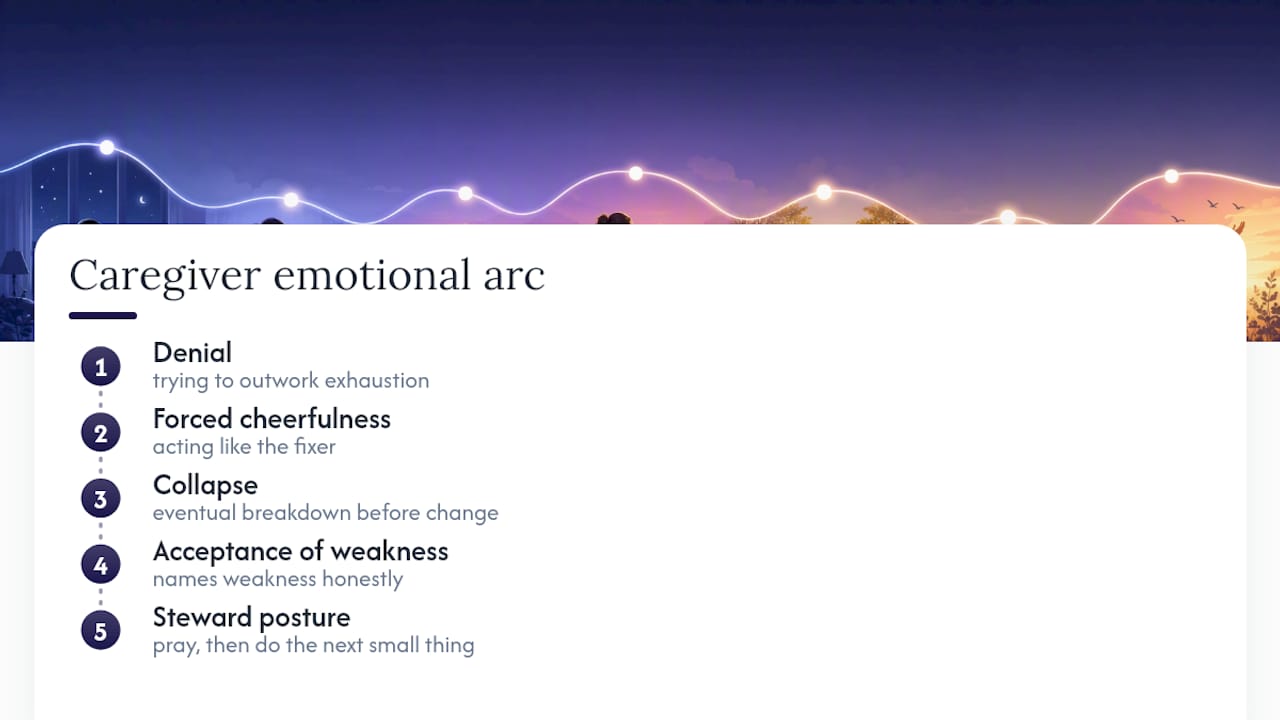
Caregiving strips away the illusion that you can out work exhaustion. I’ve watched people cycle through denial, forced cheerfulness, and eventual collapse before they finally let a verse like 2 Corinthians 12:9 do what it actually says: let grace, not grit, carry the load. The turning point isn’t usually a dramatic moment. It’s a quiet shift from acting like the fixer to acting like a steward who prays and then does the next small thing.
This selection leans on verses that name weakness honestly instead of skipping past it to a tidy resolution. That honesty is what makes them usable at 2 a.m., not just on a good Sunday. If this list resonated, Some topical collections go deeper into related territory such as patience, trust, and endurance, for whenever you need the next verse.
— Nkosi
Find More Scripture for the Season You’re In
Some resources organize verses by the exact emotional and spiritual need behind them, which means you don’t have to guess which chapter might help. Instead of scrolling through an entire Bible looking for something that fits your Tuesday, you can go straight to a themed collection built for it.

Beyond caregiving moments, some libraries cover trust, patience, encouragement, and strength, each with full verse text and short context to help understand what a passage actually meant before relying on it. If today’s need is patience with a difficult diagnosis or trust when the outcome is unclear, the full topical index is the fastest way to find it. Save a few themed lists now so you have them ready before the next hard night arrives.
Sources
FAQ
What is an uplifting quote that can inspire caregivers?
Isaiah 40:31, “those who wait on the Lord shall renew their strength; they shall mount up with wings like eagles,” is one of the most-cited lines for caregivers needing renewed endurance.
What is a short and powerful prayer for caregivers?
A common short prayer is built from 1 Peter 5:7: “I’m handing you this worry because you actually care about what happens next.” It takes seconds to say and directly applies the verse.
What is a good devotional practice for caregivers today?
A three-verse nightly reset, one verse for gratitude, one for release, one for tomorrow’s strength, works well because it fits into a few minutes before sleep and doesn’t require a full devotional book.
What Bible verses encourage healthcare workers and caregivers facing exhaustion?
Matthew 11:28 to 30 and Isaiah 40:29 to 31 are the two most commonly cited passages, since both name weariness directly before promising rest or renewed strength. A strength-focused collection expands on related passages for ongoing endurance.