Start Your Morning with 20 Bible Verses and One Breath Prayer
Start with one verse, not twenty. Pick Philippians 4:6–7 for an anxious morning or Psalm 5:3 for a fresh start, read it once, and speak it back to God before you touch your phone. Below you’ll find a curated set of morning scriptures grouped by what you’re feeling, each with a short prayer or declaration you can use right now. Biblemanna organizes verses this way for a reason: the right word finds you faster when it’s sorted by need, not just by book and chapter.
TL;DR:
- Choosing a verse that matches your current emotional state—such as anxiety, decision-making, or gratitude—helps internalize the message effectively.
- Memorizing and repeating a single verse over several days strengthens retention and allows it to surface naturally in daily situations.
- Incorporating the verse into a brief ritual, like speaking aloud or journaling, deepens its impact beyond passive reading.
- Prioritizing the timing of morning scripture, before the day’s distractions, amplifies its ability to set a calm and focused tone.
- Using themed collections and a random verse generator can help find appropriate scripture precisely when you need it most.
Table of Contents
- Bible Verses for Morning: A Curated List by Theme
- How Do You Choose the Right Verse for Your Morning Routine?
- Devotional Practices That Make a Morning Verse Stick
- Why These Verses: Biblemanna’s Approach to Morning Scripture
- Why Christians Have Prayed Scripture at Dawn for Centuries
- How to Actually Memorize a Morning Verse
- Making a Morning Verse Personal in Prayer or Journaling
- Bringing Morning Scripture Into Family or Group Devotions
- Meeting God Before the Day Gets Loud
- Find More Morning Scripture on Biblemanna
- Sources
- FAQ
Bible Verses for Morning: A Curated List by Theme
These twenty verses are grouped by the emotional state you’re likely waking up with. Read the reference, say the short prayer aloud, and move on with your day carrying that one line.
For anxiety and a racing mind:
- Philippians 4:6–7 — “Do not be anxious about anything, but in every situation, by prayer and petition, with thanksgiving, present your requests to God.” Say aloud: “Lord, I hand you what I’m carrying. Guard my heart today.” This is the most recommended morning passage for anxiety because it pairs the instruction (pray, don’t spiral) with the promise (peace that guards you).
- Isaiah 43:2 — “When you pass through the waters, I will be with you.” Breath prayer: inhale “You are with me,” exhale “I am not alone.” Use this on mornings before something hard.
- Psalm 34:18 — “The Lord is close to the brokenhearted and saves those who are crushed in spirit.” Journal one line: name what’s crushing you, then write this verse underneath it.
- Matthew 11:28 — “Come to me, all you who are weary and burdened, and I will give you rest.” Speak it as an invitation, not just a fact: “I’m coming to you tired. Meet me here.”
- Psalm 143:8 — “Let the morning bring me word of your unfailing love, for I have put my trust in you.” A natural first line to pray before you get out of bed.
For decisions and trust:
- Proverbs 3:5–6 — “Trust in the Lord with all your heart… and he will make your paths straight.” Memorize this one first; it’s short enough to recall mid-decision.
- Psalm 32:8 — “I will instruct you and teach you in the way you should go.” Say it while you plan your day, before the calendar takes over.
- Jeremiah 29:11 — “‘For I know the plans I have for you,’ declares the Lord.” Write it on a sticky note if today feels uncertain.
For strength and courage:
- Joshua 1:9 — “Be strong and courageous… for the Lord your God will be with you wherever you go.” Declare it standing up, out loud, before you leave the house.
- Isaiah 40:31 — “Those who hope in the Lord will renew their strength.” Pair with a deep breath: inhale on “renew,” exhale on “strength.”
- Philippians 4:13 — “I can do all this through him who gives me strength.” A quick declaration for a demanding day ahead.
- 2 Timothy 1:7 — “God has not given us a spirit of fear, but of power, love, and self-discipline.” Speak it if today’s task feels bigger than you.
For gratitude and joy:
- Psalm 118:24 — “This is the day the Lord has made; let us rejoice and be glad in it.” Say it while your coffee brews.
- Lamentations 3:22–23 — “Because of the Lord’s great love we are not consumed… his mercies are new every morning.” The verse most cited for the phrase “new every morning,” and worth memorizing word for word.
- Psalm 30:5 — “Weeping may stay for the night, but rejoicing comes in the morning.” Read this one on the mornings after a hard night.
- 1 Chronicles 16:11 — “Look to the Lord and his strength; seek his face always.” A one-line reminder to keep gratitude first, not last.
For guidance and a fresh direction:
- Psalm 5:3 — “In the morning, Lord, you hear my voice; in the morning I lay my requests before you and wait in expectation.” A verse built for this exact moment; pray it before you do anything else.
- Psalm 25:4–5 — “Show me your ways, Lord, teach me your paths.” Journal what direction you need today, then pray this over it.
- Colossians 3:23 — “Whatever you do, work at it with all your heart, as working for the Lord.” Speak it before work or school starts.
- Psalm 90:14 — “Satisfy us in the morning with your unfailing love, that we may sing for joy.” Close your reading time with this as a benediction.
Devotional writers have long paired lists like this with a short declaration or breath prayer so the verse doesn’t stay on the page. That’s the whole point of reading in the morning: the words move with you into the day.
How Do You Choose the Right Verse for Your Morning Routine?
Twenty verses is a lot to hold at once. Pick one and stay with it.
- Name the emotion first. Are you anxious, tired, grateful, or just directionless? That answer points you to a category above faster than scanning the whole list.
- Check your available time. If you have ninety seconds, pick a one-line verse like Psalm 118:24. If you have ten minutes, choose something with more to unpack, like Philippians 4:6–7.
- Decide what you actually need today. Comfort, courage, or direction are different requests, and the right verse changes depending on which one you’re asking for.
- Commit to one verse for a full week instead of switching daily. Meditating on a single verse over several days builds a familiarity that a new verse every morning never gets the chance to reach.
A workable short routine: read the verse once, speak it aloud a second time, write one sentence about what it means for your specific day, then pray for three slow breaths before you move on.
Pro Tip: Keep the same verse taped somewhere you’ll see it all week, your bathroom mirror or your car’s dashboard, so it keeps surfacing even after your morning reading time ends.
Devotional Practices That Make a Morning Verse Stick
Reading silently is fine. Speaking the verse changes something. Hearing scripture in your own voice helps you internalize a promise and take ownership of it in a way silent reading rarely does. Try one of these three formats depending on how much morning you have left:
- 30-second declaration: Say the verse once, then restate it as a personal claim (“God’s peace guards my heart today,” not “God’s peace guards hearts”).
- 60-second breath prayer: Inhale on the first half of the verse, exhale on the second half. Repeat three times.
- Two-minute journaling reflection: Write the verse, then one sentence on what it’s asking you to release or trust today.
Practitioners who teach breath prayer as a discipline point out that pairing a verse with confession or breath moves it from intellectual agreement into something you actually feel. That shift, from knowing a verse to living inside it for five minutes, is the entire reason morning scripture works better than a random scroll through an app.
Pro Tip: Put your chosen verse where your eyes land automatically: your phone lock screen, the mirror, or a card taped to the coffee maker. You’ll re-read it without trying.
Why These Verses: Biblemanna’s Approach to Morning Scripture
Biblemanna sorts scripture into 50 themes covering emotions, relationships, and life events, which is why a search for “morning verses” here surfaces exactly the categories above instead of a random chapter dump. Each verse comes with context so you understand not just what it says, but why it fits a specific morning.
- Explore Bible verses about peace if anxious mornings are a recurring pattern rather than a one-off.
- Browse Bible verses about trusting God for decision-heavy seasons.
This piece was reported by Nkosi, a contributor focused on devotional practice and scripture application.
Why Christians Have Prayed Scripture at Dawn for Centuries
Morning devotion isn’t a modern productivity hack borrowed from self-help culture. It traces back through monastic prayer hours, where communities gathered before sunrise for what they called Lauds, prayer specifically tied to daybreak and rooted in Psalms of praise. The instinct behind it never changed: meet God before the day gets its hooks into you.
Lamentations 3:22–23 gives the theological reason this matters. Mercy that’s “new every morning” implies yesterday’s failures don’t carry over. Each sunrise is a genuine reset, not a metaphorical one. That’s a different claim than “start fresh” self-talk; it’s a statement about God’s character, not your willpower.
The deeper aim of morning scripture is to anchor your trust in who God is before the day’s noise reshapes your heart around whatever’s loudest, an inbox, a headline, a hard conversation. Reading first thing isn’t about checking a spiritual box. It’s about deciding which voice gets to define your day before the competing ones show up.
That’s why the verse itself matters less than the timing. Almost any true word about God’s character, read before the noise starts, does the same quiet work.
How to Actually Memorize a Morning Verse
Most people try to memorize a verse by staring at it, which barely works. Try this instead.
Read the verse aloud five times in a row, same tone each time. Repetition with your voice engages memory differently than silent reading. Then say it without looking, filling in gaps from memory rather than glancing back immediately; the small struggle to recall is what cements it.
Break longer verses into two chunks. Proverbs 3:5–6 splits naturally: “Trust in the Lord with all your heart and lean not on your own understanding” is chunk one, “in all your ways submit to him, and he will make your paths straight” is chunk two. Master each half before joining them.
Attach the verse to a fixed moment in your existing routine, brushing your teeth, waiting for coffee, the drive to work. Your brain links the verse to that trigger, so the action itself becomes a recall cue days later.
Write it by hand once. Typing doesn’t create the same muscle memory as handwriting a verse onto an index card you can carry.
Review on a schedule that fights forgetting: same day, next day, three days later, one week later. Most people give up after one good recitation and lose the verse within 48 hours simply because they never test it a second time.

Making a Morning Verse Personal in Prayer or Journaling
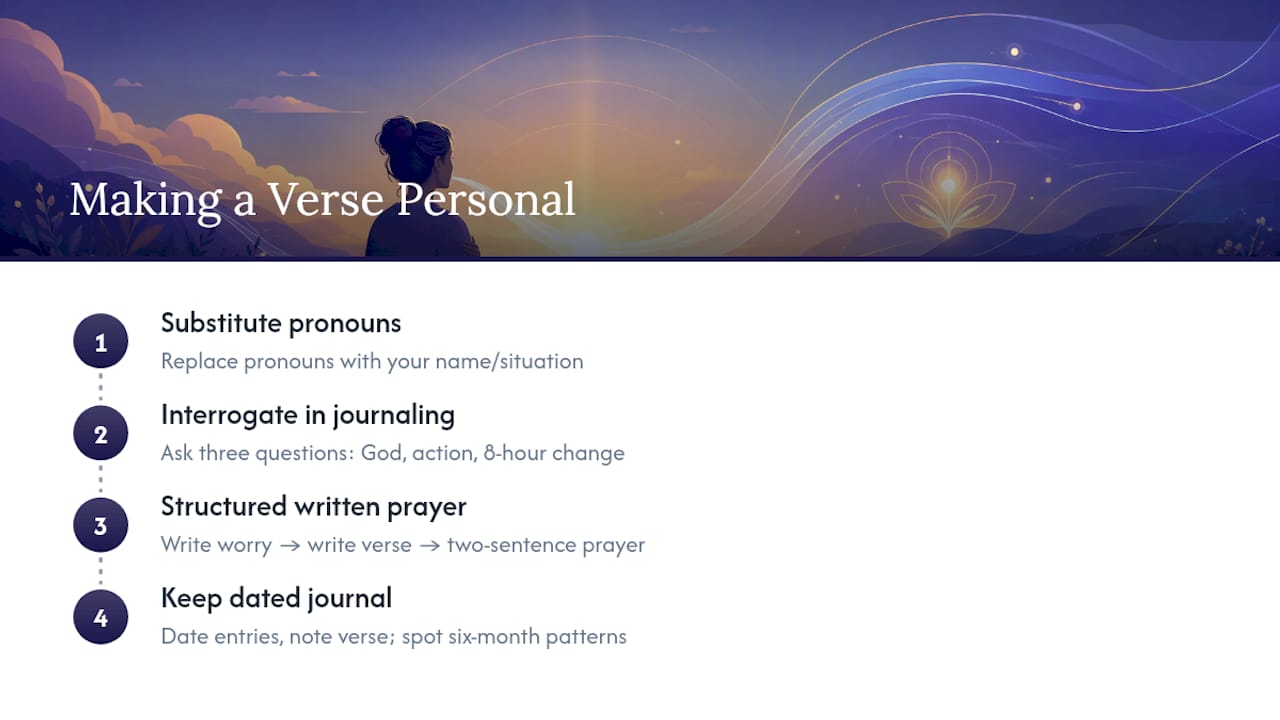
A verse read generically stays generic. The move that makes scripture feel personal is substitution: replace the pronouns with your own name or situation. Psalm 34:18 becomes “The Lord is close to me, brokenhearted this morning over [name the actual thing], and he is saving me from being crushed.”
In journaling, don’t just copy the verse; interrogate it. Ask three questions on paper: What is this verse telling me about God? What is it asking me to do or believe today? What would change if I actually lived like this were true for the next eight hours? Those three questions turn a copied sentence into an honest conversation.
Turning a verse into a written prayer works especially well with Philippians 4:6–7. Write out the actual anxious thought first, in full, without editing it. Then write the verse underneath. Then write a two-sentence prayer that names the specific worry and asks for the specific peace the verse promises. That structure, worry, word, prayer, keeps the exercise from turning into vague spiritual language.
If you keep a morning journal, date each entry and note which verse you used. Six months later, that log becomes its own kind of testimony: you’ll see which verses you returned to again and again during hard seasons, and that pattern often reveals more about what you were carrying than you noticed at the time.
Bringing Morning Scripture Into Family or Group Devotions
A verse that works alone at 6 a.m. needs slight adjustment around a breakfast table with kids or in a small group text thread. The mechanics change even though the goal doesn’t.
With young children, shorten the verse and add a physical action. Psalm 118:24 pairs naturally with clapping or a simple call and response: one parent says “This is the day the Lord has made,” the kids answer “let us rejoice and be glad in it.” The rhythm sticks faster than the explanation does.
With a spouse or roommate, try reading the same verse separately in the morning and then trading one sentence about it over dinner. That small check in does more for shared spiritual life than a longer joint devotional most couples never actually keep up.
For a small group or accountability text thread, send one verse each Monday, the same verse the whole week, and ask everyone to reply once with how it showed up in their day. This mirrors the one-verse-per-week approach that builds deeper personal application, just done together instead of alone.
The practical rule across every version: shorter, spoken aloud, and repeated beats long and read once in silence, whether you’re doing this solo or with four other people around a table.
Meeting God Before the Day Gets Loud
Most mornings I don’t get an hour of quiet. What I’ve found works is smaller than that: one verse, said out loud once, before the phone comes off the nightstand. Some weeks that’s Psalm 5:3, because waiting in expectation is exactly the posture I need before an uncertain day. Other weeks it’s Lamentations 3:22–23, because I need the reminder that yesterday’s failure doesn’t carry forward.
The goal isn’t a perfect streak. It’s showing up with the same verse enough mornings in a row that it starts showing up in you, uninvited, at 2 p.m. when you need it most.
— Nkosi
Find More Morning Scripture on Biblemanna
Twenty verses is a strong start, but some mornings call for something more specific than what fits in a general list. Biblemanna’s Bible verses by topic collection sorts scripture into 50 themes, so instead of scrolling through an entire book of Psalms looking for the right words, you go straight to the category your morning actually needs, whether that’s strength, faith, or prayer.
Each verse page includes context and background, not just the reference, so you understand why a passage fits your situation instead of guessing. If you’re not sure where to start today, the free random verse generator picks one for you in seconds, no scrolling required. Open the tool now, generate today’s verse, and read it before you check anything else.
Sources
- 7 Bible verses to pray first thing in the morning — Guideposts
- Philippians 4:6–7 — God’s antidote to anxiety (sermon)
- Lamentations 3:23 — Bible Gateway
- Meditation on the Scriptures — The Gospel Coalition
FAQ
What Is a Good Morning Bible Verse for Today?
Philippians 4:6–7 and Psalm 5:3 are two of the most recommended verses for a general morning, one for calming anxiety and one for setting a posture of expectant prayer before the day starts.
What Is a Beautiful Verse to Start the Day?
Lamentations 3:22–23 is widely considered one of the most beautiful morning verses because it frames each sunrise as new mercy, not a continuation of yesterday’s failures.
How Do I Find My Bible Verse for This Morning?
Match the verse to how you actually feel, anxious, tired, grateful, or unsure, then choose from a themed list; Biblemanna’s random verse generator also picks one instantly if you’d rather not choose.
What Generation Will Not Pass Away?
That phrase comes from Matthew 24:34 and Mark 13:30, where Jesus says “this generation will not pass away” in reference to the events he had just described; it’s a separate topic from morning devotional verses and interpretations vary among biblical scholars.
Should I Read a Different Verse Every Morning or Repeat the Same One?
Repeating one verse for a full week builds deeper familiarity than switching daily, since sustained meditation on a single truth shapes your thinking more than a new verse every morning.