Where to Read Bible Verses in Italian Right Now

You can read Bible verses in Italian online right now. For Catholic liturgy, open CEI 2008. For Protestant or historical study, try Nuova Riveduta or the Diodati 1885. For easy, everyday reading or language learning, look for a lingua corrente (contemporary-language) edition. Each serves a different reader, and picking the wrong one is the main reason people bounce off Italian scripture after two verses.
Here’s where to click first:
- Official CEI text: the Conferenza Episcopale Italiana’s own site for liturgical accuracy and translation notes.
- Multi-version readers: catalogs that list Diodati, Nuova Riveduta, CEI, and Riveduta variants side by side for app-based reading and offline downloads.
Open any of these and search “Giovanni 3:16” to see John 3:16 rendered in Italian within seconds.
Key Takeaways
Picking the right Italian Bible translation for your purpose, and knowing where to search by topic instead of by chapter, gets you to relevant scripture faster than browsing alone.
| Point | Details |
|---|---|
| Match translation to purpose | Use CEI 2008 for liturgy, Nuova Riveduta or Diodati for Protestant or historical study, ICL for easy reading. |
| Compare versions side by side | Parallel reading of a modern and older edition decodes archaic Italian phrasing quickly. |
| Learn through repetition | Reading the same verse across translations, paired with an English equivalent, builds vocabulary faster. |
| Idioms trace to scripture | Everyday phrases like “una manna dal cielo” originate in biblical passages and aid conversational fluency. |
| Search by topic when stuck | Biblemanna’s topical collections surface relevant Italian-friendly verses by theme, not just by book and chapter. |
Table of Contents
- Major Bible Passages in Italian: Which Translation Fits Which Purpose
- How to Read Italian Bible Verses Online: Tools Worth Using
- Sample Bible Verses in Italian You Can Use Today
- Choosing an Italian Bible Translation: A Quick Checklist
- Finding Italian Verses by Topic, Not Just by Chapter
- What Actually Matters When Reading Scripture in Italian
- Read Italian Verses by Topic With Biblemanna
- Sources
- FAQ
Major Bible Passages in Italian: Which Translation Fits Which Purpose
Italian has more Bible translations in active circulation than most non-native readers expect, and they aren’t interchangeable. CEI 2008 is the modern Catholic standard, revised by the Conferenza Episcopale Italiana against original-language manuscripts to balance accuracy with readable, contemporary Italian. The CEI’s own editorial process treats translation choice as dependent on the reader’s intent, which is exactly the right way to think about it.
Nuova Riveduta sits on the Riveduta lineage and is the go-to for most Evangelical and Protestant Italian readers. It keeps language accessible while staying close to the original wording, which makes it a solid middle ground between literalness and readability.
The Diodati 1885 is older, denser, and closer to a King James feel. Historical phrasing means it rewards patient readers doing comparative or academic study more than someone skimming for comfort.
Modern ICL (In Lingua Corrente) editions strip out archaic syntax entirely. If Italian isn’t your first language, or you just want scripture that reads like a conversation, this is the version that won’t fight you.
Most of these texts, including public-domain Riveduta and Diodati editions, are freely available online. CEI 2008 carries its own copyright terms through the Italian bishops’ conference, so always read it on the official CEI site rather than an unverified reprint.
Pro Tip: If you’re torn between two versions, open the same verse in both. Five seconds of comparison tells you more about tone and difficulty than any description ever will.
How to Read Italian Bible Verses Online: Tools Worth Using
Reading scripture in a second language gets easier once you stop treating it like a plain text file and start using the features built for it.
- Start with the official source. The CEI’s site pairs the 2008 text with translation notes explaining why a phrase was rendered a certain way, something a plain PDF never gives you.
- Use parallel-view comparison. Placing a modern edition next to an older one, like CEI 2008 beside Diodati, decodes archaic syntax without breaking the narrative flow. This method works especially well when older phrasing obscures meaning that a modern rendering makes obvious.
- Try audio versions. Listening to Italian scripture read aloud reinforces pronunciation and rhythm, useful whether you’re studying devotionally or learning the language.
- Search by reference or theme. Typing a reference like “Salmo 23:1” gets you the passage instantly; searching by topic, comfort, guidance, strength, works better when you don’t have a citation handy and just want relevant scripture fast.
- Check multi-version catalogs. Large Bible-hosting services list Diodati, Nuova Riveduta, CEI, and Riveduta variants together, so you can download whichever fits your device and reading habit.
Sample Bible Verses in Italian You Can Use Today
Short, memorable verses are the easiest entry point into Italian scripture, and they double as language-learning material. Here are a few worth knowing by heart:
- Giovanni 3:16: “Dio ha tanto amato il mondo…” — “For God so loved the world…”
- Filippesi 4:13: “Io posso ogni cosa in colui che mi fortifica.” — “I can do all things through him who strengthens me.”
- Salmo 23:1: “Il Signore è il mio pastore, nulla mi manca.” — “The Lord is my shepherd, I lack nothing.”
- Padre Nostro (opening line): “Padre nostro che sei nei cieli…” — “Our Father who art in heaven…”
Reading the same verse across two or three translations is one of the most effective ways to pick up vocabulary, because repeated exposure to a familiar sentence in a new language sticks faster than random reading. Grammar and word order start to feel natural once you’ve seen the same passage rendered three different ways.
Statistic Callout: Language-learning practitioners specifically recommend pairing verses like Filippesi 4:13 with their English equivalents as a repetition tool, since short, emotionally resonant text is easier to retain than a random vocabulary list.

Two idioms worth knowing: “una manna dal cielo” (“manna from heaven,” meaning an unexpected blessing) and “rimasto di sale” (“turned to salt,” referring to Lot’s wife, meaning shocked speechless). Both trace directly to biblical passages that shaped everyday Italian speech.
Choosing an Italian Bible Translation: A Quick Checklist
You don’t need a theology degree to pick the right version. You need five quick answers.
- What’s your purpose? Liturgy, personal study, or language learning each point to a different translation.
- How readable does it need to be? Modern lingua corrente editions read like plain conversation; Diodati does not.
- How literal do you want it? Word-for-word accuracy (Nuova Riveduta, Diodati) versus thought-for-thought clarity (CEI 2008, ICL) is the real trade-off.
- Do you need notes or commentary? CEI 2008 includes editorial notes explaining translation decisions; many public-domain editions don’t.
- Is it freely accessible? Public-domain Riveduta and Diodati texts are easy to find; CEI 2008 should be read on its official platform.
One-sentence version: choose CEI 2008 for liturgy, an ICL/lingua corrente edition if you’re learning the language, and Nuova Riveduta or Diodati if you want a Protestant or historically grounded reading.
Pro Tip: Bookmark two versions, not one. A modern and a traditional edition side by side turns any confusing verse into a two-minute comparison instead of a dead end.
Finding Italian Verses by Topic, Not Just by Chapter
Chapter-by-chapter reading works when you already know what you’re looking for. It falls short when you’re searching for comfort, guidance, or encouragement and don’t have a reference handy. That’s where a topical approach earns its keep.
Biblemanna organizes over 50 topics spanning emotions, relationships, and major life events, so instead of scanning entire books, you land directly on verses that match what you’re actually feeling or facing. Every entry comes with context explaining what the verse meant originally and how it applies now, which matters more in translation, where a single word choice can shift the whole meaning of a passage.
This complements official translations rather than replacing them. Use Biblemanna’s Italian landing page to browse Italian-specific resources by theme, or explore the full topical verse library when you want scripture organized by what you’re going through rather than where it falls in the canon. Pair that with the free tools, including a random verse generator, for quick, low-effort exploration.
What Actually Matters When Reading Scripture in Italian
Most guides to Italian Bible verses get stuck relitigating translation history, arguing Diodati’s merits against CEI’s like it’s a scholarly debate you need to settle before reading a single verse. It isn’t. The reader searching for Italian scripture right now usually wants one of two things: something they can understand today, or something accurate enough to trust for study. Pick based on that, not on which translation has the longer pedigree.
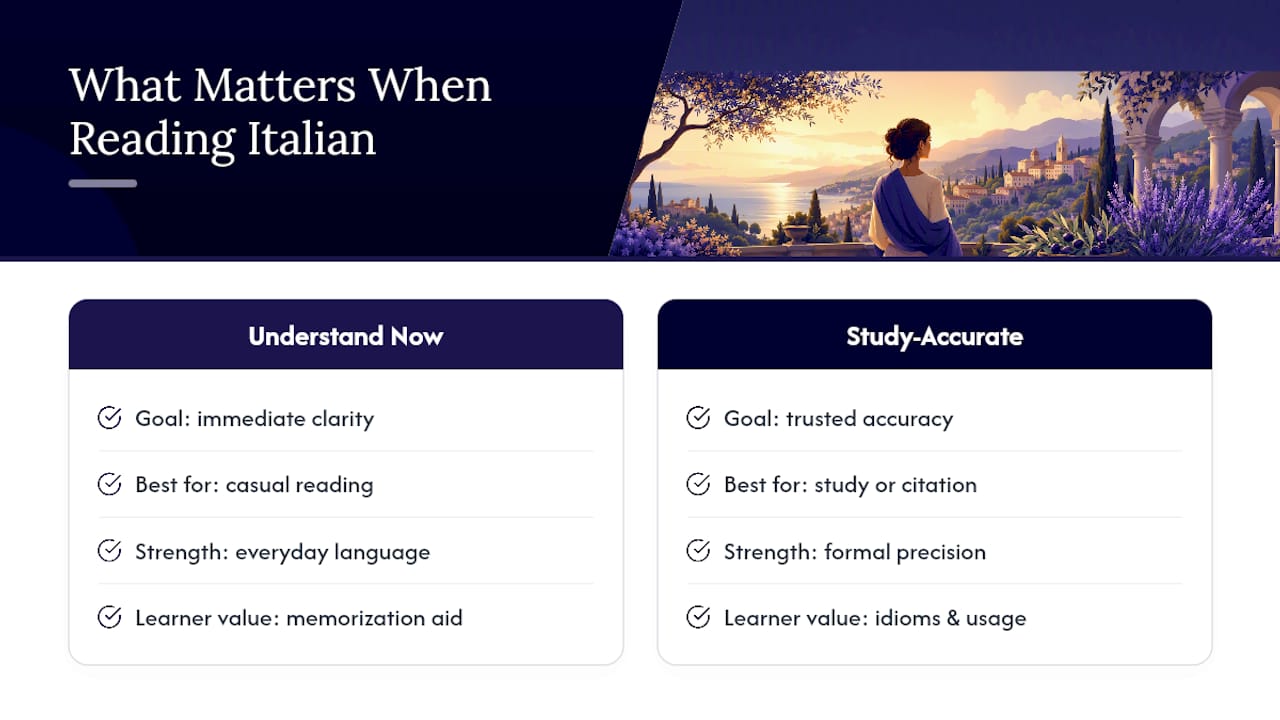
The bigger gap in most advice is language learning. Verses work as memorization tools precisely because they’re short, emotionally weighted, and easy to repeat, yet most sites treat that as a footnote instead of the main draw. Filippesi 4:13 sticks in a learner’s memory faster than any vocabulary list, and the idioms tracing back to scripture, “una manna dal cielo” among them, hand you cultural fluency most textbooks skip entirely.
If there’s one thing to prioritize, it’s this: stop hunting chapter by chapter for what you need. Search by theme first, then read the full passage once you’ve found the right one.
— Nkosi
Read Italian Verses by Topic With Biblemanna
If you’ve been flipping through chapters hoping to stumble on the right verse, Biblemanna skips that step entirely. Instead of searching book by book, you search by what you’re actually facing, comfort, strength, faith, encouragement, and land on verses matched to that need in seconds.
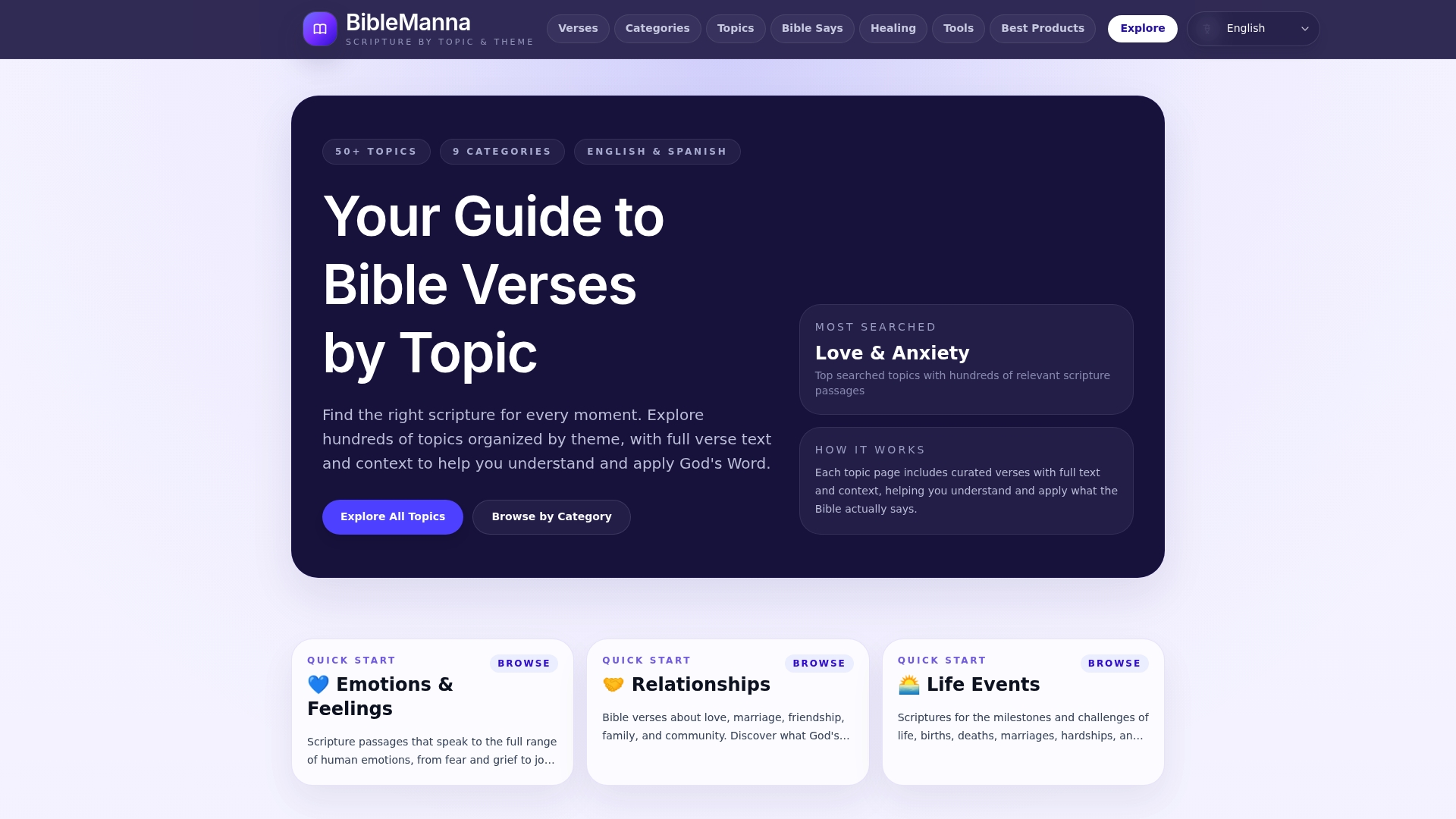
Every entry includes context explaining what the passage meant originally, which matters even more when you’re reading in translation and word choice shifts meaning. Biblemanna’s library covers over 50 topics spanning emotions, relationships, and life events, so whether you’re studying, teaching, or just need something to hold onto today, there’s a curated starting point instead of a blank search bar.
Start with the topical verse collection and search a theme that matches what you need right now, or browse verses about strength if today calls for exactly that.
Sources
- La Bibbia - leggila dal sito ufficiale CEI
- Parola di Dio: 13 common Italian expressions taken from the Bible — I Learn Italian
- Bible
- Learn Italian through the Bible — Substack
FAQ
What Are the Major Italian Translations of the Bible?
The most widely used are CEI 2008 (Catholic liturgical standard), Nuova Riveduta and the older Riveduta (Protestant/Evangelical), Diodati 1885 (historical, literal), and modern ICL/lingua corrente editions for simplified reading.
Is Luke 1:37 a Bible Verse?
Yes. In Italian it reads “Poiché nessuna parola di Dio rimarrà inadempiuta,” meaning “For no word from God will ever fail,” a verse commonly cited for encouragement and faith.
What Are the Top Bible Quotes People Search For?
Frequently searched verses include Giovanni 3:16, Filippesi 4:13, Salmo 23:1, and the opening line of the Padre Nostro, all short enough to memorize and versatile enough for study or devotional use.
What Are Some Italian Sayings That Come From the Bible?
Common examples include “una manna dal cielo” (an unexpected blessing) and “rimasto di sale” (shocked speechless), both tracing directly to biblical narratives that shaped everyday Italian speech.
Where Can I Find Italian Bible Verses Organized by Topic?
Biblemanna’s Italian landing page and its topical verse library organize scripture by theme rather than by chapter, useful when you need a verse for a specific situation rather than a full reading plan.