5 Bible Tested Signs You Are Born Again, and Where Traditions Differ
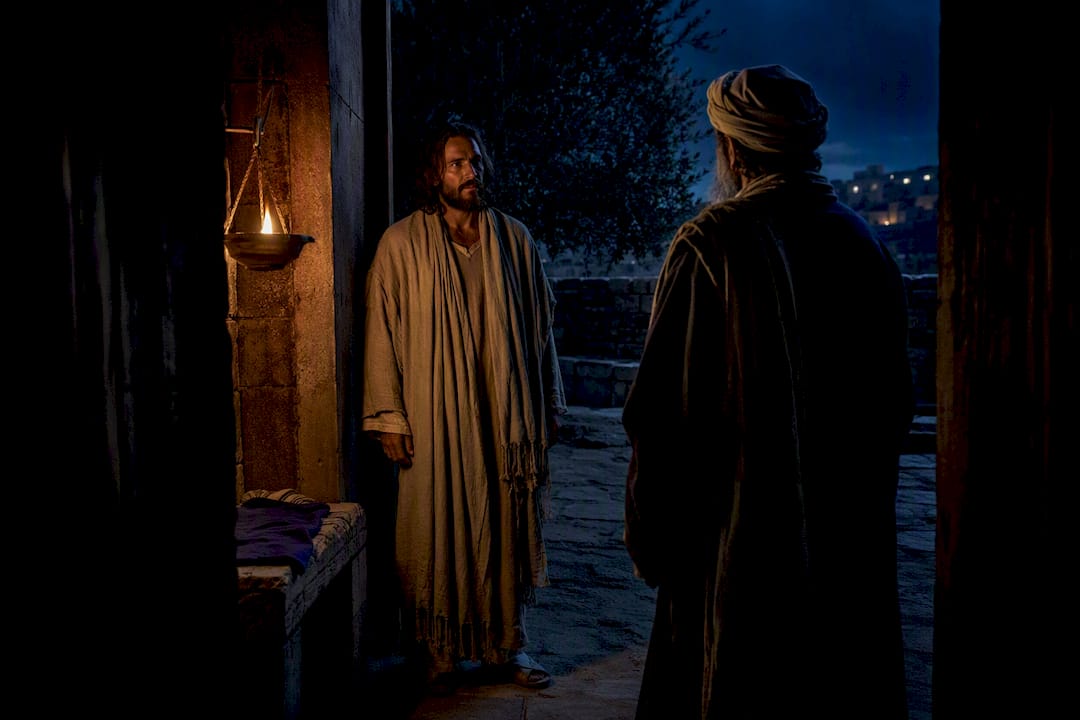
To be born again means to receive a spiritual rebirth from God, a renewal of the human spirit that happens when someone puts their faith in Jesus Christ. The term comes straight from John 3, where Jesus tells a religious leader named Nicodemus that entering God’s kingdom requires more than moral effort; it requires a new kind of life altogether. What follows is the biblical case for that claim, plus where Christian traditions agree and where they part ways on the details.
TL;DR:
- The phrase “born again” involves both being born from above by God’s Spirit and experiencing a renewal that transforms the heart through faith.
- Different traditions emphasize either a personal conversion moment or baptism as the moment of new birth, but all agree it is God’s work, not achieved by humans.
- Evidence of being born again includes lasting repentance, love for others, spiritual fruit, and a growing faith over time, not instant feelings.
- Many misunderstand the concept by expecting immediate change or relying solely on emotional or behavioral proof, rather than recognizing it as an ongoing process.
- Spiritual rebirth begins by acknowledging sin, trusting in Jesus, and participating in community and Scripture to foster growth over a lifetime.
Table of Contents
- What Does John 3 Actually Say About Being Born Again?
- How Do Different Christian Traditions Interpret Being Born Again?
- How Can You Tell if You’ve Been Born Again?
- What Do People Get Wrong About Being Born Again?
- How Do You Actually Become Born Again?
- Where Can You Study the New Birth Further?
- Why the New Birth Gets Oversimplified
- Start Studying the New Birth in Scripture Today
- Sources
- FAQ
What Does John 3 Actually Say About Being Born Again?
Jesus makes this claim to Nicodemus, a Pharisee and a respected teacher, in John 3:1–21. Nicodemus comes to Jesus at night, curious but cautious, and Jesus cuts straight past small talk: “Truly, truly, I say to you, unless one is born again, he cannot see the kingdom of God” (John 3:3). Nicodemus takes it literally and asks how a grown man can climb back into his mother’s womb. He’s not being dense. He’s reacting to a genuinely strange phrase.
That confusion is baked into the Greek. The word Jesus uses, ánōthen, can mean either “again” or “from above.” English translations have to pick one, and that single word explains most of the disagreement over what the phrase even implies. “Again” points to repetition, a second birth mirroring the first. “From above” points to origin, a birth that comes down from God rather than up from human effort. Both senses are almost certainly intended together, which is why the Wikipedia entry on the topic treats the ambiguity as a feature of the text rather than a translation problem to solve.
Jesus clarifies things a few verses later: this birth is “of water and the Spirit” (John 3:5), and it’s the Spirit, not human will or biology, that produces it. He compares the Spirit’s work to wind: you can’t see it directly, but you can see what it does. That’s the heart of the born again concept in religion — an invisible act of God with visible results.
Pro Tip: Read John 3:1–21 in one sitting instead of pulling verse 3 out on its own. The conversation only makes sense as a whole, and Nicodemus’s confusion mirrors the confusion a lot of readers bring to the passage today.
A handful of other New Testament passages back up and expand on what Jesus tells Nicodemus:
- 2 Corinthians 5:17 describes the born again person as a “new creation,” with the old life genuinely gone.
- Titus 3:5 credits the new birth to God’s mercy, not to good works, describing it as washing and renewal by the Holy Spirit.
- 1 Peter 1:3 ties the new birth to hope, calling it a rebirth “into a living hope” through Christ’s resurrection.
- John 1:12–13 connects being born again to becoming a child of God, a birth that comes “not of blood nor of the will of the flesh… but of God.”
Taken together, these passages form the backbone of the spiritual rebirth meaning: a Spirit-caused change that comes through faith, not from human effort. GotQuestions.org frames John 3 the same way, calling the new birth an act of God that grants new life to people who were spiritually dead. That’s a stronger claim than “self-improvement,” and it’s why the doctrine sits at the center of the salvation verses Christians return to again and again.
How Do Different Christian Traditions Interpret Being Born Again?
Every major tradition agrees the new birth is God’s work, not a human achievement. Where they split is on timing, mechanism, and how personal experience fits into the picture.
Evangelical, Baptist, and Pentecostal traditions typically describe being born again as a datable, personal event. Someone hears the gospel, repents, and trusts Christ, and that moment marks the new birth. This is the strand of born again Christianity most associated in popular culture with a “conversion experience,” often followed by public testimony and, later, baptism as an act of obedience rather than the moment of regeneration itself. Pentecostal communities frequently add an emphasis on the Spirit’s ongoing, felt presence after that initial moment.
Roman Catholic, Orthodox, and Anglican traditions generally locate the new birth in baptism itself, a position called baptismal regeneration. In this framing, the sacrament isn’t a symbol performed after conversion. It’s the means through which God actually accomplishes the new birth, particularly in infant baptism. The Wikipedia summary of the doctrine notes this split plainly: evangelical traditions tend to treat “born again” as a distinct experience, while historic sacramental churches locate it inside the sacrament.
Lutheran theology sits close to the sacramental camp. Lutherans hold that baptism, including infant baptism, is the ordinary means by which God works regeneration, while still affirming that faith must take hold personally as the person matures.
Methodist and Wesleyan theology offers a middle path that’s worth understanding on its own terms. John Wesley described the new birth as tied to justification but distinguished it from the process that follows: sanctification, the lifelong pursuit of holiness. In this view, being born again starts something rather than finishing it. It’s the doorway into a road toward what Wesley called Christian perfection, not a one-time event disconnected from everything after it.
So where’s the actual agreement? Every tradition covered here affirms that:
- The new birth is God’s action, not a human accomplishment
- Some form of spiritual renewal is necessary, not optional, for salvation
- Faith has to be personally exercised at some point, even where infant baptism is practiced
The disagreement is almost entirely about when and how that renewal happens, particularly around the role and timing of baptism. It’s worth taking that nuance seriously rather than flattening it, since presenting both the conversion-focused and sacramental views fairly helps readers from different traditions recognize their common ground instead of assuming their own church’s language is the only biblical option.
How Can You Tell if You’ve Been Born Again?
Scripture doesn’t point to a feeling as the test. It points to fruit, direction, and pattern over time. Here’s what the New Testament actually flags as evidence of the new birth:
- New desires. A hunger for God’s word and a pull toward prayer that wasn’t there before.
- Repentance that sticks. Not a single tearful moment, but an ongoing turn away from patterns of sin.
- Visible fruit. Galatians 5 lists love, joy, peace, patience, and kindness as evidence the Spirit is present and working.
- Love for God and other believers. 1 John repeatedly ties genuine love for other Christians to genuine new life.
- A settled, growing faith in Christ, even when it coexists with doubt and struggle.
None of these show up instantly and completely. That’s the part people miss most often. The new birth is both an event and an ongoing process: the initial regeneration happens in a moment, but sanctification, the working out of that new life, unfolds over years. Justification, God’s declaration that you’re right with him, happens once. Sanctification is the slow, sometimes uneven transformation that follows it. Confusing the two leads people to either doubt a real conversion because they’re not instantly perfect, or to assume a single emotional peak was the whole story.
Pro Tip: If you’re evaluating your own spiritual life, look at the trajectory over the last two or three years, not just this week. Growth that’s slow but real beats a dramatic memory with no follow-through.
Practically, this means discipleship isn’t optional add-on content after conversion. It’s the visible outworking of what regeneration started.
What Do People Get Wrong About Being Born Again?
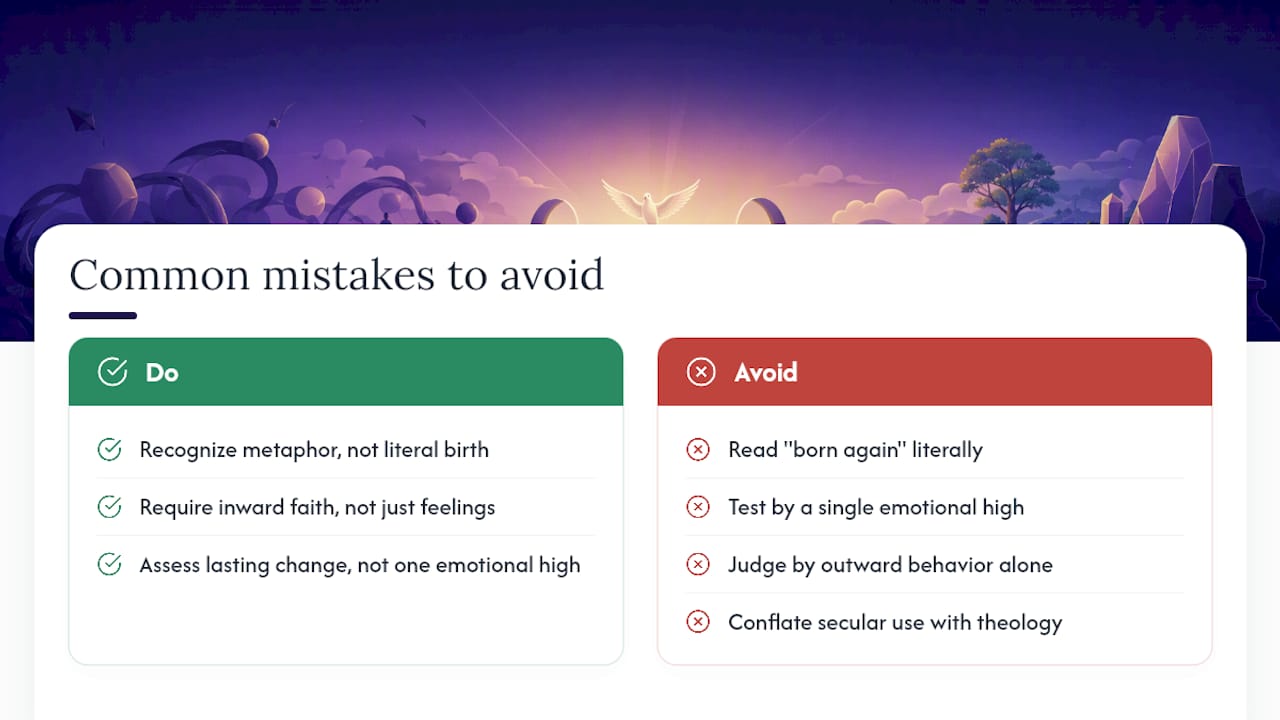
The most common mistake is Nicodemus’s own mistake: reading “born again” literally instead of catching the metaphor Jesus was using. John 3 isn’t describing biology. It’s describing a spiritual analogy, and translators have wrestled with how to render ánōthen precisely because English doesn’t have one word that captures both “again” and “from above” at once.
A second mistake is testing the new birth by a single emotional high. Real conversion often includes strong emotion, but emotion alone isn’t proof. Someone can cry at an altar and walk away unchanged, and someone else can come to faith quietly, almost undramatically, and be just as genuinely regenerated.
A third mistake is testing it by outward behavior alone, as if cleaning up habits equals spiritual rebirth. Behavior change without any inward faith is moralism, not the new birth Jesus describes.
It’s also worth knowing the phrase has drifted into everyday English outside religious contexts. Merriam-Webster and Cambridge Dictionary both define “born-again” in its religious sense, someone who has embraced evangelical Christianity through a personal experience, but both also note a broader, figurative use: someone newly and enthusiastically converted to any cause, like a “born-again vegan” or a “born-again fitness fanatic.” That secular borrowing shows how far the phrase has traveled from its origin, and it’s part of why the term became closely associated with 20th century evangelical renewal movements in popular media, well beyond its original theological context.
How Do You Actually Become Born Again?
If everything above lands as more than theory and you want to take a concrete step, Scripture keeps the path simple even if walking it isn’t always easy.
- Recognize the need. The starting point is honest acknowledgment of sin and the inability to fix your standing with God on your own.
- Repent and believe. Turn from sin and place your trust in Jesus Christ as Lord and Savior. A simple prayer of trust and repentance, something like admitting your need, believing Christ died and rose for you, and asking him to make you new, is a genuine starting point, not a magic formula.
- Get baptized. Traditions differ on exactly what baptism accomplishes and when it happens, so ask a local pastor how your specific church understands and practices it before assuming any one view.
- Read John and Romans. These two books lay out the gospel and its implications more directly than almost anywhere else in the New Testament.
- Find a Bible-teaching church and get connected. Isolation is the fastest way to stall out spiritually; mentors and discipleship groups exist precisely because growth wasn’t designed to happen alone.
Pro Tip: Don’t wait until you feel ready to talk to a pastor or join a small group. Understanding grows through relationship and repeated exposure to Scripture, not through private study alone, however thorough.
If you’re looking for a starting point in Scripture itself, curated collections like Bible verses about salvation group the most relevant passages together with context, which saves you from hunting through a concordance one reference at a time.
Where Can You Study the New Birth Further?
Some websites organize Scripture by theme to ensure that questions like this one don’t dead-end at a single verse. The John 3:16 page walks through the verse most people already half-know, with background on its context inside the wider Nicodemus conversation. The salvation verse collection gathers supporting passages, including 2 Corinthians 5:17 and Titus 3:5, in one place instead of scattered across separate lookups.
For readers who want to test their grasp of the material, the Bible quiz tool turns study into active recall rather than passive reading. And the broader topical verse library exists for the moments after this one, when a new question about faith, doubt, or growth sends you looking for Scripture again. Curated organization like this cuts the time between having a question and finding the passage that actually addresses it, which matters whether you’re preparing a sermon or just trying to understand your own faith better.
Why the New Birth Gets Oversimplified
Most explanations of being born again stop at the conversion moment and treat everything after it as optional extra credit. That’s backwards. The new birth is the start of a lifelong relationship, not the finish line, and treating it as a checkbox does real damage to people who expect instant, complete transformation and then feel like failures when growth turns out to be slow and uneven.
The traditions that emphasize baptism and sacrament aren’t wrong to take the physical, communal side of faith seriously. The traditions that emphasize personal decision aren’t wrong to insist that faith has to be genuinely yours, not inherited by default. Both are guarding something real. What I’d push back on is the instinct to pick a side and dismiss the other, when Scripture itself holds both the decisive moment and the gradual unfolding in tension.
If you’re wrestling with whether your own faith is “real,” the answer usually isn’t found by replaying an old emotional memory. It’s found by reading Scripture again, showing up in a church community, and letting people who know you well ask you hard questions. That’s uncomfortable advice, but it’s the honest one.
— Nkosi
Start Studying the New Birth in Scripture Today
Some resources organize Scripture by theme instead of leaving readers to guess which book or verse addresses what they’re actually wrestling with, which matters most when a question like this one leads to a dozen more.
If John 3 raised more questions than it answered, that’s normal. The topical library at Bible Verses by Topic groups related passages on salvation, faith, and new life with context attached, so you’re not left interpreting a single verse in isolation. Readers weighing formal theological study alongside personal Bible reading might also find Find Bible Schools useful for comparing accredited programs. Start with the topical collection, follow the cross-references it points to, and come back whenever the next question surfaces.
Sources
- Born again - Wikipedia
- Gotquestions
- BORN-AGAIN Definition & Meaning - Merriam-Webster
- born-again | Definition of born-again in English - Cambridge Dictionary
FAQ
What Is the Real Meaning of Being Born Again?
Being born again means undergoing a spiritual rebirth worked by the Holy Spirit, received through faith in Jesus Christ, as Jesus explains to Nicodemus in John 3. It describes an inward renewal, not a literal second physical birth.
What Does “Born Again” Mean in Hebrew?
“Born again” is a New Testament phrase written in Greek, not Hebrew, and comes from the term ánōthen, which carries the double sense of “again” and “from above.” There’s no direct Hebrew equivalent in the Old Testament, though prophets like Ezekiel describe a related idea using imagery of receiving a “new heart” and a new spirit.
How Do You Know You Are Born Again?
Scripture points to fruit over time rather than a single feeling: growing repentance, love for God and others, a hunger for Scripture, and the presence of the Spirit’s fruit described in Galatians 5. A one-time emotional experience isn’t the test; a changing life over months and years is.
What Does the Bible Say About Born Again?
The Bible teaches in John 3 that entering God’s kingdom requires a spiritual rebirth by the Holy Spirit, a theme echoed in 2 Corinthians 5:17, Titus 3:5, and 1 Peter 1:3. All four passages describe the same act: God granting genuinely new spiritual life to someone who trusts in Christ.