Ephesians 2:8-9 Meaning: Salvation by Grace Explained

“For by grace you have been saved through faith. And this is not your own doing; it is the gift of God, not a result of works, so that no one may boast.” The verdict is simple even though the theology runs deep: salvation is entirely God’s gift, given by grace and received through faith, never earned by human effort. That single point matters because it strips away boasting and gives believers a settled foundation for assurance instead of anxious performance. Paul, writing to the church at Ephesus, builds this claim on two Greek words worth knowing: charis (grace) and pistis (faith).
Key Takeaways
Ephesians 2:8-9 teaches that salvation is entirely God’s gift, given by grace and received through faith, with good works following as its fruit rather than its cause.
| Point | Details |
|---|---|
| Grace is the source | Charis means undeserved favor rooted in Christ’s death and resurrection, not a reward for effort. |
| Faith receives, it doesn’t earn | Pistis is the channel through which grace reaches the believer, not a contribution that merits salvation. |
| “This” points to the whole gift | The Greek pronoun’s grammar shows the entire grace-through-faith arrangement is God’s doing, not just faith or grace alone. |
| Works follow, they don’t precede | Ephesians 2:10 makes good works the purpose of salvation, resolving the apparent tension with James. |
| Biblemanna deepens the study | Biblemanna’s topical verse collections on grace and faith give readers more scripture and context to build on this passage. |
Table of Contents
- What Does Ephesians 2:8-9 Mean in Its Original Context?
- What Do ‘Grace,’ ‘Faith,’ and ‘Saved’ Actually Mean Here?
- How Do Good Works Fit If Salvation Isn’t Earned?
- How Should You Respond to Ephesians 2:8-9?
- A Pastoral Word on Grace and Guilt
- Where to Study Grace and Faith Further
- Sources
- FAQ
What Does Ephesians 2:8-9 Mean in Its Original Context?
Paul wrote Ephesians to a congregation made up of both Jewish and Gentile believers, a mixed audience that needed to hear it had no basis for spiritual pride on either side. The letter’s argument builds in stages, and 2:8-9 sits at a hinge point in that structure.
- Chapter 1: believers are described as blessed “in Christ,” chosen and adopted before the foundation of the world.
- Chapter 2:1-7: the audience is described as spiritually “dead” in sin, then “made alive” by God’s mercy, purely on his initiative.
- Chapter 2:8-9: this rescue is summarized as grace received through faith, apart from works.
- Chapter 3: Paul explains the “mystery” that Jew and Gentile now belong to one body.
- Chapters 4-6: practical instructions for how this rescued community should live.
Ephesians 2:8-9 restates the rescue language Paul just used in verses 1 through 7 and compresses it into one memorable claim, according to the Updated American Standard Version’s exegesis of the passage. It also sets up verse 10, which pivots the discussion toward the purpose of that rescue.
What Do ‘Grace,’ ‘Faith,’ and ‘Saved’ Actually Mean Here?
Getting this verse right depends on a few words Paul chose carefully, and each one closes off a common misreading.
Charis, translated “grace,” describes favor given to someone who has not earned it and cannot repay it. Paul does not use the word loosely. Throughout his letters, grace is tied directly to what Christ accomplished on the cross, not to a vague sense of divine kindness. The GotQuestions explanation of salvation by grace frames grace as the source of salvation and faith as the means, a distinction that keeps the two terms from blurring together.

“Saved” appears in the Greek perfect tense, best rendered “you have been saved” rather than “you are being saved.” That grammatical choice signals a completed action with ongoing results. Salvation, in Paul’s framing, is not a project still in progress; it is a settled status the believer already holds.
Pistis, faith, is trust that receives rather than a work that earns. It functions as the channel through which grace reaches the believer, not a contribution alongside grace.
The trickiest phrase in the verse is “and this is not your own doing.” In Greek, the demonstrative pronoun “this” is neuter, while both “grace” and “faith” are feminine nouns, so it cannot grammatically point to either word alone. The Third Millennium Ministries analysis of the Greek argues the pronoun refers to the entire preceding clause: the whole arrangement of grace-through-faith salvation is God’s gift, not a human achievement.
- Grace: undeserved favor, sourced in Christ’s death and resurrection.
- Faith: trust that receives, not merit that earns.
- Saved: a completed divine act with lasting effect.
- “This”: the whole salvation scheme, not an isolated term.
Pro Tip: If someone challenges you that faith itself is “your part” and therefore a kind of work, point them to the grammar. Paul’s pronoun does not isolate faith as your contribution; it labels the entire rescue, faith included, as gift.
How Do Good Works Fit If Salvation Isn’t Earned?
Ephesians 2:10 answers the question the previous two verses raise almost immediately: if works don’t save you, what are they for? “For we are his workmanship, created in Christ Jesus for good works, which God prepared beforehand, that we should walk in them.” Good works are the result of salvation, not the cause of it. Paul places the credit entirely with grace in verses 8-9, then explains in verse 10 that this same grace produces a life shaped for good works.

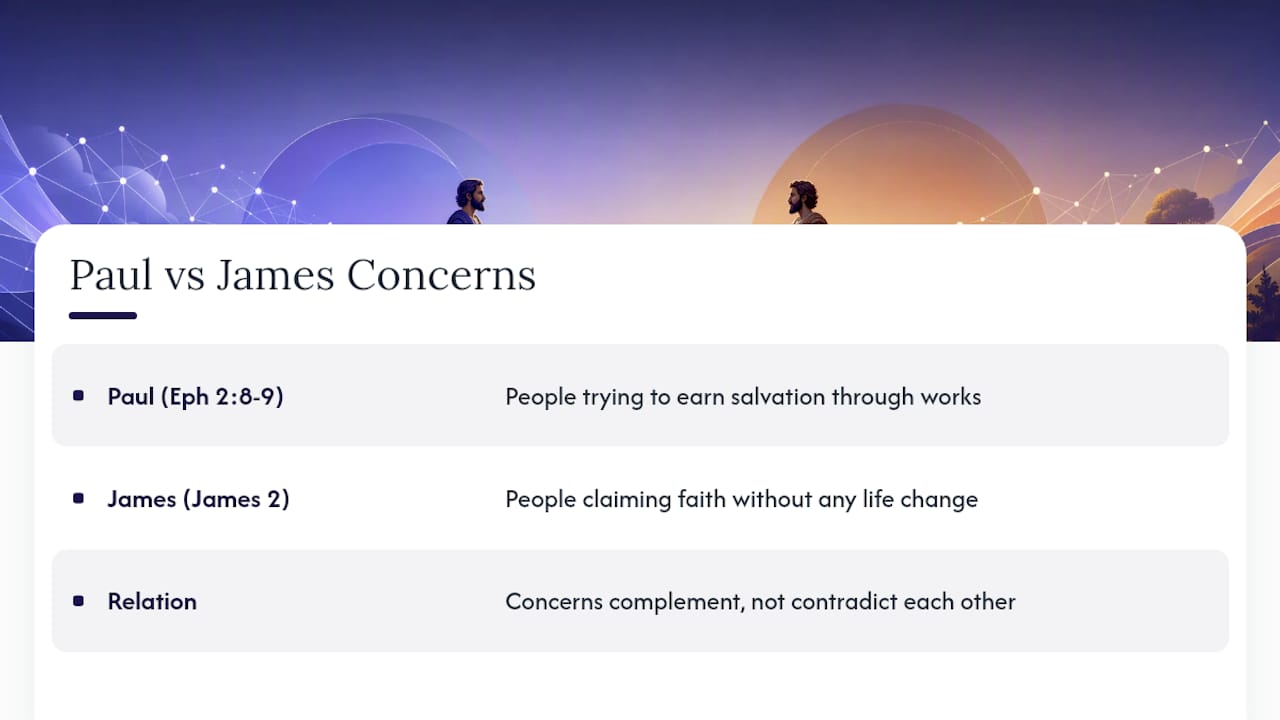
Paul makes a parallel case in Romans and again in Hebrews, both tying justification to what Christ accomplished rather than to human performance, a pattern the GotQuestions article on grace through faith traces across his letters. James, by contrast, writes that “faith without works is dead,” which sounds at first like a contradiction. It isn’t. Paul and James are solving different problems. Paul confronts people trying to earn standing with God through law-keeping; James confronts people claiming faith while living as though it changed nothing. An Apologetics Press examination of the apparent tension concludes both writers can stand together because they’re answering separate pastoral problems, not competing theologies.
Faith receives salvation. Works display it. That distinction reshapes how a believer should think day to day:
- Assurance rests on what Christ did, not on a running tally of good deeds.
- Humility follows naturally, since there’s no achievement to boast about.
- Sanctification (the slow process of becoming more like Christ) is expected, not optional, because grace always produces fruit eventually.
How Should You Respond to Ephesians 2:8-9?
Doctrine that never reaches daily life stays theoretical. Here’s a short path from understanding the verse to living inside it.
- Confess and receive. If you’ve been trying to earn God’s approval, name that instinct honestly and turn toward grace instead.
- Pray with trust, not performance anxiety. Approach God as someone already accepted, not someone auditioning.
- Memorize the verse. Having Ephesians 2:8-9 available in memory steadies you in moments of doubt or guilt.
- Find a local church community. Faith was never meant to stay private; the New Testament assumes believers grow inside a body of people.
- Practice ordinary spiritual disciplines like prayer, Scripture reading, and honest confession, not as payments toward salvation but as responses to it.
Pair this verse with a short reading list: Ephesians 2:10 for purpose, Romans 3-5 for the fuller argument on justification, Hebrews 11 for faith in action across history, James 2 for how faith shows itself, and John 15 for the picture of abiding in Christ. Two dangers sit on either side of this doctrine: legalism, which quietly reintroduces earning, and license, which treats grace as an excuse for indifference. Ephesians 2:8-10 read together rules out both.
A Pastoral Word on Grace and Guilt
Most people who wrestle with this verse aren’t confused about grammar. They’re confused about whether they’re actually forgiven, or whether one more failure will finally tip the scale against them. Understanding grace as a completed gift, not a probationary status, is what reshapes that fear into something closer to rest. It doesn’t make obedience optional; for a fuller understanding, see God’s grace: an overview, which explains grace as the foundation of Christian life. It makes obedience make sense, because love responds to what’s already been given rather than straining to earn it.
Where to Study Grace and Faith Further
Ephesians 2:8-9 is one verse, but it opens onto a much larger picture of what grace and faith mean across Scripture. Biblemanna organizes verses on both themes by topic, with context and background attached to each one, so you’re not left guessing how a single passage fits the whole.

If you want to sit with the idea of grace a little longer, Biblemanna’s collection of Bible verses about grace gathers passages that expand on what Paul is describing here. For readers wrestling with what faith looks like in practice, the Bible verses about faith page offers a wider set of scripture on trust and pistis in action. If you’d rather start from the full topical verse library, you can search by theme and land wherever your questions lead.
Sources
- What Does Ephesians 2:8–9 Mean About Salvation by Grace Through Faith? - Updated American Standard Version
- Gotquestions
- Q&A: What does Ephesians 2:8-9 mean? | Third Millennium Ministries
- Ephesians 2:8-9: Contradictory, or perfectly consistent? | Apologetics Press
FAQ
How does a person receive salvation according to Ephesians 2:8-9?
Salvation comes entirely by God’s grace, received through faith, not earned through works or good deeds of any kind.
Does Ephesians 2:8-9 contradict verses about works, like James 2?
No. Paul is addressing people trying to earn salvation through works, while James addresses people claiming faith without any life change; the two concerns complement rather than contradict each other.
What does Ephesians 2:8-9 actually say?
It states that believers are saved by grace through faith, that this salvation is a gift from God, and that it excludes works so no one can boast about earning it.
How can I apply Ephesians 2:8-9 to my life?
Let it settle your assurance in what Christ already accomplished, then let gratitude for that gift motivate the good works described in Ephesians 2:10, rather than trying to earn favor through them.