3 Proofs in James 2 That Faith Without Works Is Dead

Faith without works is dead means that genuine, saving faith always produces visible action, such as love, obedience, and care for others, and when it doesn’t, that faith isn’t functioning the way real faith functions. James isn’t saying works earn your salvation. He’s saying works are the proof that faith is alive at all. The rest comes down to Scripture, two case studies, and one very old argument about whether James contradicts Paul.
TL;DR:
- Faith that lacks visible actions is considered dead and does not reflect genuine, saving faith according to James 2:14–26.
- Abraham’s faith was confirmed through his willingness to sacrifice Isaac, and Rahab’s trust was evidenced by her risking her life to help Israelites, illustrating faith and works working together.
- Paul emphasizes that salvation is by grace through faith, while James highlights that true faith naturally results in love, obedience, and service, avoiding legalism or apathy.
- The Greek word for “dead” in James 2:26 signifies a body without spirit, meaning faith without works is entirely ineffective and has no life.
- Practical signs of living faith include loving actions in difficult situations, obedience, generosity, and repentance, which serve as tangible evidence of genuine belief.
Table of Contents
- What James 2:14–26 Actually Argues
- Abraham and Rahab: James’s Two Proof Texts
- Reconciling James and Paul on Faith and Works
- Clearing Up the Common Misreadings
- Signs of Living Faith and What to Do Next
- The Greek Behind “Dead” and Why It Matters
- Study Faith and Works With BibleManna’s Verse Collections
- A Pastoral Reflection on Small, Repeatable Faith
- Keep Studying: Faith and Work in Scripture
- Sources
- FAQ
What James 2:14–26 Actually Argues
James doesn’t ease into this topic. He opens with a blunt question: what good is it if someone claims to have faith but has no deeds to show for it? Can that kind of faith save anyone? He answers his own question with a scenario that would have stung his readers, a brother or sister without food or clothing, and someone who says “go in peace, stay warm and well fed” while doing nothing to help. That, James says, is what dead faith looks like in practice.
The structure of the passage builds like a courtroom argument:
- A rhetorical challenge (verses 14 to 17) that exposes empty profession
- The body illustration in verse 26, comparing faith without deeds to a corpse without spirit
- Two witnesses called to the stand, Abraham and Rahab, to prove the point
- A summary verdict that faith and works operate together, not in isolation
The body/spirit analogy is the hinge of the whole passage. A body without breath isn’t sleeping or resting; it’s a corpse. James 2:17 uses that same force: faith without deeds is not weakened or dormant, it’s dead. James isn’t attacking faith itself. He’s attacking a counterfeit, a mental checkbox that never touches how a person actually lives. According to BibleProject’s reading of the passage, the phrase targets hypocrisy and neglect specifically, not doubt or weak belief. This was a pastoral rebuke aimed at people ignoring the hungry while claiming spiritual confidence.
Abraham and Rahab: James’s Two Proof Texts
James doesn’t argue in the abstract. He points to two people from Israel’s history, one an insider patriarch, one a Canaanite outsider, and uses both to make the same case.
- Abraham’s obedience. James cites Genesis 15, where Abraham believed God’s promise and it was credited to him as righteousness, but then points to Genesis 22, where Abraham’s willingness to offer Isaac completes that faith. The belief came first. The action confirmed it was real.
- Rahab’s rescue. In Joshua 2, Rahab hides the Israelite spies and helps them escape Jericho, risking her own life in a city about to fall. She had no theological pedigree and no covenant history. What she had was faith that moved her to act when it counted.
- The shared pattern. Both examples show faith and works functioning as one unit, not as two competing categories. Abraham’s obedience and Rahab’s protective action didn’t create their faith. They revealed it.
That’s the core of James’s logic. Faith that never shows up in a decision, a sacrifice, or a risk isn’t hidden faith waiting to be discovered later. It’s a faith that, by James’s own definition, isn’t doing what faith does.
Reconciling James and Paul on Faith and Works
Readers often stumble here because Paul seems to say the opposite thing. In Ephesians 2:8–9, Paul writes that salvation comes by grace through faith, not by works, so that no one can boast. If James says faith without works is dead and Paul says works don’t save you, which one wins?
Neither, because they’re not actually debating the same question.
- Paul is answering: what is the basis of a person’s standing before God? His answer, consistently, is grace received through faith, not merit earned through law-keeping or ritual observance.
- James is answering: how do you know if someone’s professed faith is real? His answer is that living faith always leaves evidence.
- Both writers use Abraham as their example, which suggests they aren’t contradicting each other so much as approaching the same figure from different angles, as SBTS Equip points out.
The synthesis that most careful readers land on is straightforward: salvation is by grace through faith, full stop, and the works that follow are the Spirit’s fruit growing out of that faith, not a second payment required to keep it. GotQuestions.org frames it this way: works don’t earn salvation, they’re the evidence that salvation already happened. Paul guards the foundation. James inspects the fruit. Neither one is negotiating away the other’s point.
Clearing Up the Common Misreadings
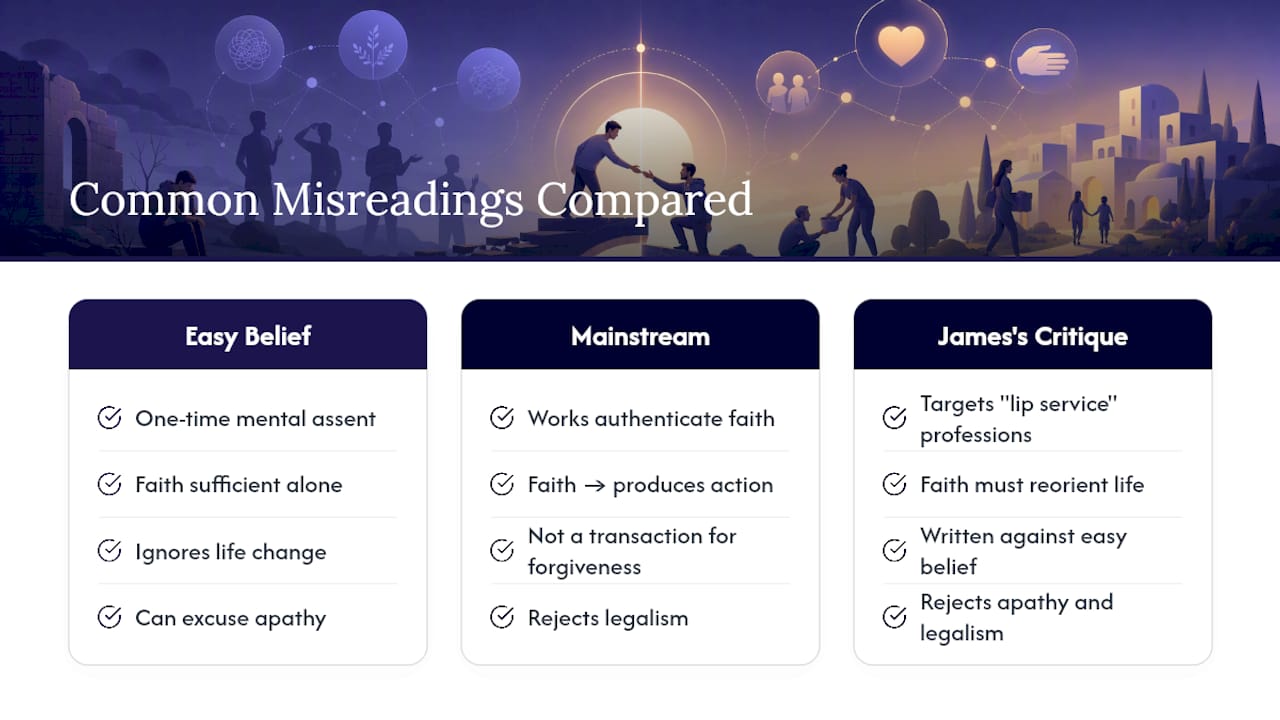
A lot of confusion around this passage comes from a habit theologians sometimes call “easy believism,” the idea that a one-time mental assent to Christian claims is the whole of saving faith, regardless of what follows in a person’s life. James was writing directly against that assumption, decades before it had a name.
The mainstream reading, shared across most evangelical commentary, holds a narrow but firm line: works authenticate faith, they don’t produce it. Zondervan Academic’s analysis describes James’s target as “lip service,” professed belief that never reorients how someone actually treats people. That’s a strong claim, but it’s not the same as saying good deeds purchase forgiveness. The direction of causation matters. Faith comes first and produces action, rather than action producing or completing faith in some transactional sense. Miss that order, and you’ve either slid into legalism or excused apathy, both of which James would reject.
Signs of Living Faith and What to Do Next
So how do you tell if faith is alive or just talk? James gives a few concrete markers, and the rest of Scripture backs them up.
- Consistent love for people who cost you something, not just people who are easy to love
- Obedience that shows up in decisions, not just in Sunday conversation
- Generosity toward people in real need, echoing James’s own example of the hungry and poorly clothed
- Fruit of the Spirit, the kind Galatians 5 describes as evidence of a life under new management
- Willingness to repent, quickly and specifically, rather than defending a pattern of neglect
Cross-references back James up here. Galatians 5:6 ties faith to love expressing itself in action, and Matthew 7:16–23 warns that trees are known by their fruit, not their branding.
If any of that feels convicting rather than affirming, that’s not a bad place to start. Prayer, an honest conversation with someone who’ll hold you accountable, and one small act of service this week will do more than another hour of theological debate.
Pro Tip: Pick one need you’ve noticed and are able to meet this week, then meet it before you talk yourself out of it. James’s whole argument is that faith shows up in the specific, not the general.
The Greek Behind “Dead” and Why It Matters
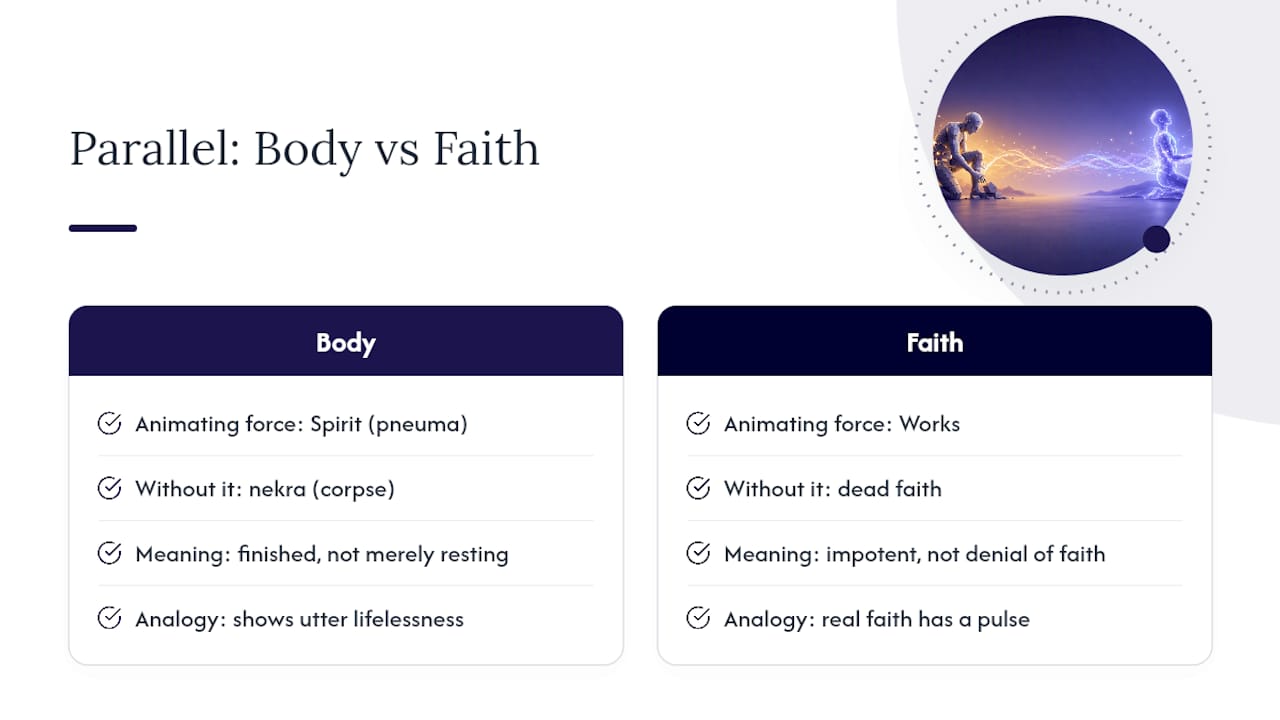
The Greek word behind “dead” in James 2:26 is νεκρά (nekra), the same term used for a corpse. That word choice isn’t decorative. In biblical anthropology, the spirit (pneuma) was understood as the animating force of a body, and a body without it isn’t resting, it’s finished. James is arguing that works function the same way for faith. They’re not an accessory faith can do without and still be called healthy. BibleHub’s commentary on the verse notes that this analogy shows the impotence of faith devoid of active obedience, not a denial of faith’s centrality. James isn’t demoting faith below works. He’s insisting that real faith, by definition, has a pulse.
Study Faith and Works With BibleManna’s Verse Collections
If you want to keep studying past this passage, BibleManna’s collection of 113 Bible verses about faith gives you the full biblical range, not just James’s take, with context for each verse. Pair it with the collection on work to see how Scripture consistently ties belief to labor and service. A simple two-week plan works well here: read five faith verses one week, five work verses the next, and journal where the two overlap in your own life. The Random Verse Generator and translation comparison tool can help you compare how different translations render James 2:26 side by side.
A Pastoral Reflection on Small, Repeatable Faith
The temptation is always to wait for a dramatic moment to prove faith is real. James points somewhere smaller: a coat given, a meal shared, a decision made when no one’s watching. Living faith usually looks unremarkable up close. Ask yourself honestly this week what your actions, not your beliefs, actually say about you.
— Nkosi
Keep Studying: Faith and Work in Scripture
Reading James 2 raises the obvious next question: what does Scripture actually expect a life of active faith to look like day to day? Rather than piecing that together from memory, BibleManna’s Bible Verses by Topic collection gives you full-text passages organized by exactly the situations James is describing, generosity, obedience, care for the vulnerable, with context notes so you’re not guessing at meaning on your own.

Start with the work and service collection if James’s example of the hungry and poorly clothed hit close to home. It’s built for exactly the kind of practical application this passage calls for, verses on labor, service, and stewardship, each with a short explanation of context so you can apply it without a seminary degree. If formal study appeals to you beyond a single passage, theology and Bible degree programs are worth exploring too. But you don’t need a classroom to start living out James 2 this week. Open the work collection, pick one verse, and act on it before Sunday.
Sources
- What Does “Faith Without Works Is Dead” Mean? (James 2:14-26) — BibleProject
- Gotquestions
- Do James and Paul disagree on grace and works? — SBTS Equip
- James 2:17 — Bible Gateway
FAQ
What is the meaning of James 2:26?
James 2:26 compares faith without works to a body without spirit, meaning it’s not weakened but functionally dead. The verse argues that action is the visible sign that faith is genuinely present, not a separate requirement added on top of it.
What does the Bible say about faith without works?
The Bible, especially James 2:14–26, teaches that faith producing no loving action is dead and useless, unable to save in any practical sense. It uses Abraham and Rahab as proof that real faith always shows up in behavior.
Did Paul believe in faith without works?
No. Paul taught that salvation comes by grace through faith apart from works of the law, but he also expected that faith to produce good works as its fruit, as seen in Ephesians 2:8–10. Paul and James are answering different questions, not contradicting each other.
Where does the Bible say that faith is not a work?
Ephesians 2:8–9 states that salvation is a gift through faith, not something earned by works, so no one can claim credit for it. James never argues against this; he argues that faith which produces no fruit was never the saving kind to begin with.
Does faith require good works to be real?
Yes, in the sense that James describes. Works don’t cause salvation, but a faith that never produces observable love, obedience, or repentance doesn’t match what Scripture calls living faith.