Top 10 Funeral Bible Verses for Comforting Services
The ten passages below cover most funerals. Pick one to three, confirm the translation with your officiant, and you’re ready. Each entry shows the reference, why it works, and whether it reads short (under 45 seconds) or long (1–4 minutes). Psalm 23 and John 14:1–3 consistently top every major funeral-resource list for good reason: they are immediately recognizable and carry both comfort and hope in a few lines.
- Psalm 23 — The shepherd’s psalm. Comfort, protection, and the promise of dwelling with God. Short.
- John 14:1–3 — “Let not your hearts be troubled.” Jesus promises an eternal home. Short.
- Romans 8:38–39 — Nothing in all creation can separate us from God’s love. Short.
- Matthew 5:4 — “Blessed are those who mourn, for they shall be comforted.” One verse. Short.
- Psalm 46:1–3 — “God is our refuge and strength.” Steady, communal, and grounding. Short.
- Revelation 21:1–4 — No more death, tears, or pain. Vivid imagery of renewal. Long.
- 1 Thessalonians 4:13–18 — Paul’s direct word on resurrection hope for those who grieve. Long.
- John 11:25–26 — “I am the resurrection and the life.” Brief and declarative. Short.
- Isaiah 41:10 — “Fear not, for I am with you.” Reassurance in a single verse. Short.
- Romans 6:4 — Baptism and new life; connects death to resurrection. Short.
Translation note: The King James Version is public domain and free to print. Modern translations (NIV, ESV, NLT) require permission for printed programs. Confirm your preferred version with the officiant before printing anything.
Key Takeaways
The most effective funeral scripture selections match the deceased’s faith, the congregation’s familiarity, and the service’s tone, then confirm translation and placement with the officiant before printing.
| Point | Details |
|---|---|
| Start with the top 10 | Psalm 23, John 14:1–3, and Romans 8:38–39 work in nearly every service and require no introduction. |
| Match verse to tone | Comfort passages suit the eulogy; hope and resurrection passages work best at the committal or closing. |
| Confirm translation early | KJV is public domain; NIV, ESV, and NLT require permission for printed programs. |
| Place readings strategically | A traditional service holds 2–3 readings; a graveside service typically holds one passage of 1–2 minutes. |
| Use Biblemanna’s collections | Biblemanna’s themed verse sets include full text, context, and translation notes, ready to use for funeral planning. |
Table of Contents
- Funeral Bible verses grouped by theme and length
- Short Bible readings that fit any part of the service
- Longer scripture passages for full readings and memorial reflections
- How to choose the right verse for this specific funeral
- Where to place Bible verses in the order of service
- How Biblemanna curates its funeral scripture collections
- Biblemanna’s ready-made verse sets for funerals and memorials
- Sources
- FAQ
Funeral Bible verses grouped by theme and length
Funeral resources consistently organize scripture by theme and length because a verse that fits the tone of the service lands far better than one chosen at random. The table below maps the most-used passages to their theme, length, and best service use. Full explanations follow.
Comfort and consolation
Psalm 23 is the most recognized passage in the English-speaking world for grief. Its imagery of the shepherd, the valley of the shadow of death, and the table prepared in the presence of enemies speaks directly to loss without requiring explanation. Read the full six verses for a complete reading, or use verses 1–4 alone for a shorter slot. Biblemanna’s Psalm 23 deep-dive walks through the meaning of each verse if you want context to share with the congregation.
2 Corinthians 1:3–4 names God as “the Father of mercies and God of all comfort, who comforts us in all our affliction.” It works especially well in a eulogy because it shifts focus from loss to the source of comfort, without requiring the congregation to hold a specific theological position on the afterlife.
Matthew 11:28–30 (“Come to me, all who labor and are heavy laden”) is an invitation rather than a declaration. It suits services where the congregation includes people who are not regular churchgoers; the language is warm and accessible.
For a broader set of comforting scripture for funerals, Biblemanna’s comfort collection covers 43 passages with full context.
Hope and resurrection
New Testament passages like Romans 8 and 1 Thessalonians 4:13–18 are the standard choices when the service calls for a clear statement of resurrection hope. Romans 8:38–39 is short enough for a prayer card but carries enormous theological weight: a list of everything that cannot separate a believer from God’s love, ending with “nor anything else in all creation.”
John 14:1–3 is the passage most people already know. Jesus speaks directly to his disciples’ grief and promises to prepare a place for them. Its familiarity is a feature, not a limitation. A congregation that recognizes the words can absorb the comfort without working to understand the text.
1 Thessalonians 4:13–18 is longer and more specific: Paul addresses people who are grieving loved ones who have already died and tells them directly not to grieve “as others do who have no hope.” It is the most pastorally direct passage in the New Testament on the subject of death and resurrection.
Biblemanna’s hope verses collection and faith collection both carry passages that work in this theme.
Psalms
Psalm 46:1–3 opens with “God is our refuge and strength, a very present help in trouble.” It is communal in tone, which makes it well-suited to a congregation reading aloud together or to an opening that sets a steady, grounded mood before the eulogy.
Psalm 121 (“I lift up my eyes to the hills”) is often chosen for graveside services because its imagery of watchfulness and protection fits an outdoor committal naturally.
Psalm 90 is longer and more reflective, meditating on the brevity of human life against the eternity of God. Verses 1–2, 10, and 12 can be read as a shorter selection without losing the arc of the psalm.
Short readings
John 11:25–26 and Isaiah 41:10 are both single-verse or two-verse readings that work on program cards, as an interlude between hymns, or as a sentence within a eulogy. See the full short-readings section below for time estimates and placement ideas.
Longer passages
Revelation 21:1–4 and 1 Thessalonians 4:13–18 are the two most-used long passages. Both are covered in detail in the long-readings section.
Short Bible readings that fit any part of the service
Funeral homes and memorial planners regularly provide short, readable passages specifically for printed programs and prayer cards, because a verse that fits on a card gets read and re-read long after the service ends. Short readings also give family members who want to participate a manageable role without the pressure of a full scripture reading.
Each entry below includes an estimated reading time and a placement suggestion.
- John 11:25–26 (2 verses, ~20 seconds) — “I am the resurrection and the life.” Works in a eulogy as an anchor statement or on a program card.
- Isaiah 41:10 (1 verse, ~15 seconds) — “Fear not, for I am with you.” Ideal for a prayer card or as an opening sentence before a prayer.
- Matthew 5:4 (1 verse, ~10 seconds) — The Beatitude for mourners. Short enough to be spoken from memory by the officiant.
- Romans 8:38–39 (2 verses, ~25 seconds) — The “nothing can separate us” passage. Strong closing line for a eulogy.
- Psalm 46:1 (1 verse, ~10 seconds) — “God is our refuge and strength.” Works as a call-and-response opener with the congregation.
- John 14:1 (1 verse, ~15 seconds) — “Let not your hearts be troubled.” A single line that carries the whole promise of the chapter.
- 2 Corinthians 1:3–4 (2 verses, ~25 seconds) — Comfort from the God of all comfort. Fits naturally in the eulogy or as a transition into a prayer.
- Lamentations 3:22–23 (2 verses, ~20 seconds) — “His mercies are new every morning.” Quieter and less familiar, but deeply consoling for those who know it.
- Philippians 4:7 (1 verse, ~15 seconds) — “The peace of God, which surpasses all understanding.” A closing benediction in a single verse.
- Psalm 121:1–2 (2 verses, ~20 seconds) — “My help comes from the Lord.” Graveside or committal.
- Romans 6:4 (1 verse, ~20 seconds) — Connects death and resurrection through baptism. Suits services with a sacramental tradition.
- Revelation 21:4 (1 verse, ~20 seconds) — “He will wipe away every tear.” The single most-quoted verse from Revelation 21 for program cards.
Who should read short passages? A close family member or friend handles a one-to-two verse reading well, even when they are grieving. The brevity means they can rehearse it to the point of confidence. For formal liturgical services, the officiant typically reads scripture from the lectern; check with them first.
Short readings also work as encouragement verses for printed memorial cards that guests take home.
Longer scripture passages for full readings and memorial reflections
A full scripture reading during a funeral service typically runs 1–3 minutes and gives the congregation time to settle into the text. The passages below are the ones most commonly chosen when the service calls for a complete reading rather than a quoted verse.
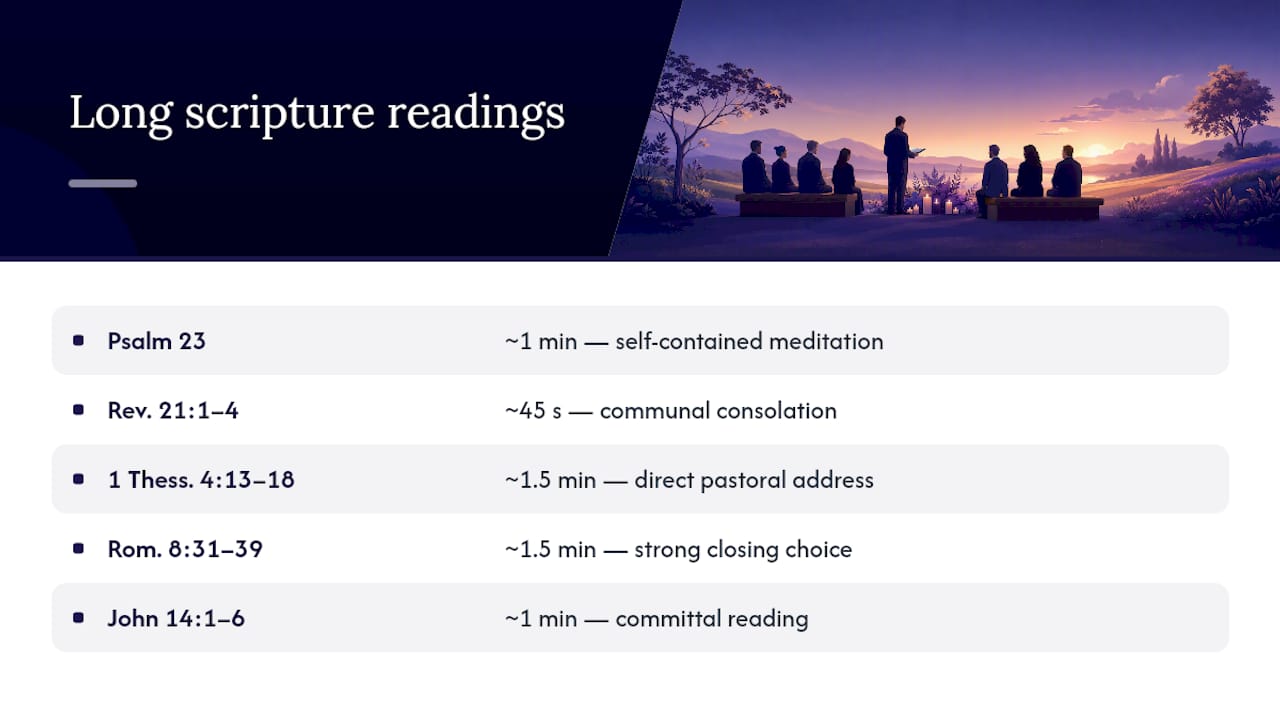
Psalm 23 (full, 6 verses) — ~1 minute. Even read slowly and deliberately, the complete psalm takes under 90 seconds. Its arc from “The Lord is my shepherd” to “I shall dwell in the house of the Lord forever” makes it a self-contained meditation on grief and hope. It works as a standalone reading or as the foundation for a short homily.
Revelation 21:1–4 — ~45 seconds. Short for a “long” passage, but the imagery is dense enough to carry a full reading slot. John’s vision of a new heaven and new earth, with God wiping every tear, is the most vivid New Testament picture of life beyond death. Funeral guides highlight it specifically for communal consolation and for services where the congregation includes people of varying faith backgrounds.
1 Thessalonians 4:13–18 — ~1.5 minutes. Paul’s most direct pastoral address to people in grief. He names the problem (“we do not want you to be uninformed about those who are asleep”) and gives the answer in plain terms. This passage works best when the deceased was a committed believer and the congregation shares that faith; its theological specificity is a strength in that context, but it can feel abrupt in a more secular service.
Romans 8:31–39 — ~1.5 minutes. The longer version of the “nothing can separate us” passage. Starting at verse 31 (“If God is for us, who can be against us?”) gives the passage a rhetorical build that the two-verse version lacks. Strong choice for a closing reading or as the scripture foundation for a eulogy.
John 14:1–6 — ~1 minute. Extending the reading to verse 6 (“I am the way, and the truth, and the life”) adds the theological grounding that verse 3 alone leaves implicit. Works well as a committal reading.
Ecclesiastes 3:1–8 — ~1 minute. “A time to be born, and a time to die.” Familiar even to people outside the church, partly through popular culture. It acknowledges the reality of death without flinching, which makes it a strong choice for a celebration-of-life service or when the congregation is mixed in faith.
Isaiah 40:28–31 — ~1 minute. “Those who wait for the Lord shall renew their strength; they shall mount up with wings like eagles.” A passage of endurance and renewal, suited to a service that wants to close on a note of forward-looking hope rather than immediate grief.
Pro Tip: Print longer passages in a formal folder or order-of-service booklet and place it on the lectern before the service begins. Reading from a phone during a formal service is distracting for the congregation and harder to pace. Rehearse aloud at least twice — the passage will feel different in the room than it does on the page.
How to choose the right verse for this specific funeral
The right passage depends on four things: the deceased’s relationship with faith, the congregation’s familiarity with scripture, the tone the family wants, and the practical constraints of the service. Work through these questions in order.
A practical selection checklist
- What was the deceased’s faith life? A lifelong churchgoer’s service can carry theologically specific passages like 1 Thessalonians 4:13–18. A cultural Christian or someone with a complicated relationship to faith is better served by accessible, widely-known verses like Psalm 23 or John 14:1–3. Matching verse tone to the deceased’s actual faith produces a more meaningful service than defaulting to the most popular passage.
- Who is in the congregation? A mixed-faith or secular audience responds better to passages with universal emotional resonance (Psalm 23, Ecclesiastes 3, Revelation 21:4) than to passages that assume shared doctrine.
- What tone does the family want? Grief and lament (Psalm 90, Lamentations 3:22–23), resurrection hope (John 14, 1 Thessalonians 4), or peace and release (Philippians 4:7, Isaiah 41:10)?
- How long is the service, and how many readings fit? A graveside-only service typically holds one short reading. A full church funeral can accommodate two to three readings of varying length. A celebration-of-life format is more flexible.
- Has the family expressed a preference? Ask directly. Families often have a verse the deceased loved or quoted, and using it is more meaningful than any “best” passage from a list.
Dos and don’ts
Do confirm the translation with the officiant before printing. The KJV is public domain; NIV, ESV, and NLT require written permission for printed programs. For formal liturgical services, the approved lectionary governs which readings may be used, and substitutions require the officiant’s approval.
Do consider a less-common passage when it reflects the deceased’s personal story. Lamentations 3:22–23 or 2 Corinthians 1:3–4 can honor a specific life more precisely than a default choice.
Don’t choose an obscure passage without giving the congregation a brief introduction. One sentence of context (“This was a verse she returned to often”) is enough.
Don’t print a passage from a copyrighted translation without checking the publisher’s permissions page. Most publishers allow limited reproduction for non-commercial worship use, but the rules vary.
Pro Tip: When you have five to ten candidate verses, read each one aloud in the room where the service will be held, or at least in a quiet space. The passage that feels right on paper sometimes feels too long, too formal, or too abstract when spoken. Trust the spoken version.
Biblemanna’s grief verse collection and Bible verses on trusting God are useful starting points when the family is still narrowing down options.
Where to place Bible verses in the order of service
Placement shapes how a verse lands. The same passage reads differently as an opening than it does at the committal. The National Funeral Directors Association provides service-structure guidance that informs the timing recommendations below.
Sample order of service: three formats
Traditional church funeral (60–75 minutes)
| Slot | Placement | Recommended verse type | Example |
|---|---|---|---|
| Opening | Before first hymn | Short, grounding | Psalm 46:1 or Isaiah 41:10 |
| First reading | After opening hymn | Full passage, comfort | Psalm 23 or John 14:1–6 |
| Eulogy | Mid-service | Short anchor quote | Romans 8:38–39 or John 11:25–26 |
| Second reading | Before homily | Full passage, hope | 1 Thessalonians 4:13–18 |
| Committal | At the graveside | Short, declarative | John 14:1–3 or Psalm 121:1–2 |
| Closing | Final benediction | Short, peace | Philippians 4:7 |
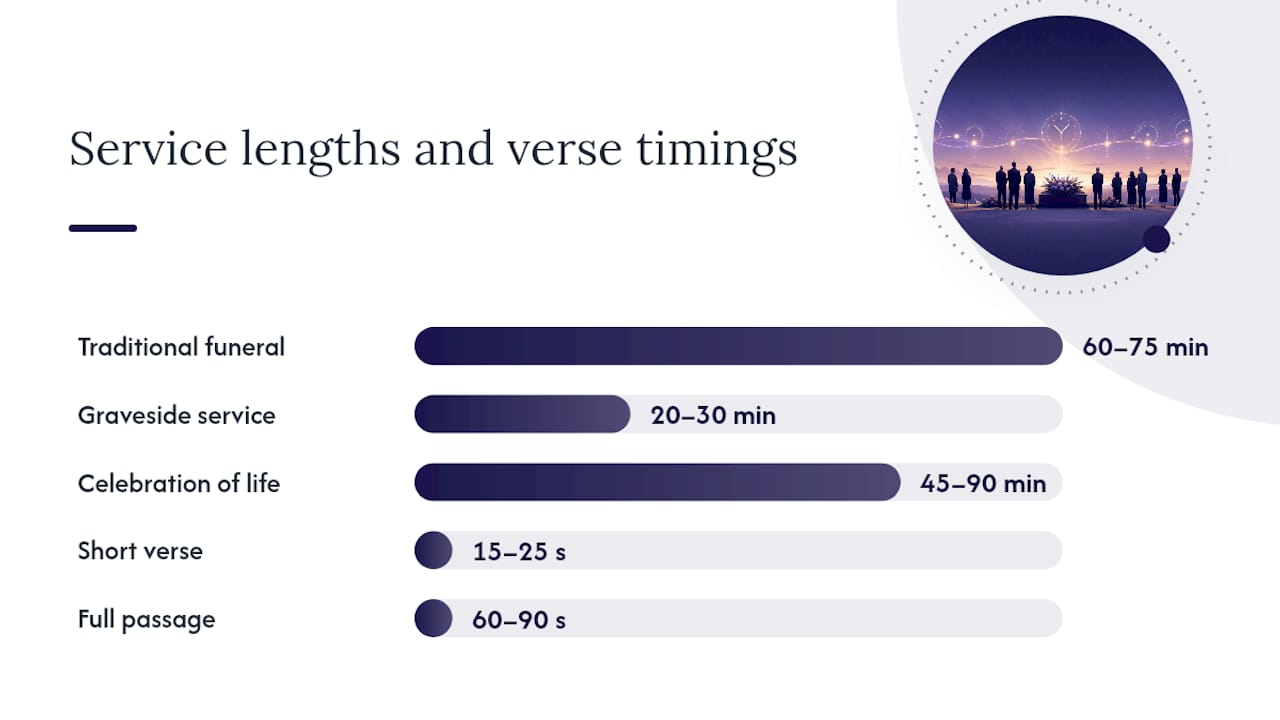
Graveside-only service (20–30 minutes)
One reading is standard. Choose a single passage of 1–2 minutes (Psalm 23, John 14:1–3, or Revelation 21:1–4) and place it after the opening prayer and before the committal words. A second short verse can close the service.
Celebration of life (45–90 minutes, flexible format)
Readings work as interludes between tributes rather than as formal liturgical slots. Ecclesiastes 3:1–8 and Romans 8:31–39 suit this format because they are familiar enough to land without a liturgical frame. Short verses (Isaiah 41:10, Revelation 21:4) work on printed programs that guests keep.
Timing rule of thumb: one short verse takes 15–25 seconds; a full passage of 6–8 verses takes 60–90 seconds. Budget accordingly when the service has a fixed time.
How Biblemanna curates its funeral scripture collections
Biblemanna organizes scripture by theme across more than 50 topics, including grief, comfort, hope, encouragement, and faith. Every verse in a collection comes with a contextual explanation, not just the text, so readers understand why a passage applies to their situation.
The selection criteria for funeral-relevant collections follow three principles:
- Tone match: passages are grouped by emotional register (lament, consolation, hope, peace) so readers can find what fits the service’s mood without reading through unrelated verses.
- Liturgical acceptability: commonly used passages appear in collections because they have a track record in actual services, not just because they mention death or heaven.
- Accessibility: verses are presented in plain language with context, so a family member who is not a regular Bible reader can understand why a passage is appropriate and how to introduce it.
Biblemanna’s tools include a random verse generator and side-by-side translation comparisons, which are useful when the family is deciding between the KJV and a modern translation for a printed program. The topical verse landing page is the fastest way to browse collections by theme. The articles section carries editorial explainers on specific passages, including the full Psalm 23 analysis.
For readers who want to go deeper into the scriptural and historical background of specific passages, Spirit of His Mouth offers exegetical commentary and scriptural studies that complement Biblemanna’s thematic collections.
Choosing what feels right
There is a version of this conversation that treats scripture selection as a checklist problem: match the tone, confirm the translation, check the length. That framework is useful, and most of this article is built around it. But it misses something.
The passages that stay with people after a funeral are rarely the most theologically correct ones. They are the ones that felt true to the person being remembered. A congregation that hears “The Lord is my shepherd” for the hundredth time at a funeral is not bored by the familiarity. They are held by it. Familiar scripture gives a grieving room shared language at the moment when private grief threatens to isolate everyone in it.
At the same time, a verse the deceased actually loved, even a less-known one, can do something a standard passage cannot: it tells the congregation something true about who that person was. Both choices are right. The question is which one this service needs more.
Coordinate with the officiant, ask the family, and then trust the passage that feels honest. That is usually enough.
Biblemanna’s ready-made verse sets for funerals and memorials
When you are planning a service under time pressure, the last thing you need is to search through a full Bible concordance. Biblemanna’s topical verse collections give you curated, print-ready scripture sets organized by theme, with full verse text and contextual notes already written.

Three concrete reasons to use Biblemanna’s grief and comfort collections for a funeral or memorial:
- Theme-sorted, ready to use. Grief, comfort, hope, and encouragement collections are already organized by emotional register, so you can match the service’s tone in minutes rather than hours.
- Translation context included. Each verse appears with notes on meaning and usage, making it easier to choose between the KJV’s familiar cadence and a modern translation’s clarity before you talk to the officiant.
- Broader than the standard list. Beyond Psalm 23 and John 14, the collections surface less-common passages like Lamentations 3:22–23 and 2 Corinthians 1:3–4 that can honor a specific life more precisely.
Browse the full Bible verses by topic collection and find the passages that fit this service.
Sources
These resources are worth bookmarking before you finalize the service order, especially for formal or denominational funerals.
- 12 Scriptures for Funerals
- Liturgy Office | Funerals — Lectionary
- Nfda
- Bible Readings For Funerals | 11 Popular Verses
- Christianity
Denominational note: Baptist, Methodist, and non-denominational Protestant services generally allow any scripture passage the family chooses. Catholic, Anglican/Episcopal, and Lutheran services follow a lectionary and may restrict readings to approved texts. Always confirm with the officiant for any formal liturgical service.
FAQ
What is the most beautiful prayer for a funeral?
The 23rd Psalm is widely considered the most beloved funeral prayer in the Christian tradition, combining comfort, protection, and the promise of God’s presence in a few short verses. For a spoken prayer rather than a scripture reading, many officiants adapt Psalm 23 or John 14:1–3 into a direct address to God.
What is a good Bible verse for a loved one who passed away?
John 14:1–3 (“Let not your hearts be troubled”) and Romans 8:38–39 (“nothing can separate us from the love of God”) are among the most comforting choices because they speak directly to grief while affirming hope. For a single verse on a card or memorial, Revelation 21:4 (“He will wipe away every tear”) is widely used.
What is a good psalm for a funeral?
Psalm 23 is the standard choice for its comfort and familiarity. Psalm 46:1–3 (“God is our refuge and strength”) works well for a communal opening, and Psalm 121 (“I lift up my eyes to the hills”) suits graveside services particularly well.
What does Psalm 46 mean for a funeral?
Psalm 46 declares that God is a present, reliable refuge even when the world feels like it is falling apart, which maps directly onto the experience of sudden loss. Funeral guides highlight it for its grounding, communal tone, making it a strong opening passage when the congregation needs to be steadied before the eulogy.