Hallelujah Meaning: Origin, Biblical Use, and When to Say It

“Hallelujah” means “Praise Yah” — a direct command in Hebrew to praise Yahweh, the God of Israel. You’ll find it throughout the Book of Psalms as a call to worship, and in Revelation as a heavenly acclamation. In modern English, it has also become a secular exclamation of relief or joy, though its roots are entirely sacred.
Table of Contents
- What does “hallelujah” literally mean?
- Where does “hallelujah” come from?
- How do you pronounce “hallelujah”?
- Where does “hallelujah” appear in the Bible?
- How does Judaism use “hallelujah” in worship?
- How do Christian traditions use “hallelujah”?
- How has “hallelujah” entered secular culture?
- Should Christians say “hallelujah”? Pastoral and scholarly perspectives
- Key Bible passages that use “hallelujah”
- Key Takeaways
- Why the word deserves more than a reflex
- Biblemanna’s praise and worship verse collections
- Useful sources
- FAQ
What does “hallelujah” literally mean?
The literal meaning is straightforward: hallel (praise) + Yah (a shortened form of Yahweh). Together, hallelū-yāh is an imperative plural — essentially “all of you, praise Yah.” It is not a vague sentiment. It is a direct address to a specific God, with a specific name.
That specificity matters. The word does not mean “praise God” in a generic sense. It names Yahweh explicitly, which is why Jewish and Christian traditions treat it with particular weight. When you say “hallelujah,” you are not expressing a mood — you are making a theological statement.
Where does “hallelujah” come from?
The word’s journey from ancient Hebrew into everyday American English covers roughly three thousand years and at least four languages.
- Hebrew origin: The phrase hallelū-yāh appears in the Hebrew Bible (Tanakh) as two words. Hallel is the imperative plural of the verb halal, meaning “to praise” or “to boast.” Yah is the short form of Yahweh, the personal name of God in the Hebrew scriptures.
- Greek transmission: When Jewish scholars translated the Hebrew Bible into Greek (the Septuagint), they transliterated the phrase as allelouia rather than translating it. The word was treated as a proper liturgical term, not a common noun.
- Latin and the Western church: Latin adopted the Greek form as alleluia, which became the standard spelling in the Vulgate Bible and Western liturgical practice through the medieval period.
- Old French and Middle English: English forms of the word appear from roughly the 12th through 16th centuries, arriving through Old French liturgical usage. Both alleluia and hallelujah were in circulation by the time of the King James Bible (1611).
- Modern English: Today, hallelujah is the dominant secular and Protestant spelling, while alleluia persists in Catholic, Anglican, and Eastern Orthodox liturgical texts.
The King James Version of the Bible uses alleluia in Revelation, while many modern translations (NIV, ESV, NASB) use hallelujah. Same word, different transliteration conventions.
How do you pronounce “hallelujah”?
American English speakers typically say it as hal-uh-LOO-yuh, with the stress on the third syllable. The Hebrew original, hallelū-yāh, places stress on the final syllable and ends with a long “ah” sound.
| Form | Spelling | Pronunciation | Common Context |
|---|---|---|---|
| Modern English | Hallelujah | hal-uh-LOO-yuh | Protestant hymnody, everyday speech |
| Liturgical Latin/English | Alleluia | ah-led-LOO-ee-ah | Catholic Mass, Anglican liturgy |
| Hebrew original | Hallelū-yāh | hah-leh-loo-YAH | Hebrew Bible, Jewish liturgy |
| Alternate English | Halleluiah | hal-uh-LOO-ee-ah | Older hymnals, some translations |
The long final “ah” vowel in the Hebrew form is no accident musically. Composers from Handel to contemporary worship leaders have exploited that open vowel to write expansive, vocally sustained lines. It is physically easy to sing on an “ah” sound, which is part of why the word lends itself to musical celebration.
Where does “hallelujah” appear in the Bible?
The word appears 24 times in the Hebrew Bible, almost entirely in the Psalms. In the New Testament, it shows up in Revelation, where it carries the weight of heavenly acclamation at a moment of cosmic victory.
| Location | Form Used | Function |
|---|---|---|
| Psalms 113–118, 150 | Hallelujah / Alleluia | Opening or closing call to praise |
| Revelation 19:1, 6 | Alleluia / Hallelujah | Heavenly chorus praising God’s judgment and reign |
In the Psalms, the word typically opens or closes a psalm as a liturgical frame. Psalm 150, for example, begins and ends with “Praise the Lord” (hallelujah in Hebrew), and the entire psalm is a cascade of instruments and voices called to worship. It functions less like a sentence and more like a signal — a call that gathers the community into a shared act.
The New Testament appearances in Revelation are striking precisely because they are so rare. GotQuestions notes that Revelation 19 presents the only New Testament uses of the word, where a great multitude in heaven cries “Hallelujah!” four times in response to God’s victory over evil. The context is not casual. It is the climactic worship scene of the entire Bible.
How does Judaism use “hallelujah” in worship?
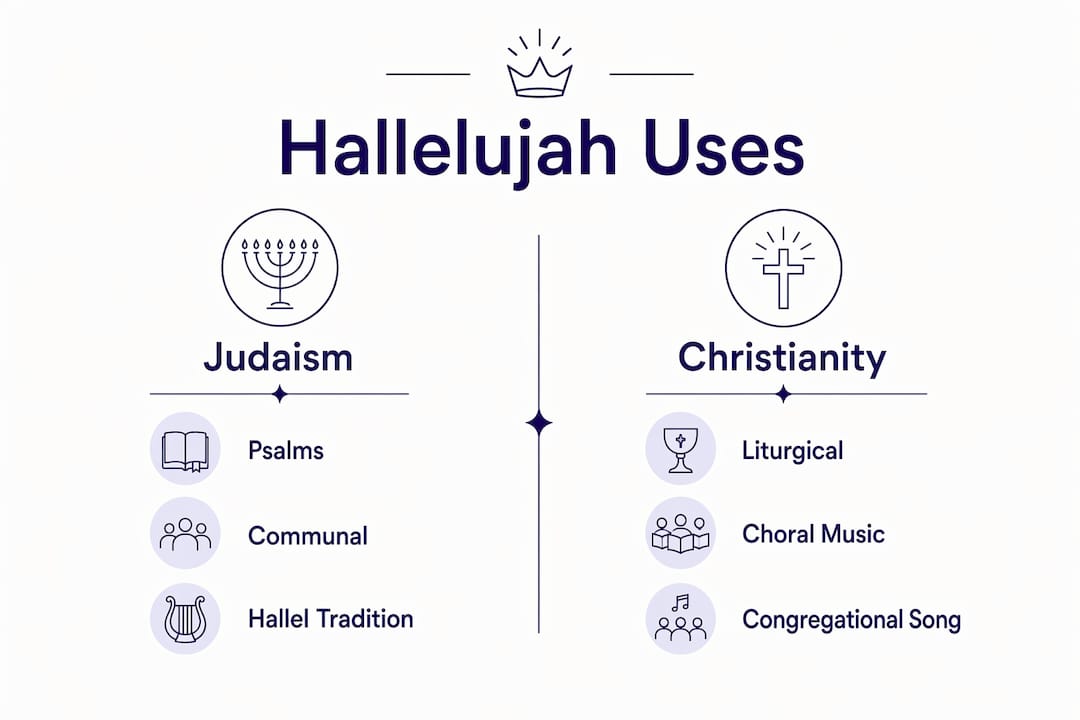
Jewish liturgical use of hallelū-yāh centers on the Hallel, a collection of Psalms 113–118 recited or sung during major festivals.
- Hallel Psalms (113–118): These six psalms form the core liturgical unit. The word hallel in “Hallel” shares its root with hallelujah, and the psalms are sung at Passover, Shavuot, Sukkot, Hanukkah, and Rosh Chodesh.
- Passover Seder: The Hallel is split across the Seder meal. Psalms 113–114 are recited before the meal; Psalms 115–118 follow after. The word hallelujah appears at the opening and close of several of these psalms.
- Temple worship: In the period of the Jerusalem Temple, Levitical choirs sang the Hallel Psalms during the Passover sacrifice. The communal, corporate nature of the praise was built into the liturgy structurally.
- Modern synagogue practice: Hallel is still recited in synagogue services on the festivals listed above. The full Hallel includes all six psalms; a “half Hallel” (omitting portions of Psalms 115 and 116) is used on certain days such as the last six days of Passover.
- Pronunciation in Hebrew prayer: In Hebrew liturgy, the word retains its original stress and vocalization, hallelū-yāh, rather than the anglicized form most English speakers use.
The Hallel tradition shows that hallelujah was never a private expression. It was communal from the start, tied to specific calendar moments and collective memory.
How do Christian traditions use “hallelujah”?
Christian use of the word spans liturgical rites, choral music, and congregational hymnody, with meaningful differences across denominations.
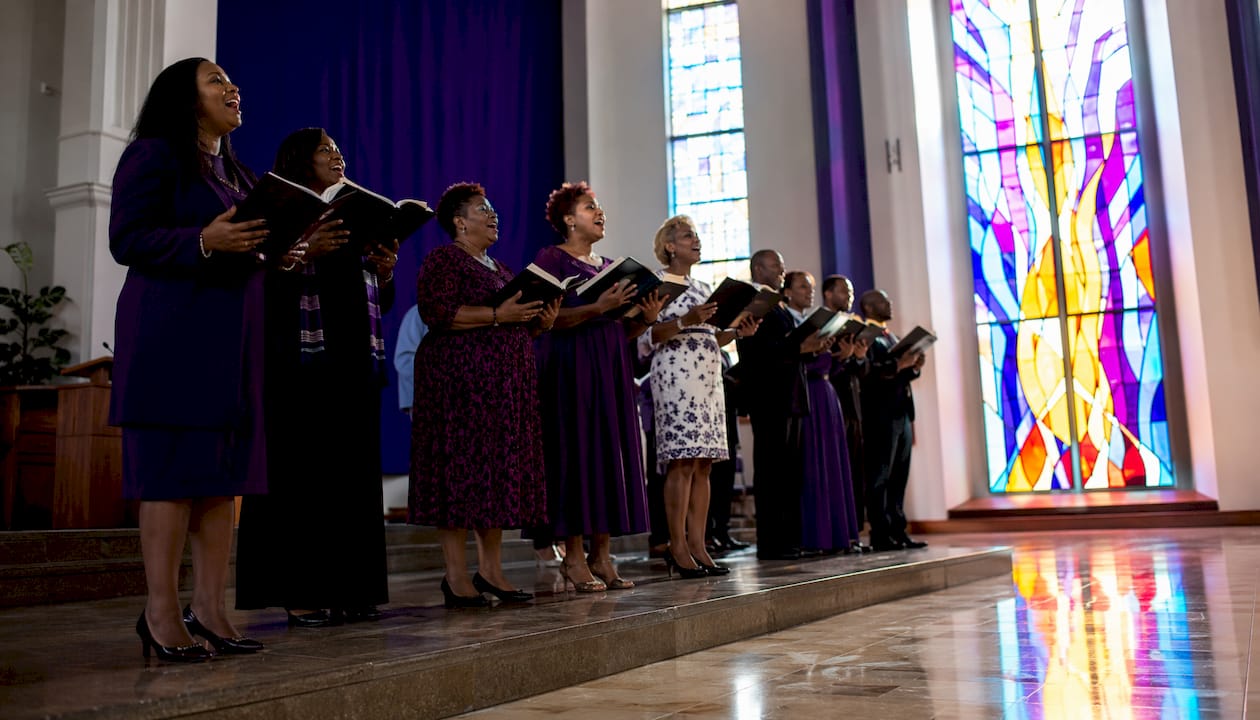
In Western liturgical churches (Catholic, Anglican, Lutheran), alleluia is sung before the Gospel reading at Mass and during the Divine Office. The word carries a seasonal weight: many Western rites suppress it entirely during Lent, replacing it with other acclamations. The logic is deliberate contrast. By withholding the word for forty days, the church makes its return at Easter feel like a release. Eastern Orthodox and Eastern Catholic traditions handle the acclamation differently, often chanting it more frequently throughout the liturgical year rather than reserving it seasonally.
In Protestant and evangelical traditions, “hallelujah” appears freely in congregational song, spontaneous worship, and prayer. There is no formal liturgical restriction, and the word is often used as a response to answered prayer or a moment of spiritual recognition.
The most culturally prominent musical example is George Frideric Handel’s “Hallelujah Chorus” from Messiah (1741). Handel’s setting treats the word as a proclamation of Christ’s reign, drawing directly from Revelation 19. The tradition of standing during the chorus, whatever its disputed origin, reflects the sense that the word demands a physical response.
How has “hallelujah” entered secular culture?
The word crossed from liturgy into everyday English gradually, and today it functions in at least two distinct registers.
- Everyday exclamation: “Hallelujah, the traffic finally cleared” is a real sentence millions of Americans say without any religious intent. Dictionaries now list this secular use explicitly: an expression of surprise and pleasure that something positive, which seemed unlikely, has happened.
- Popular music: Leonard Cohen’s 1984 song “Hallelujah” is the most cited cultural example. Cohen used the word to explore love, loss, and spiritual ambiguity, deliberately layering its sacred weight against secular subject matter. The song has been covered hundreds of times and introduced the word to audiences with no liturgical background.
- Film and television: The word appears regularly in soundtracks and dialogue as a shorthand for relief, triumph, or irony. Its recognizability makes it useful for writers who want to signal a sudden reversal.
- Journalism and everyday speech: Sports writers use it when a losing streak ends. Parents say it when a toddler finally sleeps. The word has become a general-purpose marker of unexpected good news.
Some worshippers find this drift trivializing. When a word that names God’s specific identity becomes a punchline for traffic updates, something is lost. Others argue the secular spread is evidence of the word’s deep cultural resonance. Both reactions are reasonable.
Should Christians say “hallelujah”? Pastoral and scholarly perspectives
Many Christians in liturgical traditions view the word with deep reverence and prefer to reserve it for directed worship rather than casual use. That instinct has scholarly backing.
Chris Blumhofer of Fuller Theological Seminary describes hallelujah as “a summary meant to usher believers” into an experience of praising who God is and what God has done. That framing shifts the word from an emotional outlet to a corporate act with a specific theological object.
“Hallelujah is a profound act of worship, intended for recognition of God’s sovereignty and often linked to moments of spiritual victory and communal praise.” — Christianity.com
Practical guidance from pastoral voices tends to fall along these lines:
- Encourage use in: corporate worship, thanksgiving prayer, response to answered prayer, liturgical song, and moments of genuine spiritual recognition.
- Advise restraint in: casual conversation as a filler exclamation, ironic or humorous contexts where the name of God is the implied punchline, and settings where the audience has no shared understanding of what the word means.
Pro Tip: Try using “hallelujah” as a directed prayer rather than a reflex. Before you say it, name what you are praising God for. That one-second pause turns an exclamation into an act of worship.
The question “should Christians say it?” has a simple answer: yes, and often. The more useful question is whether you are saying it to God or just about a feeling.

Key Bible passages that use “hallelujah”
These passages are worth reading in full, especially if you want to see how the word functions in context rather than in isolation.
- Psalm 113: Opens the Hallel sequence. “Hallelujah! Praise, O servants of the Lord, praise the name of the Lord.” The word frames the entire psalm as corporate address.
- Psalm 117: The shortest psalm in the Bible, and it opens and closes with hallelujah. Two verses, two bookends of praise.
- Psalm 150: The final psalm, often called the “Grand Doxology.” Every verse is a call to praise; hallelujah opens and closes it.
- Psalms 113–118 (Hallel): Read as a unit to understand how Jewish liturgy uses the word across a sustained sequence of praise and thanksgiving.
- Revelation 19:1–6: The New Testament’s only uses of the word, four times in six verses. The context is the fall of Babylon and the reign of God. Read it alongside Psalm 150 to see how the word carries the same function across both Testaments.
For translation comparison, reading these passages side by side in the KJV (which uses alleluia) and the NIV or ESV (which use hallelujah) is instructive. Biblemanna’s Bible verses about praise collection gathers many of these passages with context notes, so you can read them without hunting through a concordance. You can also compare translations directly using a tool like Vyrse’s Bible reader, which supports KJV, ASV, WEB, and YLT side by side.
Key Takeaways
“Hallelujah” is a Hebrew imperative meaning “Praise Yah,” used 24 times in the Psalms and four times in Revelation, and it carries its full theological weight only when directed at the God it names.
| Point | Details |
|---|---|
| Literal meaning | “Praise Yah” — a Hebrew imperative addressed to Yahweh, not a generic expression of joy. |
| Etymology path | Hebrew hallelū-yāh → Greek allelouia → Latin alleluia → English hallelujah or alleluia. |
| Biblical frequency | Appears 24 times in the Hebrew Bible (mainly Psalms) and four times in Revelation 19. |
| Liturgical use | Central to Jewish Hallel (Psalms 113–118) and Christian worship; suppressed in Lent by many Western rites. |
| Biblemanna resource | Biblemanna’s praise verse collection curates the key hallelujah passages with context for immediate reading. |
Why the word deserves more than a reflex
Most people who say “hallelujah” have no idea they are pronouncing a Hebrew verb in the imperative plural addressed to a specific divine name. That gap between usage and meaning is worth sitting with.
The word survived three thousand years and four languages because it does something no translation quite captures: it calls a community into a shared act of recognition. Not “I feel grateful” but “all of us, right now, acknowledge who God is.” That corporate dimension is what gets lost when the word becomes a reaction to good parking or a song lyric about romantic ambiguity.
None of that means secular use is wrong. Language shifts, and the word’s spread into everyday English is partly a sign of how deeply it shaped Western culture. But for anyone who wants to use it in worship, knowing what it actually says changes how it lands. You are not expressing a mood. You are speaking a name.
Biblemanna’s praise and worship verse collections
Knowing the hallelujah meaning is one thing. Reading the passages where it actually appears is another, and that is where the word comes alive.

Biblemanna’s topical verse collections give you the key praise and thanksgiving passages with full text and context notes, organized so you can find what you need without a concordance. The Bible verses about praise page covers the Hallel Psalms, Psalm 150, and related texts. If you want to follow the theme further, the thankfulness collection and joy collection pair naturally with hallelujah readings. Start at Biblemanna’s topical verse library to explore all 50 themes, each with scripture in full and brief explanatory notes.
Useful sources
- Etymonline — Hallelujah: The most concise etymology available online; covers Hebrew morphology and the word’s path into English from the 12th century onward.
- Wikipedia — Hallelujah: Broad overview of the word’s religious and secular uses, occurrence counts in scripture, and cultural references including Leonard Cohen.
- GotQuestions — What is the meaning of hallelujah?: Pastoral explanation with focus on New Testament usage in Revelation and the theological significance of the word.
- Christianity.com — Hallelujah in the Bible: Covers Christian liturgical use and the reverence many traditions attach to the word.
- Seattle Times — Hallelujah: The remarkable story behind this joyful word: Includes Chris Blumhofer’s theological framing and notes on musical settings and liturgical restrictions.
- Collins English Dictionary — Hallelujah: Covers both religious and secular definitions, including the informal use as an expression of relief.
- Wiktionary — Hallelujah: Useful for pronunciation variants, alternate spellings, and cross-language forms.
- Cambridge Dictionary — Hallelujah: Includes the informal humorous definition and pronunciation guidance for American and British English.
- Vyrse Biblical Glossary: A quick-reference glossary of 70+ biblical terms; useful for cross-checking definitions of related worship vocabulary.
- Biblemanna — Praise verse collection: Curated passages from Psalms and the New Testament with context notes; the fastest way to read the hallelujah passages in full.
FAQ
What does “hallelujah” literally mean?
“Hallelujah” literally means “Praise Yah” — a Hebrew imperative plural commanding praise to Yahweh, the God of Israel. It combines hallel (praise) and Yah, the shortened form of Yahweh.
Should Christians say “hallelujah”?
Yes. Scripture uses the word throughout the Psalms and in Revelation, and Christian traditions across denominations incorporate it in worship. Many pastoral voices recommend using it as directed praise to God rather than a casual exclamation, to preserve its theological weight.
What religion is “hallelujah” from?
The word originates in Judaism, appearing in the Hebrew Bible as a liturgical call to praise Yahweh. Christianity adopted it through Greek and Latin translations, and it is now central to both Jewish and Christian worship traditions.
What does the Bible say about saying “hallelujah”?
The Bible uses “hallelujah” as a corporate call to worship, most prominently in the Psalms (appearing 24 times in the Hebrew Bible) and in Revelation 19, where a heavenly multitude proclaims it four times in response to God’s victory. The biblical pattern consistently frames it as communal, directed praise rather than a personal interjection.