How to Choose a Bible Translation That Fits Your Purpose

Pick a translation by what you’re using it for, not by which one claims to be “most accurate.” No single English version wins that title outright, since scholars at Tyndale House point out that translations trade off readability against word-for-word precision, and each choice serves a different purpose.
The practical move: keep two translations on hand. One should read smoothly for daily devotional time. The other should stick closer to the original wording for study. Pair something like the NLT or NIV with the ESV or NASB, and you cover both needs without agonizing over a single “best” pick.
Before you commit to anything, try this:
- Read the same passage (try Psalm 23 or John 1) in two translations back to back.
- Note where the wording changes the feel or meaning, not just the vocabulary.
- Ask which version you’d actually want to read every day, and which one you’d trust for close study.
Key Takeaways
Choosing a Bible translation works best when you match the version to your purpose and pair a readable translation with a literal one rather than searching for a single “most accurate” edition.
| Point | Details |
|---|---|
| Choose by purpose, not rank | Match reading, study, memorization, or kids’ use to the right translation approach instead of chasing “most accurate.” |
| Pair two translations | Combine a dynamic version like the NLT or NIV with a formal one like the ESV or NASB for fuller understanding. |
| Run the sample-passage test | Read Psalm 23, Romans 5, and a Gospel narrative in two versions to feel the real difference in five minutes. |
| Check the manuscript base | KJV and NKJV use the Textus Receptus; most modern versions use Alexandrian critical editions, which explains some wording gaps. |
| Use comparison tools | Side-by-side views and text comparison tools reveal whether a wording change affects meaning or just style. |
Table of Contents
- Understanding the Translation Spectrum: Literal, Thought-for-Thought, and Paraphrase
- How Do You Match a Translation to Your Purpose?
- What Are the Most Common Bible Translations Best Used For?
- How Can You Compare Bible Translations Yourself?
- How BibleManna Helps You Compare Translations
- What I’ve Learned From Keeping Multiple Translations Open
- Sources
- FAQ
Understanding the Translation Spectrum: Literal, Thought-for-Thought, and Paraphrase
Every English Bible sits somewhere on a line between two philosophies, and knowing where a translation falls tells you more than any marketing claim on its cover.
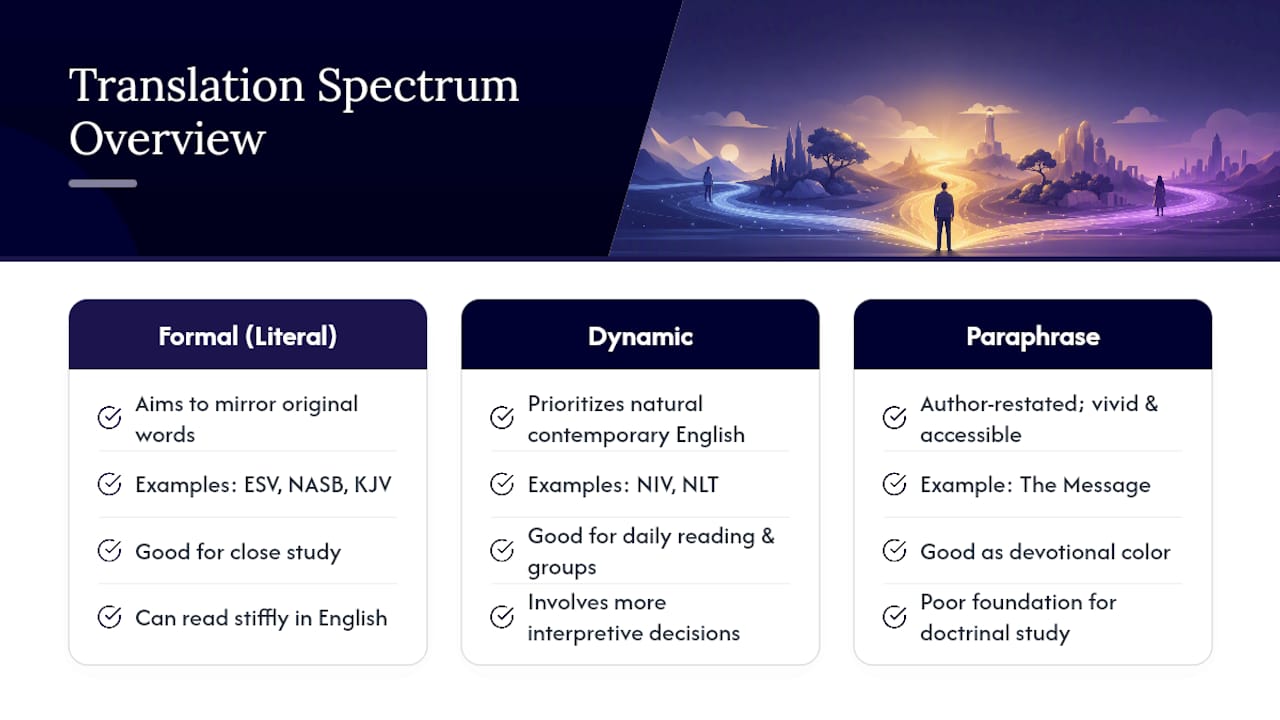
Formal equivalence translations aim to carry over the original Hebrew, Greek, and Aramaic words and sentence structures as closely as English allows. The ESV, NASB, and KJV lean this direction. This approach helps when you’re doing close study, tracing a word across chapters, or trying to catch grammatical structures that a smoother rendering might flatten out. The cost is that literal word order from ancient Greek doesn’t always sound natural in English, and some passages read stiffly as a result.
Dynamic equivalence translations, sometimes called thought-for-thought, prioritize how a phrase would be naturally expressed in contemporary English rather than mirroring the original sentence structure. The NIV and NLT are the clearest examples. These read faster and clearer for daily reading, group study, and reading aloud to a congregation or family, but they involve more interpretive decisions baked into the wording itself.

Paraphrase goes a step further. A single author or small team restates the text in their own words, prioritizing vividness and accessibility over precision to the original language. The Message is the best known example. Paraphrases work well as devotional color commentary, something that makes a familiar passage feel fresh, but they’re a poor foundation for doctrinal study since one person’s interpretive choices carry the whole text.
Here’s the detail that surprises a lot of first-time Bible shoppers: literal doesn’t automatically mean more accurate. Hebrew idioms, Greek verb tenses, and word-for-word English don’t map cleanly onto each other, so a hyper-literal rendering can actually obscure the original meaning rather than preserve it. A scholarly analysis of translation theory makes this point directly: languages differ enough in lexemes, syntax, and idiom that “literal” and “accurate” aren’t the same thing. Translation is interpretation, whichever philosophy a version follows.
A large number of English Bible translations exist, according to BibleProject’s breakdown of the accuracy question, which is exactly why hunting for one perfect version wastes time you could spend comparing a few good ones against each other.
How Do You Match a Translation to Your Purpose?
The translation that works for your morning devotional might frustrate you in a Tuesday night Bible study, and that’s fine. Different tasks call for different tools.
Here’s how purpose typically maps to translation style:
- Devotional reading favors dynamic equivalence versions like the NLT or NIV, since you want the text to flow and land emotionally without stopping to parse syntax.
- In-depth study favors formal equivalence versions like the ESV or NASB, which preserve more of the original structure for close analysis.
- Public reading or preaching benefits from a translation with strong sentence rhythm, since awkward phrasing that reads fine silently can trip up a speaker out loud. The NIV and CSB both test well here.
- Memorization rewards consistency and cadence more than strict literalness, which is part of why generations memorized the KJV despite its archaic language. The NASB and ESV also memorize cleanly for readers who prefer modern English.
- Kids and family reading call for lower reading-grade vocabulary and shorter sentences. The NLT and CSB are common picks for this, and a dedicated kids’ Bible edition often adapts the text further.
Beyond purpose, a short checklist helps narrow the field further: check the reading-grade level printed in the preface, skim the footnotes to see how much textual explanation you get, look up who sat on the translation committee, and check the gender-language policy, since some translations use gender-inclusive language for generic terms like “brothers” and others don’t. If you’re Catholic, also confirm the edition includes the deuterocanonical books, since standard Protestant editions of the ESV or NIV omit them.
Pro Tip: Run a five-minute sample-passage test before buying anything. Read Psalm 23, Romans 5, and one Gospel narrative passage in your top two candidates. If one version consistently sounds clearer to your ear without losing meaning you care about, that’s your answer, at least for that purpose.
What Are the Most Common Bible Translations Best Used For?
Every major translation has a personality, shaped by its committee’s philosophy and its target reader. None of these is the universal “best” version. Each fits certain jobs better than others.
- King James Version (KJV): Formal, literary English from the 17th century, prized for its rhythm and historical weight. Best for readers who value tradition and don’t mind archaic pronouns like “thee” and “thou,” though comprehension can suffer for newer readers.
- New King James Version (NKJV): Updates the KJV’s language while keeping its underlying textual base and much of its cadence. Best for readers who love the KJV’s tone but want modern grammar.
- English Standard Version (ESV): A formal equivalence translation built for close reading, with a preface that lays out its philosophy and textual choices in detail, as the ESV’s own preface explains. Best for study, sermon preparation, and readers who want precision over flow.
- New American Standard Bible (NASB): Often considered the most literal mainstream English translation, sitting at the formal end of the spectrum. Best for word studies and readers comfortable with denser sentence structure.
- New International Version (NIV): A widely used dynamic equivalence translation that balances clarity with fidelity. Best for general reading, group study, and first-time Bible readers.
- Christian Standard Bible (CSB): Aims for what its translators call optimal equivalence, sitting between the ESV and NIV on the spectrum, according to Cru’s translation comparison. Best for readers who want a middle ground between literalness and readability.
- New Living Translation (NLT): A thoroughly dynamic, highly readable translation built for accessibility. Best for devotional reading, younger readers, and anyone new to Scripture.
- New Revised Standard Version (NRSV): Widely used in academic and mainline church settings, with editions that include the Apocrypha for Catholic and Orthodox readers. Best for cross-denominational study and classroom use.
- New English Translation (NET): Distinguished by extensive translator footnotes explaining word choices and textual variants, and it undergoes continuous revision as scholarship updates. Best for readers who want to see the translators’ reasoning in real time.
- The Message: A paraphrase written by a single author in colloquial, conversational English. Best for devotional color and making familiar passages feel new, not for doctrinal study, since it reflects one person’s interpretive voice rather than a committee’s textual work.
Two other factors quietly shape all of these: manuscript sources and denominational tradition. The KJV and NKJV draw on the Textus Receptus, a Greek manuscript tradition compiled centuries ago, while most modern translations (ESV, NIV, NASB, CSB, NLT) rely on critical editions built from older Alexandrian manuscripts discovered since the 19th century. That’s a real reason some translations render certain verses differently. Denominational tradition matters too. Catholic editions include the deuterocanonical books that most Protestant translations leave out, and some traditions favor specific translations for liturgical use, so check whether a version’s editorial approach lines up with your own community’s expectations before adopting it as your primary text.
How Can You Compare Bible Translations Yourself?
You don’t need a seminary degree to run a useful comparison. Pick three passage types that expose different strengths: a narrative (Luke 15, the prodigal son), a poem (Psalm 23), and doctrinal teaching (Romans 5). Narrative shows you storytelling flow, poetry shows you how a version handles imagery and rhythm, and teaching passages show you how precisely a version handles theological vocabulary.
- Read the same passage in two to four translations, back to back.
- Flag any spot where the wording shifts the emphasis or meaning, not just the vocabulary.
- If a difference seems significant, check whether it traces back to a textual variant or a translation choice, which a study Bible footnote often clarifies.
Digital tools make this fast. Logos’ comparison tools include a text comparison view, a parallel display, and cluster and river visualizations that show where translations diverge across a whole book at a glance.
| Comparison method | Best for |
|---|---|
| Side-by-side parallel view | Reading two or more full versions of the same verse together |
| Text comparison tool | Spotting exact wording differences in a single click |
| Cluster or river visualization | Seeing patterns of divergence across a whole chapter or book |
| Study Bible footnotes | Understanding why a specific wording choice was made |
When a difference looks doctrinally significant rather than stylistic, that’s your cue to check a commentary or an interlinear resource that shows the original Greek or Hebrew alongside the English.
How BibleManna Helps You Compare Translations
Biblemanna’s translation comparison tool lets you pull up the same verse across KJV, ESV, NIV, NLT, and NASB side by side, so you can see wording differences without opening five separate apps.
- Test a Psalm or a Gospel passage across two versions to feel the difference between formal and dynamic phrasing firsthand.
- Use Biblemanna’s curated topical verse collections to see how different translations render the same theme, since each verse comes with context that shows why the wording matters.
- Bookmark whichever pairing feels right, then keep using both as you read.
What I’ve Learned From Keeping Multiple Translations Open
I keep an ESV and an NLT open at the same time, not because one is right and the other is a compromise, but because reading both catches things a single version hides. A phrase that sounds flat in one translation sometimes lands hard in the other. Pairing isn’t a workaround. It’s how you actually see the text.
— Nkosi
Sources
- How do we choose which Bible translation to read? – Tyndale House
- Bible Translation and the Myth of ‘Literal Accuracy’ (scholarly article)
- Which Bible translation should I choose? (Cru)
- Three tools to compare Bible translations (Logos support)
FAQ
Should I Get the NIV or the NLT?
Both are dynamic equivalence translations built for readability, but the NLT reads slightly more conversationally while the NIV stays a bit closer to formal wording. Try the same passage in both and pick whichever flows better for you.
Is the ESV or the NIV a Better Translation?
Neither is objectively better. The ESV leans formal equivalence for closer study, while the NIV leans dynamic equivalence for smoother reading, so the right pick depends on whether you’re studying or reading devotionally.
Does It Matter Which Bible Translation You Read?
Yes, wording differences can shift emphasis and clarity, though core doctrine stays consistent across major translations. Using two translations, one literal and one readable, covers the gap that any single version leaves.
What Is the Easiest Bible Translation to Read and Understand?
The NLT and The Message are generally considered the most accessible for new readers, with the NIV and CSB close behind. Reserve paraphrase versions like The Message for devotional reading rather than study, since they reflect one author’s interpretive voice.