30–60 Minute Inductive Bible Study: Practice First, No Commentaries

Inductive Bible study is a method for reading Scripture that moves through three stages: observation, interpretation, and application. Instead of starting with what a commentary or pastor says a passage means, you observe, interpret, and apply the text yourself, letting the words on the page drive your conclusions. The payoff is a deeper, more durable grasp of what Scripture actually says, because you did the work of discovering it.
TL;DR:
- Observing and marking repeated words and connectives takes at least 10 minutes and is essential before interpreting any passage.
- Cross-referencing similar passages and understanding genre and context prevent misinterpretation of Scripture.
- Forming personal observations before consulting commentaries helps ensure original insight, reducing proof-texting.
- Using translation comparison tools sharpens understanding of nuances without replacing careful observation.
- A focused 30 to 60-minute session with a specific topic can make inductive Bible study practical and effective for beginners.
Table of Contents
- What Is Inductive Bible Study, and How Does It Differ From Deductive Study?
- How Do You Do Inductive Bible Study Step by Step?
- What Mistakes Do Beginners Make in Inductive Study?
- What Tools Actually Help With Inductive Study?
- How Do You Run a 30 to 60 Minute Inductive Study Session?
- Why Does Historical and Cultural Background Matter?
- Should You Do Word Studies and Use Original Language Tools?
- How Should a Group Run Inductive Bible Study Together?
- How Do You Confirm an Interpretation Is Correct?
- An Editorial Take on Doing This Well
- Ready to Put This Into Practice?
- Sources
- FAQ
What Is Inductive Bible Study, and How Does It Differ From Deductive Study?
The goal is simple to state and hard to rush: let the text speak before you speak for it. You’re trying to recover what the biblical author meant to communicate to the original audience, not what a preacher said last Sunday or what you already assumed the verse meant. That’s a very different starting point than deductive study, where you begin with a doctrine or theme and hunt for verses to support it. Asbury Seminary’s guide frames this as an “inductive attitude,” approaching the text without forcing your presuppositions onto it, which keeps study honest and cuts down on proof-texting.
The three benefits that show up again and again in people who stick with this method:
- Independence. You stop outsourcing your understanding of Scripture to whoever you last heard preach.
- Depth. Slowing down for observation surfaces details a quick read skips entirely.
- Transformation. Conclusions you reach yourself tend to stick and change behavior more than conclusions you’re handed.
How Do You Do Inductive Bible Study Step by Step?
Every solid inductive method breaks into the same three moves, though some guides split them into more granular steps. Logos expands the process into seven stages: pray, read for the big picture, observe, interpret, discern principles, apply, and confess or hold yourself accountable. Here’s how to actually run that process on a real passage.
1. Observe before you interpret. Read the passage multiple times, out loud if you can. On the second or third pass, start marking: circle repeated words, underline commands, note connecting words like “therefore,” “but,” and “so that,” which signal the author’s logic. Build a rough timeline if the passage narrates events. Then run it through the five W’s: who is speaking, what is happening, when, where, and why. Observation is the foundation everything else rests on. Skip it, and your interpretation is built on sand, since accurate interpretation depends on careful, thorough observation.
2. Interpret with context as your guardrail. Once you’ve mapped what the text says, ask what it meant to its first readers. Check the immediate context (the verses around it), the book-level context (where this fits in the author’s argument), and the genre (a psalm behaves differently than a legal code or a letter). Cross-check any conclusion against other Scripture that speaks to the same topic. If your interpretation requires ignoring the paragraph before or after it, it’s probably wrong.
3. Apply with specificity. General application (“I should love people more”) rarely changes anything. Turn your observation and interpretation into a principle, then translate that principle into one concrete action you’ll take this week. Pray over it. Tell someone else what you’re committing to, since accountability is what turns insight into habit.
- Read the full passage three times before marking anything.
- Mark repeated words, commands, and connective phrases on your second or third read.
- Answer the five W’s in your own words, out loud or on paper.
- Check immediate context, book context, and genre before drawing conclusions.
- Cross-reference your interpretation against related passages.
- Write one specific action, not a vague resolution.
Pro Tip: Grab a passage right now, set a timer for 12 minutes, and just observe. Don’t interpret yet. Circle every repeated word, write one sentence describing what’s happening, and note anything that surprises you. That’s the entire drill, and most people skip straight past it because it feels too slow.
What Mistakes Do Beginners Make in Inductive Study?
The single biggest mistake is rushing observation to get to the “meaning” faster. Slow down here. The second is reaching for a commentary the moment something feels unclear, which short-circuits the discovery process the whole method is built on. Experts consistently recommend forming your own observations first, before opening a study Bible’s footnotes or a commentary.
- Rushing observation. Fix: force yourself to spend at least ten minutes just reading and marking before you ask “what does this mean?”
- Reaching for commentaries too early. Fix: write your own paraphrase and initial questions first, then compare notes against a commentary afterward, not instead of your own work.
- Proof-texting. Fix: always check a verse against its paragraph and book before using it to support a point.
- Missing your own bias. Fix: ask “would this interpretation survive if I read the whole book first?” A conclusion that only works when isolated from context is a warning sign.
What Tools Actually Help With Inductive Study?
Tools support the process; they don’t replace it. Comparing translations during observation is one of the few places a tool genuinely sharpens your eye, because wording differences between the KJV, ESV, NIV, NLT, and NASB often reveal a nuance the original language carries that no single English translation fully captures. BibleManna’s translation comparison tool is built for exactly this: lay two or three renderings side by side before you settle on what a verse is saying.
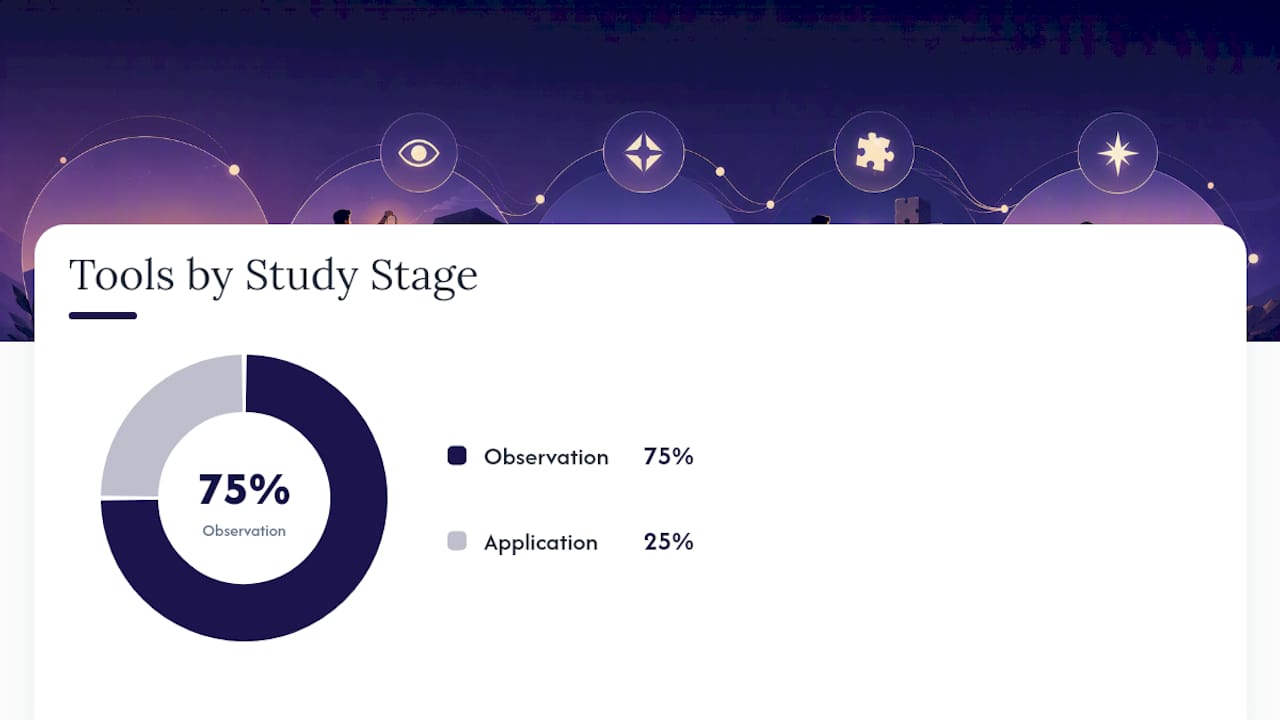
Study Bibles and commentaries still matter. Just use them second, after you’ve formed your own observations, the same wait-before-commentaries discipline that keeps your conclusions genuinely yours. When you’re ready for that stage, a study Bible buyer’s guide can help you pick one that fits how you study.
A minimal toolkit looks like this:
- A notebook or a notes app for your paraphrase, questions, and cross-references
- Two highlighter colors, one for repeated words and one for commands or promises
- A translation comparison tool for the observation stage
- A topical verse collection for finding related passages once you reach application
| Tool | Best Used During | What It’s For |
|---|---|---|
| Notebook or notes app | Observation | Recording paraphrase, questions, marked patterns |
| Highlighters | Observation | Marking repeated words, commands, connectives |
| Translation comparison | Observation | Spotting wording differences across versions |
| Topical verse collections | Application | Finding related passages for cross-reference and action steps |
How Do You Run a 30 to 60 Minute Inductive Study Session?
You don’t need a full afternoon to do this well. Here’s a session you can run today, built loosely on the seven-step framework compressed into one sitting.
- Pray (2 minutes). Ask for clarity and honesty about what the text says, not what you want it to say.
- Read the whole passage twice (5 minutes). Get the big picture before you zoom in.
- Observe (10 to 15 minutes). Mark repeated words, commands, and connectives. Answer the five W’s on paper.
- Interpret (10 to 15 minutes). Check immediate context, book context, and genre. Ask what the author intended for the original audience.
- Discern a principle and apply (10 minutes). Write one sentence: “Because this passage says ___, I will ___ this week.” Make it specific enough that you’ll know if you actually did it.
- Confirm and commit (5 minutes). Cross-reference one related verse. Tell someone your application, or write it somewhere you’ll see it again.
Example application statement: “Because James 1 says trials produce endurance, I will thank God for one specific hard thing in my day tomorrow instead of complaining about it.” Follow up by journaling what happened, or bringing your observations to a small group for feedback. Small-group discussion tends to sharpen individual conclusions, catching blind spots a solo reader misses.
Why Does Historical and Cultural Background Matter?
A passage written 2,000 to 3,500 years ago carries assumptions its original readers didn’t need explained. You do. Knowing that first-century wedding customs involved a groom’s extended absence to prepare a home changes how you read Jesus’s wedding imagery. Knowing that ancient Near Eastern covenants followed a specific structure, with stipulations, blessings, and curses, reshapes how Deuteronomy reads.
This isn’t a separate step bolted onto inductive study; it’s an extension of good observation. When you hit a custom, an idiom, or a reference that doesn’t make immediate sense, that’s your cue to look outward, not to guess. A study Bible’s introductory notes, a Bible dictionary, or a background commentary can fill the gap, but the same rule from earlier applies: use these after you’ve done your own observation and marked what you don’t understand.
Genre awareness fits here too. A parable functions differently than a genealogy, which functions differently than an apocalyptic vision. Reading Revelation’s imagery the way you’d read a straightforward historical narrative in Kings produces bad interpretation almost every time. Ask yourself what kind of literature you’re reading before you decide how literally to take a given phrase. That single question resolves more interpretive confusion than any other background check you can run.
Should You Do Word Studies and Use Original Language Tools?
Word studies are worth the effort, but only on words that matter to the passage, not every word in it. If a term repeats, carries theological weight, or seems to be doing more work than its English translation suggests, that’s a candidate. The Greek word “agape” versus “phileo” is the classic example. Both get translated “love” in English, but they carry different shades of meaning that matter enormously in a passage like John 21.
You don’t need to read Greek or Hebrew to do this responsibly. A Strong’s Concordance, an interlinear Bible, or a reputable online lexicon lets you look up the original word behind an English translation and see its range of meaning and other places it appears in Scripture. The discipline here is restraint: a word study is a magnifying glass on one term, not a license to reinterpret the whole passage around a single Greek word divorced from its sentence.
Cross-checking translations does double duty as an informal word study. When the ESV renders a phrase one way and the NLT renders it noticeably differently, that gap usually points to a translation decision worth investigating, and comparing three or four versions side by side often surfaces the question before you even open a lexicon.
How Should a Group Run Inductive Bible Study Together?
Group study amplifies the method rather than replacing individual work. Each person should still observe and interpret on their own before the group meets. The discussion works best as a refining process, not a first exposure to the text.
A workable rhythm: open with prayer, read the passage aloud together, then go around sharing observations before anyone offers interpretation. This order matters. If someone jumps straight to “this means,” it anchors the whole group’s reading and shuts down other people’s independent observations. Precept’s research on group study frames this well: participants test and refine their observations together, which only works if everyone brought their own material to the table first.
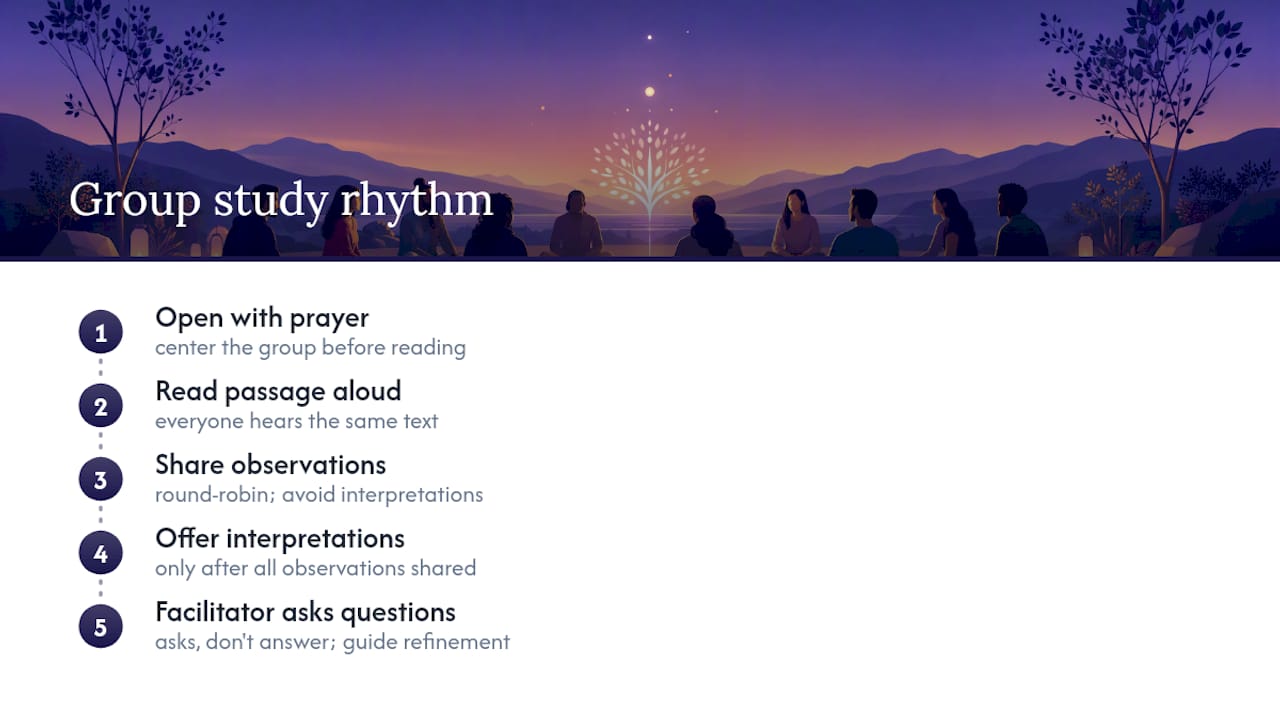
Assign a facilitator whose job is to ask questions, not supply answers. “What did you notice?” and “why do you think the author said it that way?” keep the group in observation and interpretation mode longer than a leader who lectures. Groups leading younger participants may want to adjust pacing and language; a guide to how younger adults engage Scripture offers useful framing for that adjustment. And if your group is transitioning insights into a Sunday teaching or lesson outline, a service planning checklist can help structure that handoff without losing the inductive groundwork.
How Do You Confirm an Interpretation Is Correct?
Scripture interpreting Scripture is the single most reliable check available to you. If your reading of a passage contradicts something clearly taught elsewhere in the Bible, that’s a signal to revisit your work, not to explain away the tension. Cross-referencing means finding other passages that address the same topic, character, or event, and asking whether your interpretation holds up against the fuller picture.
Start with parallel passages. Gospel accounts of the same event, for instance, often clarify details that one Gospel alone leaves ambiguous. Then widen to thematic cross-references: if you’re studying a passage on faith, check how the same author uses the term elsewhere, and how other authors use it. Consistency across authors and eras carries real weight; a wildly novel interpretation that no other biblical writer seems to share should raise your suspicion, not your confidence.
Reading the whole book multiple times before isolating a short passage is part of this same discipline. This habit prevents you from lifting a verse out of the author’s larger argument, which is where most bad interpretations start. A concordance or a well-organized topical verse collection makes this cross-referencing fast rather than tedious. If you’ve already built a habit of writing a personal paraphrase during observation, go back and check whether your paraphrase still holds once you’ve read the cross-references. If it doesn’t, that’s useful information, not a failure.
An Editorial Take on Doing This Well
Most advice on Bible study skips the part that actually matters: the discipline of waiting. Everyone agrees observation comes first in theory. In practice, people read a verse, feel a tug of familiarity, and jump straight to application before they’ve asked a single honest question about what the text says. The method doesn’t fail because it’s flawed. It fails because people don’t run it.
What’s underrated here is the pen. Writing forces a kind of attention that reading alone doesn’t. A paraphrase you write in your own words exposes gaps in your understanding that silent reading lets you glide past. If you take one thing from this method, take that: mark the page, write the paraphrase, resist the commentary for twenty more minutes.
Tools like translation comparisons and topical verse collections earn their place only when they support that discipline instead of replacing it. Use them to sharpen observation, not to skip it. The reader who does the slow work first is the one who actually changes.
— Nkosi
Ready to Put This Into Practice?
The fastest way to start is with a passage that already matters to you. BibleManna’s topical Bible verse collections organize Scripture by theme, so if you’re studying what the Bible says about work, strength, or getting through hard times, you can find a focused set of passages instead of hunting blind. Each entry includes context to help your observation stage, not shortcuts around it. Pick a topic, choose one passage, and run the 30 to 60 minute session outlined above this week.
Sources
- What is IBS? — Asbury Seminary guide
- What Is Inductive Bible Study? | Precept
- 7 Steps: How to Do an Inductive Bible Study — Logos
FAQ
What Are the Five W’s in Inductive Bible Study?
The five W’s are who, what, when, where, and why. Asking each of these during observation forces you to notice the specific details of a passage, the speaker, the audience, the setting, and the situation, before you attempt any interpretation.
What Is the Difference Between Inductive and Deductive Bible Study?
Inductive study starts with the text and lets observation lead to a conclusion about its meaning. Deductive study starts with a conclusion, doctrine, or theme and looks for verses to support it, which risks reading assumptions into the text rather than drawing meaning out of it.
What Are the Disadvantages of Inductive Bible Study?
It takes more time and discipline than reading a devotional or commentary summary, and beginners can misinterpret a passage without guardrails like context checks and cross-referencing. It also requires patience, since resisting the urge to consult commentaries early can feel slower than getting a quick answer.
Do I Need to Know Greek or Hebrew to Do Word Studies?
No. Tools like a Strong’s Concordance, an interlinear Bible, or a reputable online lexicon let you research the original word behind an English translation without reading the original languages yourself.
How Long Should a Beginner Spend on Observation?
Ten to fifteen minutes minimum for a single passage, more for longer or denser texts. Observation is the foundation the rest of the method rests on, so resist moving to interpretation until you’ve genuinely exhausted what you can notice on the page.