Jeremiah 29:11 Meaning: Hope in Exile, Not Instant Success

Jeremiah 29:11 is God’s promise of long-term shalom to Jewish exiles in Babylon, not a personal guarantee of quick prosperity. The verse was written to a specific community facing a 70-year exile, and its hope is real but patient. Ripping it from that context turns a profound covenantal promise into a bumper sticker.
The original addressees were not graduates or grieving families. They were deportees in a foreign empire, told by false prophets that rescue was coming soon. Jeremiah’s letter said the opposite: settle in, build houses, plant gardens, and trust a God whose timeline runs longer than your suffering. That is the Jeremiah 29:11 meaning that holds up under scrutiny.
Key Takeaways
Jeremiah 29:11 is a covenantal promise of long-term shalom to Jewish exiles in Babylon, not a personal guarantee of quick success for every individual reader.
| Point | Details |
|---|---|
| Original audience | The verse was written to Jewish exiles in Babylon facing a 70-year wait, not to individuals seeking personal breakthroughs. |
| Shalom means wholeness | The Hebrew word translated “prosper” means communal wholeness and restored relationship, not material wealth. |
| Read verses 12–14 too | The promise is activated through prayer and wholehearted seeking; verse 11 without verses 12–14 is incomplete. |
| Misuse causes real harm | Using the verse as a quick-comfort slogan at funerals or graduations strips its exile context and can mislead people in genuine suffering. |
| Biblemanna for deeper study | Biblemanna’s topical collections on hope, prayer, and encouragement pair full verse text with context notes for responsible application. |
Table of Contents
- Who first heard Jeremiah 29:11 and why the 70-year timeline changes everything
- How the letter structure of Jeremiah 29 frames the verse
- What the Hebrew words in Jeremiah 29:11 actually mean
- What scholars and pastors say about Jeremiah 29:11
- How to apply Jeremiah 29:11 in a difficult season
- Companion scriptures and a 7-day reading plan
- What Jeremiah 29:11 is not — and how to push back on misuse
- Related passages and where to read more
- Why the contextual reading actually changes pastoral practice
- Jeremiah 29:11 in context: Biblemanna’s curated resources
- Sources
- FAQ
Who first heard Jeremiah 29:11 and why the 70-year timeline changes everything
The verse lands differently once you know who was in the room. Around 597 BCE, Babylonian king Nebuchadnezzar deported a significant portion of Jerusalem’s leadership, craftsmen, and priests to Babylon. This was not a brief displacement. Viable Faith’s close contextual reading shows the verse follows Jeremiah’s announcement that the exile would last 70 years, meaning the first generation of exiles would almost certainly die before seeing restoration.
The key events leading to deportation:
- Late 7th century BCE: Babylon rises as the dominant regional power after defeating Assyria.
- 605 BCE: First Babylonian incursion; Daniel and others are taken.
- 597 BCE: Second deportation; King Jehoiachin and Jerusalem’s elite are exiled.
- 586 BCE: Jerusalem falls; the temple is destroyed; a third wave of exiles departs.
Why the 70-year horizon reshapes the verse:
- A 70-year exile means most recipients of Jeremiah’s letter would not personally experience the promised return.
- The promise was addressed to a community, not to individuals seeking personal career breakthroughs.
- GCU’s analysis notes that Jeremiah’s instructions to “settle” — build houses, plant gardens, marry and have children — show the verse counsels long-term endurance, not quick rescue.
That 70-year frame is the single most important fact for reading the verse honestly. God’s plans were real. They were also slow.
How the letter structure of Jeremiah 29 frames the verse
Jeremiah 29:11 is not a standalone quote. It sits inside a formal letter Jeremiah sent from Jerusalem to the exiles in Babylon, recorded in Jeremiah 29:1–14. Reading the verse in isolation is like reading a verdict without the trial.
The letter’s structure matters:
- Verses 1–3: Jeremiah sends the letter through royal messengers, establishing its authority.
- Verses 4–7: God commands the exiles to build, plant, marry, and — most strikingly — to “seek the welfare of the city” of Babylon and pray for it. Their shalom is tied to Babylon’s shalom.
- Verses 8–9: A direct warning against false prophets and diviners who are promising a quick return. This is the letter’s antagonist: Hananiah-style optimism that Jeremiah calls a lie.
- Verses 10–11: The actual promise. After 70 years, God will fulfill his word and bring the exiles home. Then comes verse 11.
- Verses 12–14: The mechanism. God will be found when the exiles seek him with their whole heart. Restoration follows prayer and pursuit, not passive waiting.
Crossway explains that applying the verse to believers today is valid, but only when read within Scripture’s wider covenantal story. Verse 11 is the promise; verses 12–14 are the path. Quoting one without the other is how the verse gets misused.
Jeremiah’s counsel to seek Babylon’s welfare is also worth sitting with. Faithful witness, the letter implies, looks like working for the good of the surrounding society even when that society is hostile. That is a harder ask than a motivational poster.

What the Hebrew words in Jeremiah 29:11 actually mean
The phrase-by-phrase meaning of Jeremiah 29:11 turns on four Hebrew terms that most English translations compress or soften.
Key Hebrew terms:
- Machashavot (plans/thoughts): This word implies deliberate, purposeful intention. God is not reacting to events; he is actively thinking toward the exiles. The word carries weight, not vagueness.
- Shalom (often translated “prosper” or “welfare”): BibleProject argues this is the verse’s most misread word. Shalom means wholeness, peace, and restored relationship — communal and covenantal, not personal material success. Translating it as “prosper” nudges readers toward a prosperity-gospel reading the Hebrew does not support.
- Ra’ah (harm/evil): The contrast is not between wealth and poverty but between God’s restorative intent and the destructive consequences of sin and exile.
- Acharit and tikvah (future and hope): Acharit literally means “what comes after” — an end or outcome. Tikvah is the word for hope, carrying the sense of expectation and waiting. Together they point forward without specifying a timeline.
How major translations render the verse:
| Translation | Key phrase | Interpretive weight |
|---|---|---|
| NIV | “plans to prosper you” | Most widely used; “prosper” risks material reading |
| ESV | “plans for welfare and not for evil” | Closer to shalom; “welfare” is more communal |
| NASB | “plans for welfare and not for calamity” | Precise; “calamity” echoes the exile’s devastation |
| KJV | “thoughts of peace, and not of evil” | “Thoughts” captures machashavot; “peace” reflects shalom |
The ESV and NASB renderings stay closer to the Hebrew’s communal register. The NIV’s “prosper” is not wrong, but it is the translation most vulnerable to being read as a financial promise. Crossway’s analysis reinforces that shalom here denotes wholeness and restored relationship, not wealth.
What scholars and pastors say about Jeremiah 29:11
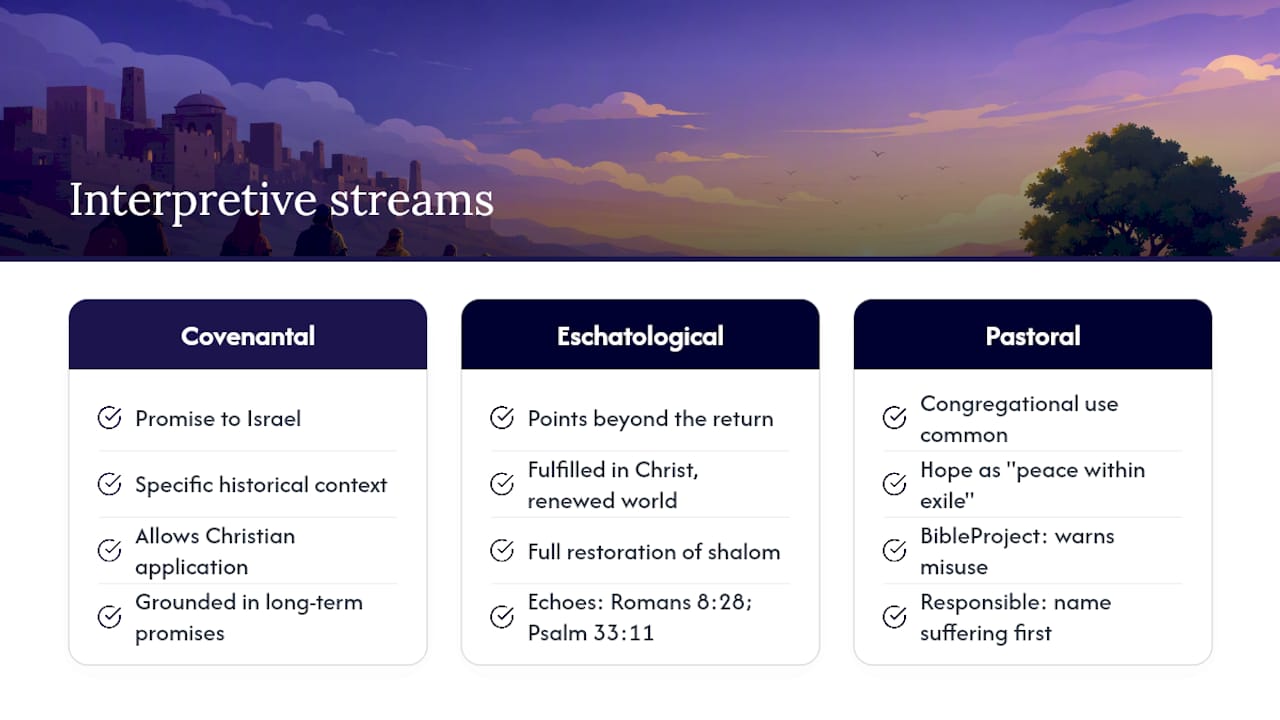
Three broad interpretive streams run through the scholarly and pastoral literature, and they are not mutually exclusive.
Covenantal/historical reading: This is the baseline scholarly position. The promise belongs first to Israel as a covenant community. God made specific commitments to a specific people at a specific historical moment. GotQuestions distinguishes the original particular promise to Israel from broader applications to believers and warns against universalizing the verse without that context. The covenantal reading does not deny application to Christians; it insists that application must be grounded in the same God who keeps long-term promises.
Eschatological reading: Some theologians read Jeremiah 29:11 as pointing beyond the Babylonian return to the new creation. The full restoration of shalom — wholeness, peace, right relationship — is not completed when the exiles return in 538 BCE. It finds its ultimate fulfillment in Christ and the renewed world. Romans 8:28 (“all things work together for good”) and Psalm 33:11 (“the plans of the Lord stand firm forever”) echo this forward-looking hope.
Pastoral/practical reading: This is where most congregational use lives, and it is also where the most damage gets done. BibleProject’s scholarship argues the modern use of the verse as a life-success slogan misses its brutal context entirely. The verse offers hope as “peace within exile,” not a promise of easy escape. Responsible pastoral use names the suffering first, then points to God’s long-term faithfulness. Irresponsible use skips the exile and goes straight to the prosperity.
Russell Moore has written about this, noting that a correct pastoral use emphasizes God’s presence and providence across long, difficult processes, not guaranteed short-term relief for every individual.
How to apply Jeremiah 29:11 in a difficult season
The verse is not useless for personal application. It is just more demanding than a greeting card suggests. Here is what faithful engagement with it looks like in practice.
Steps grounded in the text itself:
- Read verses 12–14 alongside verse 11. God’s promise is activated through prayer and wholehearted seeking. Verse 12 says, “Then you will call on me and come and pray to me, and I will listen to you.” The promise is not passive.
- Name the exile before claiming the hope. What is the hard season you are actually in? Naming it honestly is not faithlessness; it is what the exiles had to do before Jeremiah’s letter meant anything to them.
- Settle in. Jeremiah told the exiles to build houses and plant gardens. What does that look like for you? Investing in community, maintaining spiritual disciplines, serving others — these are the “build and plant” equivalents.
- Seek the welfare of your Babylon. Pray for your city, your workplace, your difficult relationships. The exiles’ shalom was tied to Babylon’s shalom. Yours may be tied to the flourishing of people and places you did not choose.
- Pair the verse with Bible verses on perseverance. Long seasons of hardship need more than one verse. Passages on endurance give the verse company it needs.
Reflection questions:
- What would “settling in” look like in your current circumstances rather than waiting for rescue?
- Are you seeking God with your whole heart (v. 12), or are you treating the promise as automatic?
- Who in your community is also in exile? How can you seek their welfare alongside your own?
A short prayer rooted in the verse:
Lord, I believe your plans are for my wholeness, not my harm. Help me to settle where you have placed me, to seek your face with my whole heart, and to trust that your timeline is longer and better than mine. Give me hope that holds through the long wait.
Pro Tip: For pastors using this verse at funerals or graduations, lead with the exile before the promise. Say something like: “This verse was written to people who had lost everything and were told the wait would be long. That is exactly why it has something real to say to us today.” That framing honors suffering and makes the hope credible.
Companion scriptures and a 7-day reading plan
Jeremiah 29:11 gains its full weight when read alongside the passages that surround and echo it. Here is a curated list with brief context notes, drawn from Biblemanna’s topical collections.
Companion passages:
- Jeremiah 29:12–14 — The mechanism of the promise: prayer, seeking, and God’s response. Never quote verse 11 without reading these three.
- Jeremiah 31:31–34 — The new covenant passage. God’s long-term plan for Israel points forward to a restored relationship written on the heart.
- Romans 8:28 — “All things work together for good for those who love God.” The New Testament echo of Jeremiah’s covenantal hope, now grounded in Christ.
- Psalm 33:11 — “The plans of the Lord stand firm forever.” A direct parallel to machashavot; God’s intentions are not derailed by exile or empire.
- 1 Peter 2:11 — Peter addresses Christians as “foreigners and exiles.” The exile metaphor carries directly into New Testament ecclesiology.
- Isaiah 65:17–25 — The eschatological vision of shalom: a new creation where the plans of Jeremiah 29:11 find their ultimate completion.
Suggested 7-day reading order:
Day 1: Jeremiah 29:1–14 (the whole letter). Day 2: Jeremiah 31:31–34. Day 3: Psalm 33:1–11. Day 4: Romans 8:18–30. Day 5: 1 Peter 1:3–9. Day 6: Isaiah 65:17–25. Day 7: Return to Jeremiah 29:11 and journal what has shifted.
For a prayer-focused reading, Jeremiah 29:12–14 pairs naturally with Philippians 4:6–7 and Matthew 7:7–11. If you want to build a prayer room or devotional space around these themes, anchoring it visually with a verse like Jeremiah 29:11 or Romans 8:28 can help make the practice stick.
Biblemanna’s topical collections on hope and faith are organized with context notes for each verse, which makes them useful for both personal devotion and pastoral preparation.
What Jeremiah 29:11 is not — and how to push back on misuse
The verse’s popularity has outrun its context, and the gap causes real harm to people in genuine suffering.
Common misuses:
- Personal guarantee of quick success. The verse is addressed to a community facing a 70-year wait. Using it to promise someone that their job search, health crisis, or broken relationship will resolve soon is not what the text says.
- Funeral and graduation platitudes. Athletes in Action notes that presenting the verse as an upbeat slogan to grieving or transitioning people can mislead them if the exile context is stripped away. A grieving parent does not need a bumper sticker; they need the God who speaks into 70-year waits.
- Proof-texting for unrelated promises. The verse is sometimes used to justify specific decisions (“God told me this business will prosper”) in ways that go far beyond what the text claims.
- Prosperity gospel readings. Translating shalom as material wealth and machashavot as a personal success plan misreads both the Hebrew and the historical situation.
Why these misuses happen:
The NIV’s “prosper” is partly responsible. Cultural pressure to fix suffering quickly also plays a role — it is easier to hand someone a verse than to sit with them in their Babylon. GotQuestions warns against reading the verse as a universal personal promise without its covenantal context.
Model pastoral responses:
- “This verse was written to people in the middle of a long, painful exile. It does not promise quick rescue. It promises that God’s intentions toward you are for wholeness, and that he will be found when you seek him.”
- “The hope here is real, but it is patient hope. Let’s sit with that together.”
Related passages and where to read more
A few passages that deepen the themes of Jeremiah 29:11, with short notes on what each adds:
- Jeremiah 31 — The new covenant. God’s plan for restoration extends beyond the Babylonian return to a fundamental renewal of relationship.
- Isaiah 65:17–25 — The new creation vision. Shalom in its fullest eschatological form.
- Romans 8:28 — Paul’s covenantal echo. God’s purposes hold even through suffering, grounded now in Christ’s resurrection.
- Psalm 33:11 — God’s plans (machashavot) stand forever. A direct Old Testament parallel.
- 1 Peter 2:11 — Christians as exiles. Peter applies the exile metaphor to the church’s identity in the world.
For further reading, Biblemanna’s Bible verses by topic index covers hope, perseverance, prayer, and encouragement with full verse text and context notes. The perseverance collection is particularly useful for anyone in a long, difficult season who needs more than one verse to hold onto.
For academic depth, the sources cited throughout this article — BibleProject, Crossway, GotQuestions, GCU, and Viable Faith — each offer accessible, well-researched treatments of the verse’s context and application.
Why the contextual reading actually changes pastoral practice
Reading Jeremiah 29:11 in its exile context is not an academic exercise. It changes what you say to someone who is suffering.
The decontextualized version of the verse offers a kind of spiritual anesthesia: God has a plan, so feel better. The contextual version offers something harder and more sustaining: God’s plans are real, they are oriented toward your wholeness, and they hold even when the wait is 70 years long. That second version can actually survive contact with grief, job loss, illness, and broken relationships. The first one often cannot.
Scholarship and pastoral care are not opposites here. Knowing what shalom means, knowing who first heard this letter, knowing that Jeremiah was countering false prophets who promised quick rescue — all of that makes you a better friend to someone in pain, not a colder one. Pair this kind of study with community and prayer, and the verse becomes what it was always meant to be: a covenant anchor, not a comfort cliché.
Jeremiah 29:11 in context: Biblemanna’s curated resources
Jeremiah 29:11 points toward shalom, prayer, and long-term trust in God’s purposes. Biblemanna’s topical verse collections are built for exactly this kind of study: each page pairs the full verse text with context notes so you can read a passage the way it was meant to be read, not in isolation.

The Bible verses by topic index covers hope, perseverance, prayer, encouragement, and faith, with curated collections that work for personal devotion, small group study, or pastoral preparation. If Jeremiah 29:11 has opened a question about what God’s plans look like in a hard season, the encouragement collection and the faith topic page are good next stops. Browse the full index and find the passages that speak to where you actually are.
Sources
- What Does Jeremiah 29:11 Mean? — BibleProject
- What Does Jeremiah 29:11 Mean? | Crossway
- Theology Thursday: Jeremiah 29:11 in Context | GCU Blog
- Gotquestions
- Jeremiah 29:11 – Comprehensive Analysis - Viable Faith
FAQ
What does Jeremiah 29:11 mean in its original context?
God promised the Jewish exiles in Babylon that his plans were oriented toward their shalom (wholeness and restored relationship), not their destruction, with restoration coming after a 70-year exile. The verse was never a personal promise of quick individual success.
How should Christians apply Jeremiah 29:11 today?
Christians can apply the verse by trusting God’s long-term covenantal faithfulness, but only when they read it alongside verses 12–14, which show that the promise is realized through prayer and wholehearted seeking, not passive expectation.
What does “plans to prosper you” mean in Hebrew?
The Hebrew word shalom (translated “prosper” in the NIV) means wholeness, peace, and communal well-being, not material wealth. Paired with machashavot (deliberate plans/intentions), the phrase describes God’s purposeful orientation toward restoration, not a financial guarantee.
What does God’s plan mean in Jeremiah 29:11?
God’s plan (machashavot) refers to his intentional, purposeful commitment to restore the exiles after 70 years, grounded in the covenantal relationship between God and Israel, not a blueprint for every individual’s personal ambitions.
Is Jeremiah 29:11 being misused in modern Christianity?
Yes. The verse is widely used as an upbeat slogan on cards and social media, stripped of its exile context. That use can mislead people in genuine suffering by implying quick rescue, which is precisely what Jeremiah’s letter told the exiles not to expect.