Matthew 6:33 Meaning: Seek God’s Kingdom First

Matthew 6:33 meaning, in plain terms: Jesus commands his followers to make God’s kingdom and God’s righteousness their primary, ongoing pursuit, and promises that when they do, he will provide what they need. That’s the whole verse in one sentence.
But read the second half carefully, because it’s where most people trip up. This is a promise about provision, food, clothing, the basics Jesus just spent several verses talking about, not a formula for wealth, career success, or answered prayer on demand. The verse doesn’t say seek the kingdom and you’ll get whatever you want. It says seek the kingdom and God will handle what you actually need.
A few things worth knowing before we dig into the Greek and the context:
- The command is present tense, meaning ongoing, repeated seeking, not a one-time decision.
- “First” sets an order of priorities, not a strict sequence where kingdom comes before everything else in time.
- The provision promised is tied directly to the anxieties Jesus just named: food, drink, clothing.
Biblemanna exists partly for moments like this, when a single verse deserves more than a surface read. Let’s get into what the words actually mean and how this plays out in daily life.
Key Takeaways
Matthew 6:33 works because it replaces anxious self-provision with ongoing, priority-driven trust in God, without promising instant wealth in return.
| Point | Details |
|---|---|
| The core command is continuous | The Greek imperative ζητεῖτε means ongoing seeking, not a one-time decision. |
| “First” means priority, not sequence | Πρῶτον sets what matters most, not a strict order of events in your day. |
| Provision covers needs, not wants | The promise addresses food and clothing anxieties, not career or financial windfall. |
| Matthew adds emphasis Luke doesn’t | Matthew’s “first” and “his righteousness” sharpen the parallel found in Luke 12:31. |
| Application beats analysis alone | Daily habits, prayer, budgeting, hospitality, turn the verse into lived practice. |
Table of Contents
- What Do the Greek Words in Matthew 6:33 Actually Mean?
- How Does Matthew 6:33 Fit Into Jesus’ Teaching on Worry?
- What Are the Main Interpretations of Matthew 6:33?
- How Do You Actually Seek the Kingdom First?
- Where Can You Study Matthew 6:33 Further?
- What the Conventional Reading of Matthew 6:33 Gets Wrong
- Sources
- FAQ
What Do the Greek Words in Matthew 6:33 Actually Mean?
Three Greek terms carry the theological weight of this verse, and the grammar matters more than most English translations let on.
Ζητεῖτε (zēteite), translated “seek,” is a present active imperative. That’s a command form built for continuous action, not a single event. BibleHub’s lexicon entry confirms this grammatical detail, and it changes how you read the whole verse. Jesus isn’t asking for a decision made once at an altar. He’s asking for a posture maintained daily, the kind of seeking that shows up again tomorrow and the day after.

Πρῶτον (prōton), “first,” functions as an adverb of priority rather than a marker of sequence. It answers the question “what matters most,” not “what happens chronologically first.” That distinction keeps the verse from becoming a checklist item you complete before moving to your real life.
Δικαιοσύνη (dikaiosunē), “righteousness,” ties kingdom pursuit to ethical living. This isn’t ritual correctness or church attendance. It’s the kind of just, faithful conduct woven through the rest of the Sermon on the Mount.
Manuscript note: Some translations render the phrase “his righteousness,” while others simplify to just “righteousness.” The variation affects emphasis slightly (whose standard of righteousness is meant) but doesn’t change the core command.
Grammatical callout: The present active imperative in ζητεῖτε is the single most important grammatical detail in this verse. It’s the difference between “seek once” and “seek as a way of life.”
How Does Matthew 6:33 Fit Into Jesus’ Teaching on Worry?
Matthew 6:33 doesn’t stand alone. It caps a section, Matthew 6:25 through 34, where Jesus repeatedly tells his listeners not to worry about their lives, using birds and wildflowers as evidence that God already provides for creatures with far less capacity to plan than humans have.
The chapter builds an argument, then lands the punchline in verse 33. Worry gets addressed first (verses 25 to 32), and the resolution arrives last: seek the kingdom, and the provision follows.
- Matthew 6:25 to 32 dismantles anxiety about material needs using nature as the argument.
- Matthew 6:33 delivers the positive command that resolves the worry.
- Matthew 6:34 closes with a practical note about not borrowing tomorrow’s trouble.
Luke’s Gospel records a parallel saying in Luke 12:31, but Matthew’s version adds two words Luke doesn’t include: “first” and “his righteousness.” Comparative analysis of the two passages shows this isn’t a contradiction. Both teach the same core principle, but Matthew’s additions sharpen the point toward deliberate priority and ethical conduct, not just kingdom awareness in general. That addition matters for anyone doing a serious Matthew 6:33 in context study, since it shows Matthew wanted his readers to link trust in God’s provision with a life ordered around righteousness.
What Are the Main Interpretations of Matthew 6:33?
Three interpretive threads show up consistently across serious commentary on this verse, and each one guards against a different misreading.
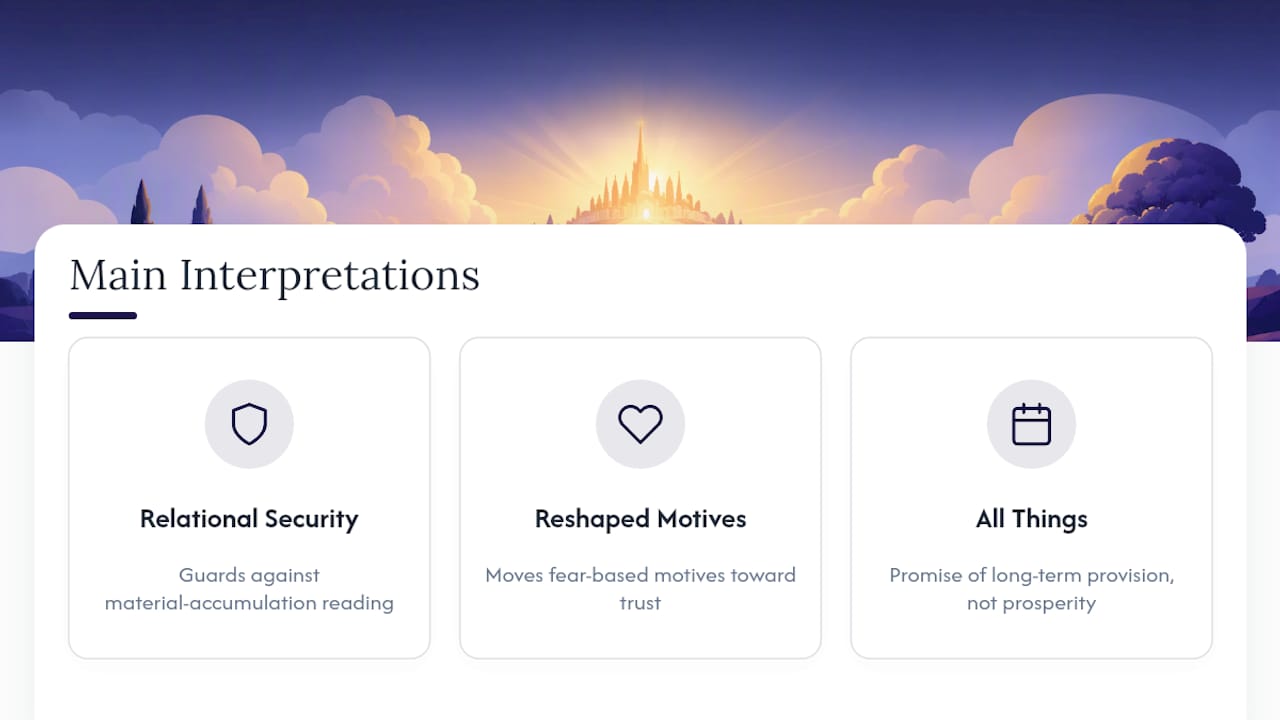
The first treats the kingdom as relational security rather than material accumulation. BibleProject’s analysis frames the verse as reshaping motives, moving someone from fear-based self-protection toward a life rooted in relationship with God. Under this reading, “all these things will be added to you” isn’t a vending machine promise. It’s a description of what happens when your foundational anxiety gets replaced by trust.
The second thread is more pastoral and practical. GotQuestions summarizes the command as a shift in priority that changes attitude rather than eliminating responsibility. You still go to work. You still pay bills and plan meals. Seeking the kingdom first doesn’t excuse you from ordinary daily duties; it reorders why you’re doing them.
The third thread wrestles with timing. BibleProject’s own reading of “will be added to you” treats the promise as pointing toward long-term fulfillment, not an instant transaction.
The kingdom-first life doesn’t promise you’ll never worry about a bill again. It promises that your deepest security stops depending on the size of your bank account.
That last point deserves its own warning: Matthew 6:33 is not a prosperity formula. Nothing in the verse or its immediate context supports the idea that seeking God guarantees financial windfall, career advancement, or health. It guarantees provision for genuine need, on God’s timeline, defined by God’s wisdom, not yours.
How Do You Actually Seek the Kingdom First?
Understanding Matthew 6:33 explained on paper is one thing. Living it out is another, and it usually comes down to small, repeated choices rather than one dramatic decision.
- Start your day with Scripture before your phone. Even five minutes of reading before checking email resets what gets your first attention.
- Build a short morning prayer into your routine. It doesn’t need to be long. It needs to happen regularly, matching the ongoing sense of ζητεῖτε.
- Protect a weekly rest. A Sabbath rhythm is a physical declaration that your productivity isn’t what sustains you.
- Set a budget that reflects kingdom priorities. Generosity built into your numbers, not left to spontaneous impulse, is a concrete way to test where your trust actually lives.
- Prioritize hospitality and neighbor care over convenience. Kingdom-shaped relationships often cost you time you’d rather spend on yourself.
Two questions work well as a nightly check: “Where did I spend my best energy today?” and “What did I choose sacrificially?” If the honest answers never touch anything kingdom-related, that’s worth sitting with.
Pro Tip: Keep a running list titled “Kingdom First” in your notes app. Each week, jot one decision, financial, relational, or time-related, where you chose the kingdom over the easier default. Reviewing that list monthly shows you patterns no single day reveals.
Financial stewardship questions specifically connect to a wider set of Bible verses about money worth reading alongside this passage, and readers wrestling with the anxiety Jesus addresses in verses 25 through 32 often find it helpful to pair this study with devotional reflections like Grace Notes from The Broken Seam.
Where Can You Study Matthew 6:33 Further?
Studying a verse like this works best with a curated set of related Scripture close at hand, rather than searching one-off each time worry or financial stress hits.
Biblemanna organizes exactly that kind of resource. The 43 Bible Verses About Anxiety collection pairs directly with the “do not worry” section that leads into Matthew 6:33, giving you a fuller biblical picture of how Scripture addresses fear over provision. The 32 Bible Verses About Trusting God page works well for memorization, short verses you can carry through a stressful week. And the full Bible Verses by Topic index is a solid starting point if you want to build your own prayer bookmarks or daily reading prompts around kingdom-first living.
A verse this dense rewards slow, repeated reading paired with related Scripture, not a single pass and moving on.
Try building a short memorization list from two or three of these pages, then revisit it during your morning prayer time for a week. That’s a practical way to turn ζητεῖτε from a Greek grammar lesson into an actual habit. If you’re setting up a dedicated space for that daily rhythm, even a small prayer corner, simple steps for creating a faith-focused room can help make the practice stick.
For readers ready to go deeper into related themes, Biblemanna’s full topical index covers everything from provision to purpose, organized so you’re not starting from scratch every time a new question comes up.
What the Conventional Reading of Matthew 6:33 Gets Wrong
Most popular treatments of this verse split into two unhelpful camps. One turns it into a prosperity slogan, quietly implying that enough spiritual effort unlocks financial blessing. The other treats it as harmless encouragement, a nice sentiment to feel good about without changing anything concrete in how you spend your Tuesday.
Neither holds up against the grammar. The present imperative in ζητεῖτε demands repeated action, and that’s a much higher bar than a feel-good read allows. At the same time, nothing in the Greek or the surrounding context in Matthew 6:25 to 34 supports treating the verse as a wealth guarantee.
What the text actually supports is something harder and more honest: a daily, unglamorous reordering of attention, time, and money around God’s priorities, with provision for genuine needs as the result, on God’s schedule rather than yours. That’s less exciting than a prosperity promise and more demanding than a comfort verse. It’s also, based on everything the grammar and context actually say, the more faithful reading. Readers who treat this as a slow practice rather than a single insight tend to describe less anxiety over time, not because their circumstances changed overnight, but because their definition of security did.
Sources
- What Matthew 6:33 (Seek First the Kingdom of God) Means
- What does it mean to seek first the kingdom of God?
- Matthew 6:33 Lexicon
FAQ
What does it mean to seek first the kingdom of God and his righteousness?
It means making God’s rule and ethical standards your primary, ongoing priority in daily decisions, trusting that he’ll provide for your genuine needs as a result.
How do we seek the kingdom of God and his righteousness practically?
Through repeated daily choices, prayer, Scripture reading, generous giving, and ethical living, rather than a single decision made once and left alone.
Is Matthew 6:33 a promise of financial success?
No. The verse promises provision for real needs like food and clothing, not wealth, career advancement, or instant material blessing.
How can I apply Matthew 6:31 to 33 to my life?
Start by replacing anxious planning with a daily rhythm of prayer and Scripture, then let that priority shape your budget and relationships over time.
Why does Matthew’s version of this teaching differ from Luke 12:31?
Matthew adds “first” and “his righteousness,” sharpening the emphasis on deliberate priority and ethical conduct alongside the kingdom pursuit that Luke also describes.