One Week, Five Steps to Memorize Bible Verses with a Pastor’s Plan

The fastest way to memorize Bible verses is active recall paired with spaced repetition, practiced in short daily sessions instead of one long cram. Learn the verse using a technique like first-letter prompts or handwriting, then quiz yourself from memory on a schedule that stretches out over days and weeks. Curated topical lists can make picking the right verse to start with far easier than guessing.
TL;DR:
- Memorizing Bible verses is most effective when combining active recall with spaced repetition, practiced through short daily sessions over weeks.
- Starting with a personally relevant, short verse and writing it out helps encode it better before using recall and review cycles.
- Longer passages benefit from sequence-preserving techniques like chunking or memory palaces, especially for full chapters, whereas short verses need simpler methods.
- Regular review over at least 12 weeks, gradually increasing intervals, is crucial for long-term retention, with some experts suggesting up to 100 days of review.
- Using targeted topical lists and tools like spaced-repetition apps or index cards can streamline the process, especially as your collection grows past a handful of verses.
Table of Contents
- How Do I Memorize Bible Verses Quickly?
- Which Memorization Technique Actually Works Best?
- How Should I Build a Long-Term Review Schedule?
- How Do I Choose Which Bible Verses to Memorize?
- What Tools Actually Help You Remember Scripture?
- A Pastor’s Note on Making This a Lifelong Habit
- Let BibleManna Do the Hard Part of Choosing What to Memorize
- Sources
- FAQ
How Do I Memorize Bible Verses Quickly?
Start with one verse and a five-step plan you can finish in a week. A great resource to explore more options is Find Bible Schools — Compare Accredited Bible Colleges & Theology Programs. Most people who quit scripture memorization don’t fail because the method is wrong. They fail because they never had a plan past day one.
Here’s the sequence that works, in order:
- Run active recall cycles. Look at the verse, look away, say it out loud, then check what you missed. Repeat this three or four times in a single sitting. This is the actual learning, not the reading.
- Follow a review schedule for days one through seven. Review the verse twice on day one, once on day two, then every other day through day seven. Five minutes at breakfast or five minutes before bed covers it.
- Attach a retrieval cue. Tie the verse to an image, a location, or a tune. Pairing a verse with a personal cue makes it surface naturally in real moments, not just during study time, far more than rehearsal alone.
Pro Tip: Test yourself before you think you’re ready. Most people move to review too early because recognizing a verse feels like knowing it. Recall is a different skill, and it’s the only one that matters when you need the verse in a real moment.
Which Memorization Technique Actually Works Best?
None of them work alone. Every proven technique for scripture memory is really an encoding method, a way to get the verse into your head, and it still needs active recall and spaced repetition to make it stick long-term. Combining a learning technique like melody or first-letter prompts with a retention technique like spaced review consistently produces better long-term results than either one by itself.
Here’s how the main techniques break down and when each one earns its place:
- Active recall is the practice of retrieving a verse from memory rather than rereading it. It’s the single most tested method for durable retention and the backbone every other technique should support.
- Spaced repetition spreads your review sessions out over increasing intervals instead of clustering them. Multiple memorization resources point to this combination of active recall and spaced review as the actual retention engine behind long-term scripture memory.
- First-letter method replaces each word with its first letter, so “For God so loved the world” becomes “FGsltw.” You write out the cue, then force yourself to recall the full text from it. This converts a passive glance into a real recall attempt, which is the whole point.
- Copy work (handwriting or typing) slows down initial exposure enough for motor memory to help encode the words, not just your eyes.
- Memory palace (method of loci) attaches phrases to specific spots along a familiar route, like your walk from the front door to the kitchen. It shines on longer, sequence-heavy passages like a whole psalm or chapter, where order matters more than any single phrase.
- Rhythm and song turn a verse into something closer to a jingle than a sentence. If you’ve ever noticed you can sing a chorus you haven’t heard in years, you already know why this works.
- Chunking breaks a long verse or passage into three or four phrase-sized pieces you learn separately before stitching them together. It’s the difference between memorizing a whole phone number at once and learning it in blocks.
- Imagery builds a mental picture for a phrase, turning abstract language into something visual and easier to hold onto.
Memory palace and chunking earn their keep specifically on longer material. If you’re tackling a full chapter rather than a single verse, sequence-preserving techniques like these matter more than they do for a one-line memory verse.
Pro Tip: Match the technique to the verse’s shape. A short, punchy verse like Philippians 4:13 barely needs a memory palace. A full psalm does. Pick the tool for the job, not the tool that’s trendy.
How Should I Build a Long-Term Review Schedule?
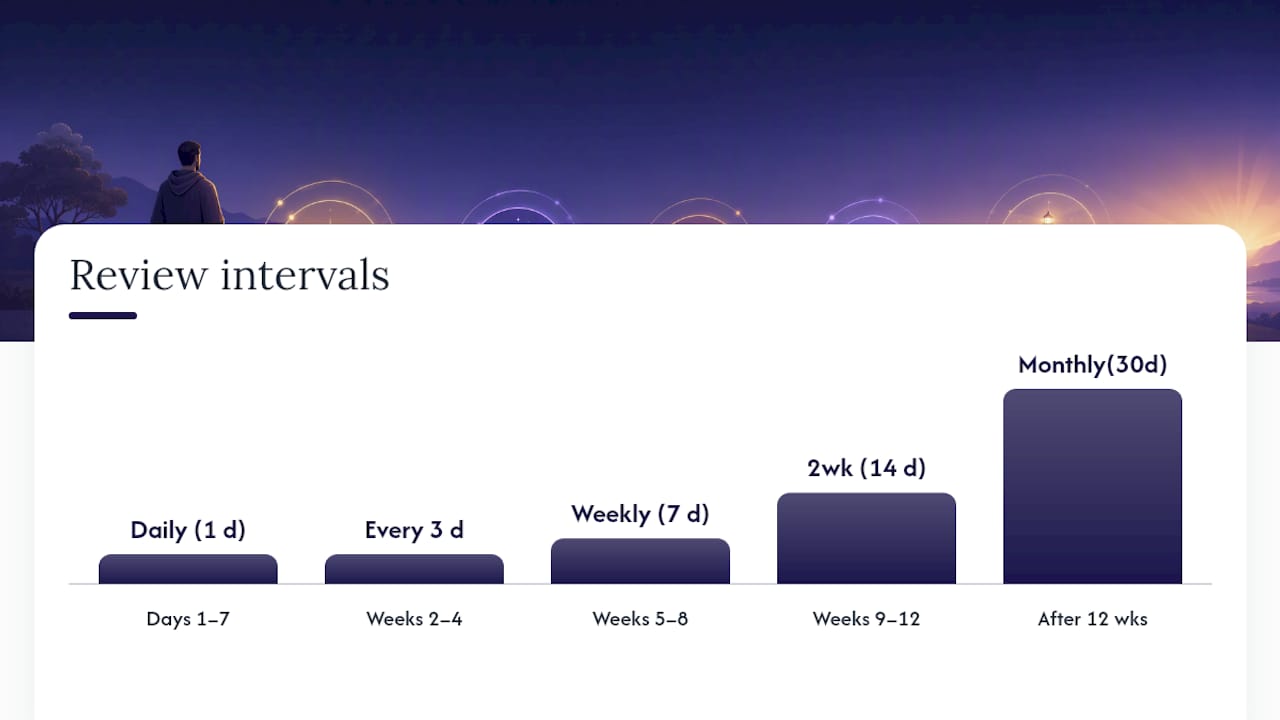
Your review schedule matters more than your learning technique once the first week is over. Most memorization failures don’t happen during learning. They happen during review, when people quietly stop checking a verse they assume they’ve “got.”
A workable interval progression for the first twelve weeks looks like this:
- Days 1 to 7: Review daily, ideally twice on day one and once every day after.
- Weeks 2 to 4: Review every three days.
- Weeks 5 to 8: Review once a week.
- Weeks 9 to 12: Review every two weeks.
- After 12 weeks: Shift to a monthly check-in, folding the verse into a rotating “maintenance” list.
Some experienced memorists push this even further, recommending 100 days of review for a verse you want to own for life. That’s a longer horizon than most beginners need, but it signals something important: durable retention is a function of time spent reviewing, not how well you learned it on day one.
As your list grows past ten or fifteen verses, you need a way to track what’s due. Index cards sorted into “daily,” “weekly,” and “monthly” stacks work fine for a small collection. A simple spreadsheet with a “last reviewed” column scales better once you hit twenty or thirty verses. A spaced-repetition app automates the schedule entirely and tells you exactly what’s due each morning. “Retire” a verse to a quarterly check only after it survives at least two full review cycles without a slip.
Three pocket routines cover most people’s day without adding a new habit to protect:
- Morning coffee routine: Recite yesterday’s verse out loud while the coffee brews, five minutes, done before you check your phone.
- Commute routine: Say the current week’s verse from memory at every red light or bus stop, no notes allowed.
- Bedtime routine: Review one “maintenance” verse from an older week right before lights out, when quiet recall sticks best.
How Do I Choose Which Bible Verses to Memorize?
Choose verses by relevance first, length second. A short verse that speaks directly to what you’re facing right now, anxiety, doubt, a hard relationship, will outlast a longer, more “impressive” verse you picked because it sounded like something a serious Christian should know.
Three criteria matter more than any ranked list:
- Personal relevance. A verse tied to a current prayer, struggle, or season sticks because you have a reason to retrieve it.
- Length and context. Single verses are easier entry points; full passages need chunking or a memory palace and more calendar time.
- Occasion. Some verses serve prayer, some serve moments of temptation, some serve encouragement on a hard day. Knowing which bucket a verse fills helps you actually use it later.
Once you have a handful of verses, organize them instead of letting them pile up loosely. Topical folders (peace, strength, faith, encouragement) beat a flat list because you can grab what fits the moment. If you’re working through a whole chapter, treat it as one chunked unit rather than a string of unrelated verses. Tagging by season, Advent, a hard year, a new job, gives you a way to revisit old verses when life circles back to a familiar struggle.
This is where a curated topical collection saves real time. Instead of scrolling a “top 100” list and guessing, you can start from a theme that already matches your need. New memorizers especially benefit from working through a themed list, like verses about encouragement, rather than trying to tackle an intimidating, unsorted mega-list on day one.
What Tools Actually Help You Remember Scripture?
Tools split into four categories, and which one you need depends on how many verses you’re juggling and how you like to practice. Spaced-repetition apps automate your review schedule, surfacing the right verse on the right day without you tracking anything manually. That’s the right call once you’re past ten or fifteen verses and the mental math of “when did I last review this” gets unreliable.
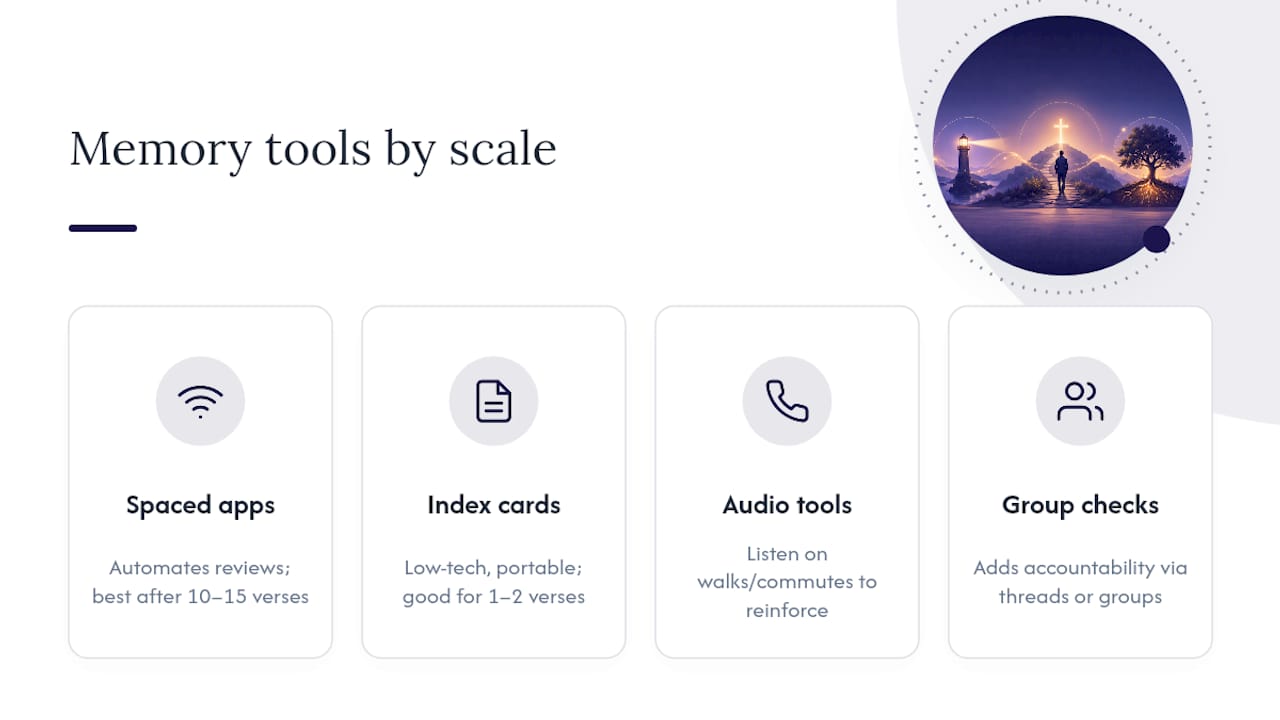
Index-card systems are the low-tech version of the same idea. They’re fully portable, work without a phone, and force the same active recall the apps automate. Audio and recording tools let you listen to a verse read aloud on a commute or during a walk, which reinforces the words through a different channel than reading. Group tools, a text thread, a small group check-in, add the accountability piece that solo memorization usually lacks.
On the selection side, BibleManna’s topical verse pages solve the “which verse do I even start with” problem by organizing scripture around real emotional and life-stage categories instead of arbitrary lists. The Random Verse Generator and Bible Quiz tools add variety to plain review, since free, low-friction tools make it easier to sustain short daily practice than a static printed list ever does.
If you’re memorizing one or two verses a month, index cards or a simple list are enough. If you’re building toward a real collection, twenty, fifty, a hundred verses, an app-based review system paired with a topical starting point will save you from the spreadsheet chaos that kills most long-term efforts.
A Pastor’s Note on Making This a Lifelong Habit
Scripture memory isn’t a productivity project. It’s how the Word becomes something you carry instead of something you look up.
My working routine is unglamorous: one verse a week, reviewed over coffee and again before bed, no exceptions for busy weeks.
Start smaller than feels necessary. One verse, fully owned, beats five verses half-remembered. Celebrate the moment a verse surfaces on its own, uninvited, in a hard conversation or a quiet drive. That’s the actual goal, and it happens more often than beginners expect once the habit takes hold.
— Nkosi
Let BibleManna Do the Hard Part of Choosing What to Memorize
Picking the right verse is often the biggest obstacle to starting, and that’s exactly where BibleManna saves you the guesswork a flat “top 100” list can’t solve. Instead of scrolling an intimidating mega-list, you start from a real need, comfort, strength, faith, and work from a collection already organized around it.
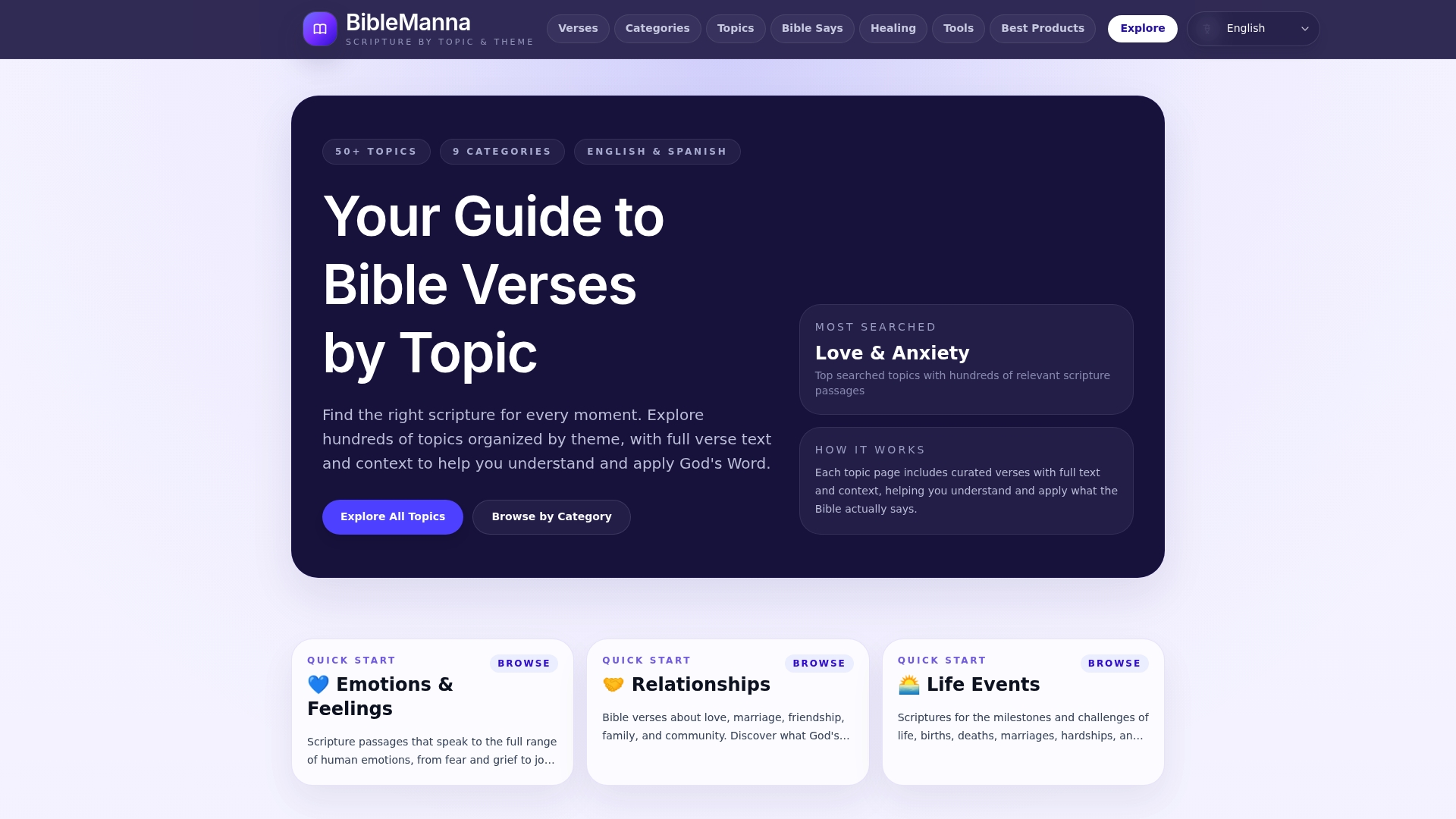
The topical verse library maps directly onto the quick-start plan above: pick a theme, read one verse in context, and begin your first recall cycle the same day. Pair that with the free Random Verse Generator and Bible Quiz to add variety once your list grows past the first few verses, so review sessions never feel like the same flashcard on repeat. For readers building a memorization habit around a specific season or struggle, the faith verse collection or strength verse collection make solid seven-day starter sets.
Try this as a real experiment: pick one topical list, choose one verse today, and run the five-step plan for seven days. Browse BibleManna’s topical verses and start your first verse this week.
Sources
The step-by-step system in this guide draws on a handful of sources worth knowing directly. Biblememory backs the active recall and spaced repetition foundation. Gotquestions supplies the practical basics around context, handwriting, and accountability partners. The technique comparison at Betania Digital maps out first-letter, imagery, and memory palace methods in detail, while Logos’s 45-book memorization method informs the longer-horizon review schedule, including the 100-day retention benchmark for readers aiming past a handful of verses.
- Gotquestions
FAQ
What is the easiest way to memorize Bible verses?
Pick a short, personally relevant verse, write or type it once for context, then quiz yourself from memory using active recall for a week before stretching your review interval out. Combining active recall with spaced repetition is consistently the most effective approach for retention.
What are some good Bible verses to memorize for beginners?
Start with a short verse tied to a real need rather than a famous but lengthy passage. Topical starter lists on themes like strength or encouragement give beginners a manageable, motivated place to begin.
Should I try to memorize the “top 100” Bible verses?
A giant unsorted list usually overwhelms new memorizers before they finish the first ten entries. A smaller, topic-driven list you actually connect with tends to stick far better than working through a generic ranked list.
How many Bible verses should I try to memorize at first?
Start with one verse and a full week’s review cycle before adding a second. Building a review system that scales, index cards, a spreadsheet, or an app, matters more early on than the number of verses you attempt.
How long does it take to actually retain a memorized verse long-term?
Initial recall can happen within a week, but durable, long-term retention depends on continued spaced review over months. Some experienced memorists recommend reviewing a verse for up to 100 days to lock it in permanently.