NKJV vs KJV: Which to Read for Worship or Daily Life

For most modern readers, the NKJV is the better daily Bible. The KJV remains the right call when you want historic diction, liturgical cadence, or a text that has shaped English-speaking worship for four centuries. Both share the same manuscript tradition, so the choice is almost entirely about language, not doctrine.
- Same textual DNA: Both the KJV and NKJV draw from the Textus Receptus for the New Testament and the Masoretic Text for the Old Testament. Neither omits books or rewrites theology.
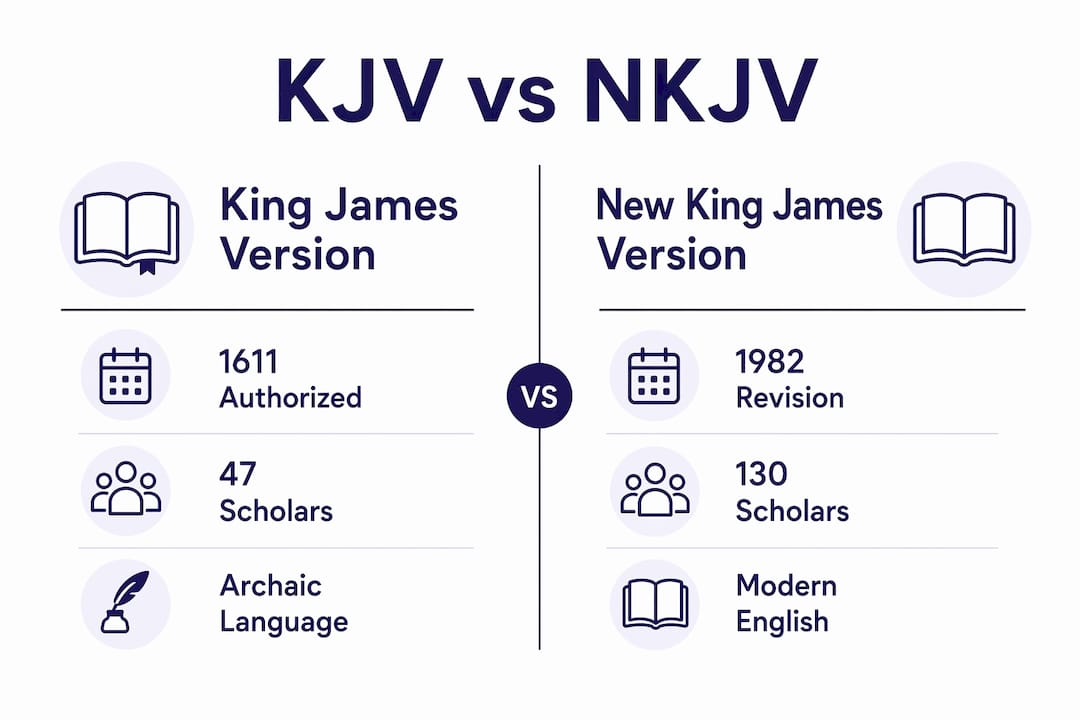
- Four centuries apart: The KJV was published in 1611; the NKJV followed in 1982, produced by roughly 130 scholars with the explicit goal of modernizing vocabulary while keeping the KJV’s style intact.
- The real difference is language: “Thou art” becomes “You are.” “Hath” becomes “has.” “Charity” becomes “love.” The meaning is preserved; the wording is updated.
Table of Contents
- How does the NKJV vs KJV comparison break down at a glance?
- Where did the KJV and NKJV come from?
- What manuscripts underlie each translation?
- How do the two translations handle wording and grammar?
- Does the NKJV omit verses that appear in the KJV?
- Side-by-side passages: what the differences actually look like
- Which translation should you choose?
- Key Takeaways
- Why the NKJV deserves more credit than it gets
- Explore both translations with Biblemanna
- Useful sources and further reading
- FAQ
How does the NKJV vs KJV comparison break down at a glance?
| Dimension | KJV (1611) | NKJV (1982) |
|---|---|---|
| Language style | Early Modern English (thou, thee, hath, doth) | Contemporary English (you, has, does) |
| Textual basis | Textus Receptus (NT); Masoretic Text (OT) | Same — Textus Receptus (NT); Masoretic Text (OT) |
| Translation philosophy | Formal equivalence (word-for-word) | Formal equivalence; modernized vocabulary |
| Textual variants | Includes all traditional passages in main text | Follows same base; variant readings noted in footnotes |
| Best use cases | Public worship, liturgy, memorization, scholarship | Personal reading, family devotions, study, new readers |
| Translator info | ~47 scholars appointed by King James I | ~130 scholars; Thomas Nelson Publishers |
Three quick decision triggers:
- Read aloud in church or ceremony? The KJV’s rhythmic prose and poetic cadence make it the standard for liturgy and memorization.
- Reading daily or with family? The NKJV’s modern wording removes the friction of archaic grammar without changing the underlying text.
- Studying with commentaries and cross-references? The NKJV works well in study Bible formats; the KJV is the reference standard that most commentaries cite.
Textus Receptus simply means “Received Text” — the compiled Greek New Testament manuscripts that formed the basis of Reformation-era Bible translations. Both versions here use it, which sets them apart from modern translations like the ESV or NIV that draw from different manuscript families.
Where did the KJV and NKJV come from?
KJV: the 1611 Authorized Version
The King James Version was commissioned by King James I of England and published in 1611. Around 47 scholars, divided into six companies, worked from the Textus Receptus and the Masoretic Text. They were not just translators; they were theologians and linguists who deliberately chose elevated, formal language to convey the gravity of Scripture. Even in 1611, the diction sounded ancient — that was intentional, meant to command reverence.
The KJV’s preface, “The Translators to the Reader,” is worth reading on its own. It explains the committee’s philosophy, their use of multiple manuscripts, and their reasoning for formal equivalence. Most modern KJV printings omit this preface, but it remains one of the clearest statements of translation intent in English Bible history.
NKJV: the 1982 revision project
The NKJV was a new translation effort, not a light edit. Thomas Nelson Publishers assembled roughly 130 scholars from conservative evangelical backgrounds, all committed to preserving the KJV’s textual base while replacing Early Modern English with contemporary equivalents. The complete Bible was published in 1982.

| Version | Year | Translators | Publisher |
|---|---|---|---|
| KJV | 1611 | ~47 scholars (six companies) | Royal warrant (Church of England) |
| NKJV | 1982 | ~130 scholars | Thomas Nelson Publishers |
The NKJV preface documents the editorial decisions made — which words were modernized, where the team chose to retain traditional phrasing, and how footnotes were used for variant readings. If you want to understand why a specific verse reads differently, the preface is the first place to look.
What manuscripts underlie each translation?
Both the KJV and NKJV share the same foundational manuscript tradition. For the New Testament, that is the Textus Receptus. For the Old Testament, it is the Masoretic Text. This is the single most important fact in the NKJV vs KJV debate: the two translations are textually aligned in a way that sets them apart from most other modern versions.
Other modern translations, including the ESV and NIV, follow the Alexandrian manuscript family (the Nestle-Aland/UBS critical text). That difference in manuscript source choice is what drives the variation in footnotes and occasional verse differences between those translations and the KJV/NKJV pair.
Practical impact of the shared textual base:
- Passages that appear in the KJV main text also appear in the NKJV main text, because both draw from the same source.
- Verses that critical-text translations bracket or move to footnotes (such as the longer ending of Mark, or the Johannine Comma in 1 John 5:7–8) are retained in both the KJV and NKJV.
- The NKJV does add footnotes indicating where the Alexandrian manuscripts differ, giving readers a window into textual scholarship without removing the traditional text.
The KJV’s traditional text represents the vast majority of the more than 5,000 known partial and complete Greek manuscripts — a point that advocates of the Received Text tradition cite as a key reason for its reliability.
How do the two translations handle wording and grammar?
Both the KJV and NKJV use formal equivalence — they aim to translate word-for-word rather than paraphrase meaning. The difference is that the KJV preserves Early Modern English forms that were already archaic in 1611, while the NKJV systematically replaces those forms with their modern equivalents.
Common archaic-to-modern shifts in the NKJV:
- thou / thee / thy → you / your
- ye → you (plural)
- hath / doth → has / does
- charity (1 Corinthians 13) → love
- conversation → conduct or way of life
- suffer (as in “suffer the children”) → allow or permit
These are not doctrinal changes. They are vocabulary updates that reflect how English evolved over four centuries.
Two KJV features worth knowing for study
The KJV uses italics to mark words the translators added for English clarity that have no direct equivalent in the Hebrew or Greek source. This gives readers a transparent signal about where the English text goes slightly beyond the original. The NKJV’s italicized words serve the same function, so both versions maintain this useful convention.
The KJV also distinguishes singular and plural second-person pronouns in a way modern English cannot. Thou/thee is singular; ye/you is plural. That distinction sometimes clarifies whether a promise or command is addressed to one person or a group — a nuance that disappears in the NKJV’s uniform “you.” For example, in John 3:7, Jesus says “ye must be born again,” addressing the crowd, not just Nicodemus. The KJV makes that visible; the NKJV does not.
| KJV term | NKJV equivalent | What changes |
|---|---|---|
| thou / thee | you | Singular “you” — individual address |
| ye | you | Plural “you” — group address |
| hath / doth | has / does | Verb conjugation only |
| charity | love | Vocabulary modernization |
| conversation | conduct | Meaning shift over centuries |
Does the NKJV omit verses that appear in the KJV?
The short answer: no. The NKJV does not intentionally omit verses that appear in the KJV. Because both translations use the Textus Receptus as their base, the same passages appear in the main text of both. What the NKJV adds is a footnote apparatus that notes where the Alexandrian manuscripts differ — something the KJV does not do.
Common contested passages and how each handles them:
- Mark 16:9–20 (the longer ending): Present in the main text of both KJV and NKJV. The NKJV adds a footnote noting that some manuscripts omit it.
- John 7:53–8:11 (the woman caught in adultery): Present in both main texts. NKJV footnotes the manuscript variation.
- 1 John 5:7–8 (the Johannine Comma): Included in both KJV and NKJV main texts, following the Received Text tradition.
- Acts 8:37 (Philip and the eunuch’s confession): Present in both; NKJV notes the variant.
The Trinitarian Bible Society has published a detailed critique of the NKJV, arguing that some editorial choices depart from strict Received Text principles. Their analysis is worth reading if you want a rigorous scholarly perspective, though the NKJV’s editors have documented their reasoning in the translation preface.
Pro Tip: When reading aloud from the NKJV and you encounter a bracketed passage or a footnote marker, simply read the main text as printed. The footnote is for study, not for interrupting the reading. If you are preaching or leading worship, decide in advance which passages you will read from the main text and note any variants in your sermon preparation.
Side-by-side passages: what the differences actually look like
Abstract descriptions of “archaic language” only go so far. Reading the same verse in both translations reveals something about cadence and word choice that no summary can fully capture.
| Passage | KJV | NKJV |
|---|---|---|
| John 3:16 | “For God so loved the world, that he gave his only begotten Son, that whosoever believeth in him should not perish, but have everlasting life.” | “For God so loved the world that He gave His only begotten Son, that whoever believes in Him should not perish but have everlasting life.” |
| Psalm 23:1 | “The LORD is my shepherd; I shall not want.” | “The LORD is my shepherd; I shall not want.” |
| 1 Corinthians 13:4 | “Charity suffereth long, and is kind; charity envieth not; charity vaunteth not itself, is not puffed up.” | “Love suffers long and is kind; love does not envy; love does not parade itself, is not puffed up.” |
| Philippians 4:13 | “I can do all things through Christ which strengtheneth me.” | “I can do all things through Christ who strengthens me.” |
A few observations from these examples:
- John 3:16 is nearly identical. The main differences are capitalization of “He/Him” in the NKJV and “believeth” becoming “believes.” The rhythm is preserved almost perfectly.
- Psalm 23:1 is word-for-word identical. Many of the most memorized KJV verses carry over unchanged into the NKJV.
- 1 Corinthians 13 shows the biggest shift: “charity” to “love” and “suffereth long” to “suffers long.” The NKJV reads more naturally but loses the specific weight the word “charity” carried in 1611 English.
- Philippians 4:13 is a clean modernization: “which strengtheneth” to “who strengthens.” Same meaning, easier to say aloud in a contemporary setting.
Which translation should you choose?
Choose the KJV if you are reading aloud in a traditional worship setting, memorizing passages for long-term retention, or studying alongside classic commentaries and scholarship that cite the KJV as the reference text. The KJV’s poetic cadence is unmatched for public liturgy, and its singular/plural pronoun distinctions offer a layer of precision that modern English cannot replicate.
Choose the NKJV if you are reading daily, leading family devotions, introducing someone new to Scripture, or studying in a setting where archaic grammar creates a barrier rather than a benefit. The NKJV is widely used in evangelical and conservative circles precisely because it bridges KJV tradition with modern readability.
A simple decision flow:
- Will you read this aloud in a traditional church or liturgical setting? Yes → KJV. No → continue.
- Do you want to memorize passages that match what your congregation or tradition already uses? If your church uses KJV, match it. Otherwise, → NKJV.
- Are you new to reading the Bible, or reading with children? NKJV. The modern grammar removes an unnecessary obstacle.
- Do you want to study with a formal commentary or cross-reference tool? Either works, but the KJV is the standard reference most commentaries cite.
- Is the primary goal daily personal reading or family devotions? NKJV. The practical difference between the two is language modernization, not doctrine.
Situational recommendations:
- Public worship / pulpit: KJV. Its cadence carries in a room.
- Personal daily reading: NKJV. Modern grammar keeps you in the text, not puzzling over it.
- Family devotions with children: NKJV. Children engage with language they understand.
- Memorization: KJV if your tradition uses it; NKJV if you are starting fresh. Both are highly memorizable.
- Academic or seminary study: KJV as primary reference; NKJV as a readable companion.
Key Takeaways
The KJV and NKJV share the same Textus Receptus manuscript base, making the choice between them a matter of language style and use case rather than doctrinal or textual accuracy.
| Point | Details |
|---|---|
| Same textual foundation | Both KJV and NKJV use the Textus Receptus (NT) and Masoretic Text (OT) — no doctrinal difference. |
| Language is the real divide | KJV keeps Early Modern English; NKJV updates it to contemporary equivalents without changing meaning. |
| KJV for worship and memory | The KJV’s poetic cadence and historic diction make it the standard for liturgy and long-term memorization. |
| NKJV for daily reading and study | Roughly 130 scholars modernized vocabulary in 1982; the result reads naturally for contemporary readers. |
| Biblemanna for verse comparison | Use Biblemanna’s topical verse collections to read passages side-by-side and find scripture by theme. |
Why the NKJV deserves more credit than it gets
The NKJV occupies an uncomfortable middle position in Bible translation debates. KJV traditionalists sometimes dismiss it as a watered-down compromise. Advocates of critical-text translations like the ESV or NIV see it as unnecessarily tied to the Received Text tradition. Neither critique is quite fair.
What the NKJV actually did was harder than either camp acknowledges. Modernizing four centuries of English while preserving the KJV’s formal equivalence philosophy and its textual base required thousands of individual decisions. The team of roughly 130 scholars had to ask, for every archaic phrase: does updating this word change the meaning, or just the grammar? In most cases, the answer was grammar only. That is not a small achievement.
The singular/plural pronoun distinction is the one genuine loss. When the KJV writes “thou” and the NKJV writes “you,” a layer of precision disappears. For most readers in most passages, this does not matter. But for a student working through the Psalms or the Epistles, it occasionally does. That is worth knowing before you commit to the NKJV as your only text.
My honest recommendation: use the NKJV as your primary reading Bible and keep a KJV close for the passages your tradition has memorized and for public reading. They complement each other better than the debate around them suggests. And if you want to test a passage in both before deciding, Biblemanna’s topical verse pages let you find scripture by theme and read it in context.
Explore both translations with Biblemanna
Deciding between two translations is easier when you can read actual passages side-by-side on a topic you care about. Biblemanna organizes scripture across more than 50 themes, from encouragement to strength, with full verse text and context for each passage.

Read a passage on a topic that matters to you right now, in the translation you are considering, and see how the wording lands. That single exercise will tell you more than any comparison article. Biblemanna’s topical verse collections are free, organized by theme, and built for exactly this kind of side-by-side reading. Start with a topic close to where you are today.
Useful sources and further reading
The sources below were used in researching this article. Each is worth consulting if you want to go deeper on a specific point.
| Source | What it covers |
|---|---|
| Trinitarian Bible Society: Does the NKJV Live Up to Its Claims? | Detailed scholarly critique of the NKJV’s editorial choices; useful for readers who want a rigorous counterpoint to the NKJV’s own preface claims. |
| Text and Translation: Why the KJV? | A pastor’s case for the KJV’s accuracy and formal equivalence; covers the Textus Receptus tradition and the pronoun distinction in depth. |
| Dr. Beeke: Practical Reasons for Retaining the KJV | Reformed perspective on why the KJV remains the preferred choice for public worship, memorization, and church unity. |
| APU: Why the KJV Is Still My Favorite Bible | Accessible essay on the KJV’s poetic cadence and its continuing role in worship and memorization. |
| The KJV Store: What Is the Difference Between the KJV and NKJV? | Clear explainer on how the NKJV was produced and what distinguishes it from a simple revision. |
| BibleInYear: KJV vs NKJV Key Differences | Practical comparison covering translation philosophy, language changes, and use-case recommendations. |
| Wikipedia: New King James Version | Background on the NKJV’s publication history, committee structure, and reception. |
For original prefaces: The KJV’s “Translators to the Reader” preface and the NKJV’s introduction are included in most study Bible editions. Reading them takes about 20 minutes and answers most questions about each committee’s intent directly. Biblemanna’s topics index is a practical next step for readers who want to explore passages by theme after settling on a translation.
FAQ
Is the NKJV as accurate as the KJV?
Yes, in all the ways that matter for most readers. Both use the same Textus Receptus and Masoretic Text sources, so the underlying textual base is identical. The NKJV updates vocabulary and grammar; it does not change doctrine or meaning.
Does the NKJV omit verses that appear in the KJV?
No. Because both translations share the Textus Receptus tradition, the same passages appear in the main text of both. The NKJV adds footnotes noting where other manuscript families differ, but it does not remove verses from the traditional text.
Should I read the KJV or NKJV?
Choose the KJV for public worship, liturgy, and memorization in a traditional church setting. Choose the NKJV for daily personal reading, family devotions, and study where modern English aids comprehension without changing the textual base.
What is the main difference between the KJV and NKJV?
Language modernization. The NKJV replaces Early Modern English forms (thou, thee, hath, charity) with contemporary equivalents (you, has, love) while keeping the same formal equivalence philosophy and manuscript tradition as the KJV.