NLT vs NIV: Which Bible Translation Is Right for You?

For most readers, the New Living Translation (NLT) is the easier daily read, while the New International Version (NIV) is the stronger all-purpose choice for both reading and study. Here is the quick version:
- Pick the NLT if your main goal is building a consistent reading habit, you find traditional Bible language slow going, or you are reading with children or new believers.
- Pick the NIV if you want one Bible that works for personal reading, group study, church use, and public reading without switching versions.
Both are reliable, modern translations. The difference is where each one sits on the readability-versus-accuracy dial.
Table of Contents
- How do NLT and NIV compare at a glance?
- Where did each translation come from?
- What are the key differences between NLT and NIV?
- How do NLT and NIV handle manuscript variants and footnotes?
- Which translation is best for your reading needs?
- How to choose between NLT and NIV right now
- How to sample both translations before you decide
- Key Takeaways
- The version you read is the one that matters
- Biblemanna helps you find the translation that fits
- Useful sources
- FAQ
How do NLT and NIV compare at a glance?
| Dimension | NLT | NIV |
|---|---|---|
| Best for | Devotional reading, beginners, youth ministry | Study, church use, public reading, group Bible study |
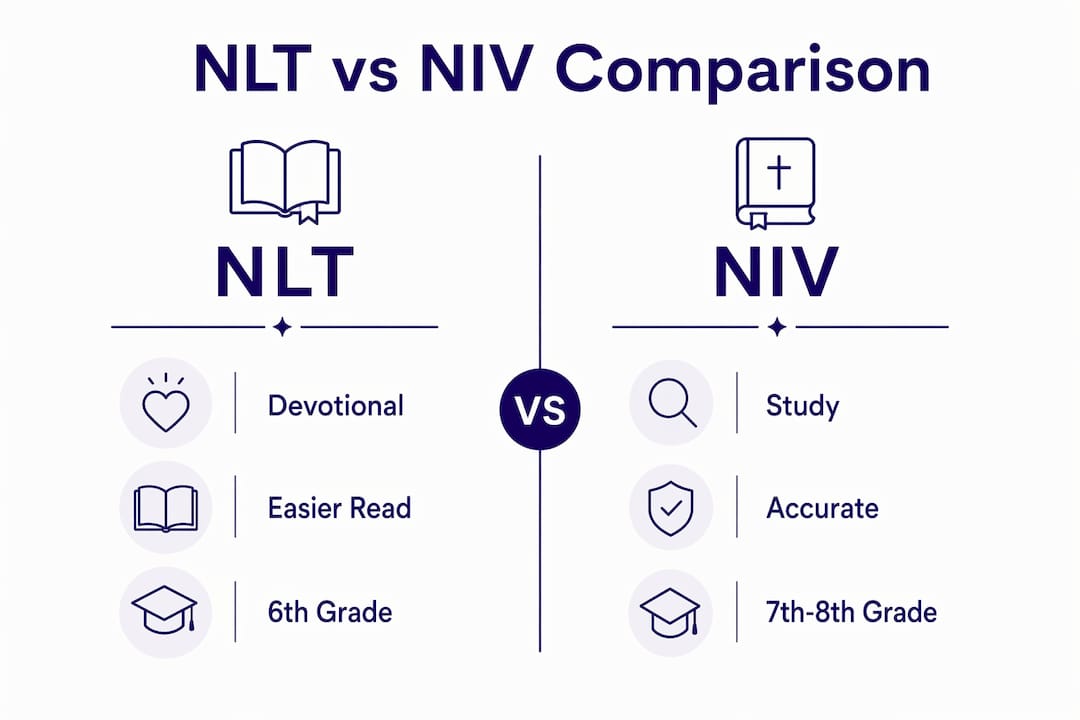
| Reading grade level | ~6th grade | ~7th–8th grade |
| Translation philosophy | Dynamic equivalence (clarity-first) | Dynamic equivalence (balanced) |
| Literalness | Prioritizes communicative intent | Closer to original sentence structure |
| Manuscript basis | Modern critical editions | Modern critical editions (Biblia Hebraica Stuttgartensia; UBS Greek NT) |
| Footnotes | Alternate renderings, clarifications | Alternate manuscripts, translation options |
| Church/group adoption | Popular in youth ministries and devotional settings | 500 million+ copies sold; widely used in churches worldwide |
Quick winner by use: NLT for devotional and beginner reading; NIV for study, preaching, and a single go-to Bible.
Where did each translation come from?
The NIV was born out of a 1965 initiative by evangelical scholars who wanted a modern English Bible that was both accurate and readable. The New York Bible Society (now called Biblica) took responsibility for the project in 1967, assembling a team of scholars from multiple denominations and countries. The New Testament appeared in 1973, the complete Bible in 1978. A minor revision followed in 1984, and a major update in 2011 addressed language and gender-inclusive wording. The Committee on Bible Translation (CBT) continues to oversee the NIV, meeting regularly and applying a high threshold for changes to prevent the text from chasing passing linguistic trends.
The NLT has a different origin story. It grew out of The Living Bible, a paraphrase produced by Kenneth Taylor in the 1970s. Tyndale House Publishers later commissioned a team of biblical scholars to transform that paraphrase into a full scholarly translation, published in 1996. The NLT editorial board has continued to refine it since. Unlike its paraphrase ancestor, the NLT is a genuine translation from the original Hebrew, Aramaic, and Greek texts, not a rewording of an existing English version.
What are the key differences between NLT and NIV?

Where each sits on the translation spectrum
Bible translations run along a spectrum from word-for-word (formal equivalence) on one end to free paraphrase on the other. The ESV and NASB sit near the formal end. The NIV occupies the dynamic-equivalence middle ground, aiming to balance accuracy and readability by rendering the thought of the original text in clear modern English. The NLT sits further toward the readable end of that spectrum, prioritizing communicative intent: what did the original author mean to convey, and how would a modern English speaker say it naturally?
Readability and reading level
The NIV reads at roughly a 7th–8th grade level; the NLT at about a 6th grade level. That one-to-two grade gap sounds small, but it shows up noticeably in sentence length, vocabulary, and how complex theological ideas are handled. The NLT tends to unpack a difficult phrase into plain language; the NIV tends to preserve the phrase and let the reader work with it.
- Tone: NLT is conversational; NIV is clear but slightly more formal.
- Sentence structure: NLT simplifies and restructures; NIV stays closer to the original syntax.
- Public reading: NIV reads more naturally from a pulpit; NLT can feel informal in a liturgical setting.
- Devotional flow: NLT moves faster and requires less re-reading to grasp meaning.
| Metric | NLT | NIV |
|---|---|---|
| Reading grade | ~6th | ~7th–8th |
| Copies in circulation | Widely used in personal/devotional contexts | 500 million+ copies sold worldwide |
| Translation type | Dynamic equivalence (clarity-first) | Dynamic equivalence (balanced) |
Pro Tip: If you are using one of these translations for close word study, pair it with a more literal companion like the ESV or NASB. Neither the NLT nor the NIV is designed for granular lexical analysis, but the NIV holds up better for that purpose of the two.
How do NLT and NIV handle manuscript variants and footnotes?
Both translations draw from modern critical editions of the original texts. The NIV uses the Biblia Hebraica Stuttgartensia for the Old Testament and the UBS Greek New Testament for the New Testament. The NLT uses comparable critical editions. Neither relies on the older Textus Receptus tradition that underlies the King James Version.
Footnotes in both translations serve a real purpose. They flag places where manuscripts differ, where a word carries an alternate meaning, or where translators made a judgment call. The NIV’s footnotes tend to be more detailed about manuscript variants, which matters when you are studying a passage closely and want to know why a phrase reads differently than in an older translation.
Some passages that appear in the KJV are absent or relegated to footnotes in both the NIV and NLT. Matthew 17:21 (“But this kind does not go out except by prayer and fasting”) is one frequently cited example. It does not appear in the main text of either translation because it is absent from the earliest and most reliable Greek manuscripts. Similarly, 1 John 5:7 in its extended Trinitarian form (the Comma Johanneum) is not included in the main text of either version, reflecting the scholarly consensus that this wording was added to later manuscripts rather than being original.
These differences rarely affect core Christian doctrine. They reflect the evidence of the earliest manuscripts and the careful judgment of translation committees — not theological bias. When a verse is absent from the main text, a responsible translation will note it in a footnote.
Which translation is best for your reading needs?
The right answer depends on what you are actually going to do with the Bible, not which one sounds more scholarly.

Brand-new readers will almost always get more out of the NLT. The accessible language removes the friction that causes many first-time readers to quit after Genesis. Daily devotional readers who want to move through large portions of Scripture quickly will also find the NLT’s conversational flow easier to sustain.
Bible study students and anyone working through a structured study guide will generally do better with the NIV. Its closer adherence to original sentence structure means cross-referencing with commentaries and study notes is more straightforward. Pastors and lectors reading aloud in a church setting tend to favor the NIV because it sounds authoritative without feeling archaic.
Parents reading with children can go either way, but the NLT’s simpler vocabulary makes it the more natural choice for younger readers. Youth ministry leaders often keep both: NLT for group discussion and personal reading, NIV for teaching and reference.
One approach worth considering: use the NLT as your daily reading Bible and a more literal version for close study. Many readers find this combination gives them the best of both worlds, consistent reading habit plus the precision needed when a passage demands careful attention.
How to choose between NLT and NIV right now
Work through these six questions and the answer usually becomes clear:
- What is your reading speed and comfort level? If you find yourself re-reading sentences to understand them, choose the NLT.
- Who is the primary reader? A child or new believer benefits most from the NLT’s 6th-grade readability; an adult with some Bible background will be comfortable with the NIV.
- Do you need study notes or cross-references? The NIV pairs better with most study Bibles and commentaries on the market.
- Will you read this aloud in a group or church setting? The NIV’s slightly more formal register holds up better in public reading contexts.
- Do you want one Bible for everything? The NIV handles that role more reliably, covering devotional reading, study, and church use without feeling out of place in any of them.
- Are you pairing this with a more literal translation? If yes, the NLT makes a natural complement; if no, the NIV is the more self-sufficient choice.
Decision rule: If your first priority is readable daily intake, pick the NLT. If you need a single go-to Bible for both reading and study, pick the NIV.
How to sample both translations before you decide
Reading about translations is useful. Actually reading them is better. Three low-effort ways to test which one sticks:
Side-by-side passage reading. Pick a familiar passage, John 3:16 or Psalm 23, and read it in both translations back to back. Notice which one you understood immediately and which one you had to process. That gut reaction is data.
The one-week alternating experiment. Days 1–3, read your morning passage in the NLT. Days 4–7, switch to the NIV. At the end of the week, ask yourself: which version did you look forward to opening? Which one prompted you to keep reading past the planned stopping point? Engagement is a better signal than theoretical readability scores.
Audio while commuting. Both translations are available in audio form. Listening while driving or walking strips away the visual experience and forces you to process the language purely by ear. The translation that sounds clearest and most natural to you is likely the one that will serve you best in print too.
Biblemanna’s Bible verses by topic pages make the side-by-side experiment easy without needing two physical Bibles. Pull up a themed collection, like verses about encouragement or faith, and read through the same passages in each translation. You get a consistent set of verses across a theme, which gives you a more reliable read on each translation’s tone than a single isolated passage would.
Pro Tip: Use Biblemanna’s random verse generator for a blind test. Read a verse without knowing which translation it came from, then check. If you consistently prefer one translation’s phrasing before you even know which it is, that preference is telling you something real.
Key Takeaways
The NLT and NIV are both reliable modern translations; the choice comes down to whether you prioritize maximum readability (NLT) or a balanced text that works equally well for reading, study, and church use (NIV).
| Point | Details |
|---|---|
| Reading level gap | NLT reads at ~6th grade; NIV reads at ~7th–8th grade, making NLT noticeably easier for new readers. |
| Translation philosophy | Both use dynamic equivalence, but NLT leans harder toward clarity while NIV preserves more of the original structure. |
| Best single-Bible choice | NIV’s widespread use reflects its versatility across devotional, study, and church contexts. |
| Manuscript handling | Both use modern critical editions; neither includes verses absent from the earliest manuscripts. |
| Biblemanna sampling | Biblemanna’s topical verse pages let you read the same passages in both translations to find your natural fit. |
The version you read is the one that matters
Here is the honest editorial take: most of the online debate about NLT vs NIV is conducted by people who have already decided which one they prefer and are looking for confirmation. The real question is simpler than the debate suggests.
The single biggest barrier to Bible reading is not translation accuracy. It is consistency. A translation that you open every morning and actually finish reading is worth more than a theoretically superior version that sits on your shelf because the language feels like work. If the NLT is the version that gets you to Revelation, it is the right Bible for you right now. If the NIV is the one you reach for when a question comes up in your small group, that is the version doing its job.
My advice: do not overthink the research phase. Spend fifteen minutes with each translation on a passage you already know well, then pick the one that felt alive. You can always add a second translation later when your reading habit is solid. If you are still genuinely undecided after reading this, Biblemanna’s topical verse collections give you a structured way to compare both versions on the same passages without committing to either.
Biblemanna helps you find the translation that fits
Choosing between the NLT and NIV is easier when you can read both on the same passage, in context, without hunting through two physical Bibles. Biblemanna’s themed verse collections do exactly that. Each topical page groups relevant scripture by theme, with full verse text and background context, so you can see how a translation handles a consistent set of passages rather than guessing from a single verse.
Start with a topic that matters to you right now. Bible verses by topic covers more than 50 themes, from strength and wisdom to salvation and faith. Read five verses in the NLT, then the same five in the NIV. The translation that reads more naturally to you across a full theme is almost certainly the one you will stick with. That is a better test than any readability score.
Useful sources
- The NIV Bible — official site: Publisher page for the NIV, including translation philosophy, editorial oversight, and the Committee on Bible Translation.
- NIV translation philosophy — NIV official site: Detailed explanation of how the NIV balances accuracy and readability, and how the CBT vets changes.
- About the NIV Bible — Biblica: Biblica’s overview of the NIV’s history, revision cycles, and global reach.
- Comparing Bible Translations — NLT official site: The NLT publisher’s own translation-spectrum chart placing major English versions from word-for-word to paraphrase.
- NIV vs NLT — BibleInYear blog: Independent readability comparison with grade-level data for both translations.
- NIV vs. NLT: Comparing Bible Translations — Best Bible Commentaries: Practical synthesis of how each translation serves different reader profiles.
FAQ
Is the NIV or NLT better for Bible study?
The NIV is generally the stronger study Bible choice. Its closer adherence to original sentence structure makes it easier to cross-reference with commentaries, and most published study Bibles use the NIV as their base text.
What verses are left out of the NLT?
The NLT omits verses that are absent from the earliest and most reliable Greek manuscripts, such as Matthew 17:21 and the extended form of 1 John 5:7. These are not editorial deletions; they reflect the manuscript evidence used by modern critical scholarship, and responsible translations note them in footnotes.
Is the NLT biblically accurate?
Yes. The NLT is a full scholarly translation from the original Hebrew, Aramaic, and Greek texts, not a paraphrase. It prioritizes communicative clarity over strict word-for-word rendering, but its translators worked from the same critical manuscript tradition as the NIV.
Why is Matthew 17:21 removed from the NIV?
Matthew 17:21 does not appear in the NIV’s main text because it is absent from the oldest and most reliable Greek manuscripts. Both the NIV and NLT follow modern critical editions of the Greek New Testament, which reflect that manuscript evidence rather than the later Textus Receptus tradition used by the KJV.
Which Bible translation is best for beginners?
The NLT is the most commonly recommended translation for new readers. Its 6th-grade reading level and conversational tone remove the language barrier that causes many beginners to disengage early.