From Confession to a New Heart: Psalm 51 Meaning With 3 Practical Steps

Psalm 51 meaning centers on one plea: a broken sinner asking God to erase guilt and remake the heart from the inside out. David wrote it after his affair with Bathsheba and the killing of Uriah came crashing into the open, and the prayer moves in three stages: raw confession, a request for inner cleansing, and a vow to praise God again. It is the Bible’s clearest map of what real repentance looks like when consequences can’t be undone.
TL;DR:
- Psalm 51 was written after David’s confrontation by Nathan and reflects a response to prolonged denial and deep guilt, not a spontaneous apology.
- The psalm emphasizes that true repentance involves asking for inner renewal, creation of a new heart, and active commitment to serve others, not just seeking forgiveness.
- Biblical language such as “blot out” and “bara” underscores the need for divine creative action to repair a broken heart, not mere moral effort.
- Ritual sacrifices are insufficient without inner transformation, making a broken and contrite heart the core of genuine repentance.
- Psalm 51 remains a foundational liturgical text because of its comprehensive portrayal of guilt, mercy, renewal, and outward purpose rooted in biblical understanding.
Table of Contents
- Historical Background: David, Bathsheba, and Nathan’s Rebuke
- What Does Psalm 51 Say? A Verse-by-Verse Look at Its Three Movements
- The Theology Behind Psalm 51: Forgiveness, Guilt, and a Broken Heart
- How to Pray Psalm 51 Today: A Practical Guide to Confession
- Why Churches Use Psalm 51 for Ash Wednesday and Confession
- Who Wrote Psalm 51, and Why Scholars Still Study It Closely
- How Psalm 51 Compares to Other Penitential Psalms
- The Hebrew Wordplay and Poetry That Get Lost in Translation
- Catholic, Protestant, and Orthodox Readings of Psalm 51
- Psalm 51 in Music, Art, and Literature
- What Psalm 51 Taught Me About Repentance That Doesn’t Stop at Sorry
- Take Your Study of Psalm 51 Further with BibleManna
- Sources
- FAQ
Historical Background: David, Bathsheba, and Nathan’s Rebuke
David didn’t write Psalm 51 in the abstract. He wrote it after a prophet named Nathan walked into his palace and told him a story about a rich man who stole a poor man’s only lamb. David, incensed, declared the man deserved death. Nathan’s answer landed like a blow: “You are the man.” The confrontation follows a chain of events recorded in 2 Samuel 11–12, where David saw David noticed Bathsheba bathing, summoned her while her husband Uriah was away at war, and got her pregnant. When the cover-up failed, David arranged for Uriah to die in battle.
For an extended period, David said nothing. No confession, no visible remorse, just a king going about his business while a dead man’s blood sat on his hands. That silence matters for reading the psalm correctly. Psalm 51 isn’t the prayer of someone caught mid-sin and instantly sorry. It’s the prayer of someone confronted after months of denial, someone who finally has nowhere left to hide.
That backstory explains phrases that would otherwise feel oddly intense for a private prayer. When David writes “against you, you only, have I sinned” in verse 4, he isn’t ignoring the damage done to Bathsheba, Uriah, or the child who died as a result. He’s naming the deepest layer of the offense: every sin against another person is first a violation of God’s character and law. The bloodguilt language in verse 14 only makes sense once you know Uriah is dead by David’s design, not by accident.
Here’s what the narrative sets up for the rest of the psalm:
- Nathan’s confrontation, not personal guilt alone, triggers the written prayer.
- David faces a prophetic sentence that his household will suffer, even as he seeks God’s mercy.
- The child conceived in the affair dies, a consequence the psalm doesn’t undo or erase.
- David’s plea for restoration happens after judgment has already been pronounced, not before.
That last point is easy to miss and important to hold onto: David seeks divine mercy while earthly consequences remain fully in force. This is not a story where confession cancels the fallout. It’s a story where confession restores the relationship even when the fallout stays.
What Does Psalm 51 Say? A Verse-by-Verse Look at Its Three Movements
Psalm 51 reads less like a single statement and more like a journey with three distinct legs. Working Preacher’s commentary on the passage and the structural analysis at CCO Church both trace the same arc: confession, transformation, and a return to worship. Here’s what happens verse by verse.
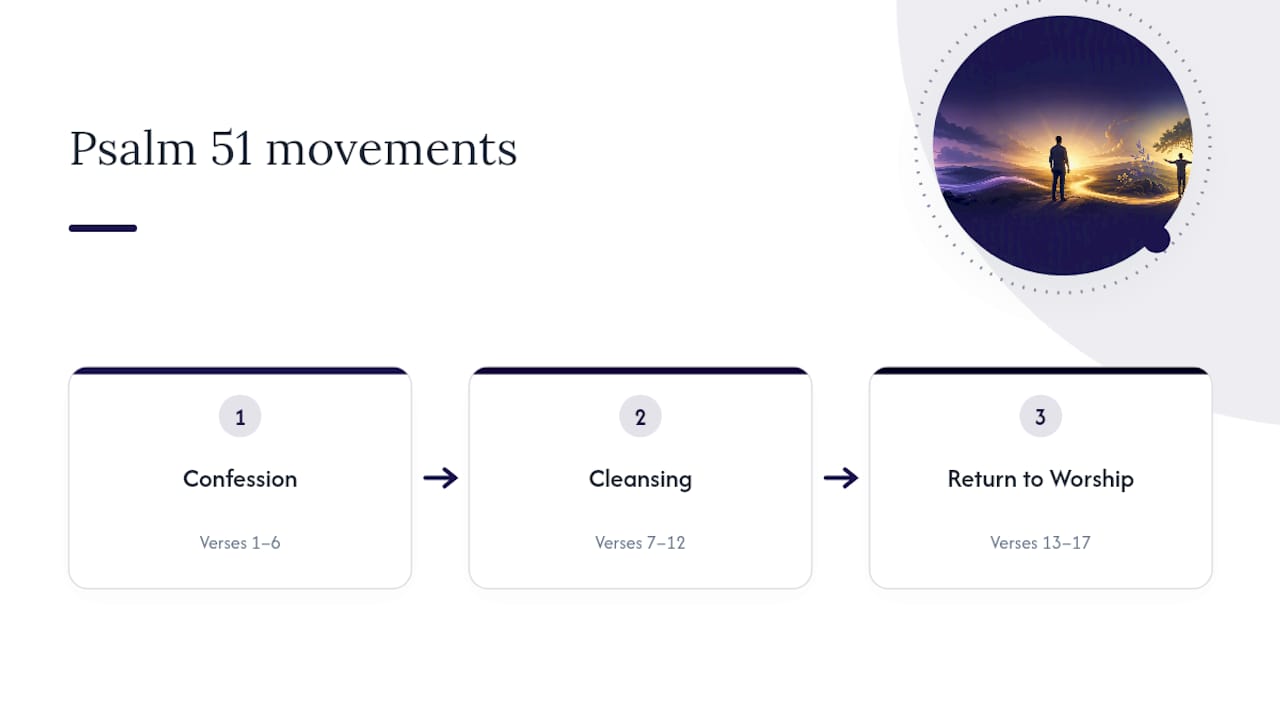
Confession (verses 1–6): naming the sin honestly
David opens by begging for mercy, not fairness: “Have mercy on me, O God, according to your unfailing love.” That phrase echoes the language God used to describe himself to Moses in Exodus 34:6, where mercy, steadfast love, and compassion define God’s own character. David isn’t inventing a case for forgiveness; he’s appealing to attributes God already claimed for himself.
The phrase “blot out my transgressions” in verse 1 uses an image borrowed from ancient record-keeping, where scribes literally wiped ink from a surface to erase an entry. David isn’t asking for a lighter sentence. He’s asking for the record itself to disappear.
Verse 4’s “against you, you only, have I sinned” has confused readers for centuries, since David clearly sinned against Bathsheba and Uriah too. The verse isn’t denying that harm. It’s insisting that every human wrong is, at bottom, a rebellion against God’s authority, which is why only God can grant the pardon David is asking for.
Cleansing and renewal (verses 7–12): the language of washing and re-creation
“Purge me with hyssop, and I shall be clean” is one of the most vivid lines in the psalm. Hyssop was a small, bushy herb used in purification rituals, most famously to apply lamb’s blood to doorframes during the Passover and in ceremonial cleansing after skin disease or contact with death. Referencing it here signals both ritual purification and vulnerability. Bible Gateway’s commentary on Psalm 51 notes that hyssop appears elsewhere in Scripture specifically as a purifier, which sharpens David’s plea into something closer to desperation than routine ritual.

Then comes the psalm’s theological hinge, verse 10: “Create in me a clean heart, O God.” The Hebrew verb here is bara, the same word used in Genesis 1:1 for God’s creation of the universe out of nothing. David isn’t asking for moral improvement or a better set of habits. He’s asking for something that doesn’t exist yet to be brought into being. A repaired heart wouldn’t be enough. He wants a new one, built by an act of divine creation rather than human effort.
Praise and commitment (verses 13–17): from private plea to public purpose
The final movement shifts from pleading to promising. David commits to teaching other sinners God’s ways once restored, and verse 17 delivers the psalm’s most quoted line: “The sacrifices you desire are a broken spirit and a broken and contrite heart.” Enduring Word’s commentary frames this as the psalm’s real climax: David isn’t rejecting the sacrificial system outright, but he’s insisting that ritual without inward change is empty.
Pro Tip: Read verses 16–17 alongside Ezekiel 36:26, where God promises to replace a stony heart with a heart of flesh. Both passages describe repentance as something God performs in a person, not just something a person performs for God.
Three things happen across this arc that are worth tracking as one movement rather than three separate ideas:
- David moves from asking for mercy to asking for transformation, showing that forgiveness alone was never his actual goal.
- The washing and creation imagery both point toward the same conviction: sin runs deeper than behavior, so the fix has to run deeper than willpower.
- The psalm ends aimed outward, toward teaching and worship, proving that private repentance was always meant to serve a public purpose.
The Theology Behind Psalm 51: Forgiveness, Guilt, and a Broken Heart
Psalm 51 forces a distinction that gets blurred in casual conversation: being forgiven and feeling clean are not automatically the same experience. David gets both, but the psalm treats them as two separate requests. Verse 1 asks for pardon, a legal and relational reality. Verses 7 through 10 ask for an inner sense of restored purity, which is closer to an emotional and spiritual experience than a judicial one.
That distinction matters for anyone who has confessed something honestly and still felt dirty afterward. Guilt, biblically, can be removed the moment God grants pardon. Shame, the felt sense of being unclean, often lingers and has to be prayed through separately, which is exactly what David does with the washing and hyssop imagery.
The psalm also corrects a common shortcut people take with repentance: assuming remorse is the same thing as repentance. David feels crushed. He says so plainly in verse 8, describing broken bones. But feeling bad is the starting point of the psalm, not its conclusion. The real turn happens in verse 13, when sorrow becomes a promise to teach and serve others. Repentance in Psalm 51 is active, not passive. It produces a changed direction, not just a changed mood.
Here’s where the psalm draws its sharpest line:
- Ritual sacrifice, on its own, could never address the interior problem David describes.
- A “broken and contrite heart” outranks any external religious performance, according to verse 17.
- Genuine repentance results in restored joy (verse 12) and active ministry to others (verse 13), not just relief.
- Consequences and forgiveness can coexist; David’s forgiveness doesn’t erase his household’s coming turmoil.
One detail from the biblical text is worth sitting with directly: David’s plea for a “clean heart” uses the same creation verb, bara, reserved almost exclusively for God’s original acts of making something from nothing. That word choice alone signals that biblical repentance was never framed as self-improvement. It’s framed as dependence on a creative act only God can perform.
How to Pray Psalm 51 Today: A Practical Guide to Confession
Praying Psalm 51 well means following its structure instead of skimming its most quotable lines. The psalm gives you an order, and the order does spiritual work.
- Name the specific sin, not a vague category. David doesn’t pray “forgive me for my mistakes.” He names adultery and violence in blunt terms. Vague confession produces vague relief.
- Ask for cleansing, not just pardon. Pray verse 10 directly: ask God to create something new in you, rather than just patch the old pattern.
- Commit to something outward. David promises to teach transgressors God’s ways. Real repentance in this psalm always points toward future action, whether that’s restored relationships, restitution, or renewed service.
Pro Tip: Try praying Psalm 51 slowly, pausing at each imagery shift, blotting, washing, creating, restoring, rather than reading it straight through. The psalm’s power is in its progression, not just its individual lines.
A pastoral note belongs here too. Psalm 51 models honest confession before God, but it doesn’t replace restitution owed to people who were harmed. David still faced Nathan’s prophetic judgment and years of family turmoil. Anyone shepherding someone through repentance should hold both truths: God’s forgiveness is immediate and complete, while trust with other people, and sometimes legal or relational consequences, has to be rebuilt over time.
Why Churches Use Psalm 51 for Ash Wednesday and Confession
Psalm 51 shows up most prominently on Ash Wednesday, where its themes of mortality, guilt, and mercy match the day’s focus on repentance at the start of Lent. Many liturgical traditions also build it into regular corporate confession, using its verses as a shared script when a congregation confesses sin together rather than individually.
Private devotional use tends to look different. Some readers journal through the psalm’s three movements one section at a time. Others pair it with related passages, Ezekiel 36:26 for the new-heart theme, or Psalm 23 for what restored trust in God can look like afterward.
- Corporate confession liturgies often recite verses 1–4 responsively before a pastor pronounces absolution.
- Ash Wednesday services frequently pair Psalm 51 with readings on human frailty and mortality.
- Private devotion works well as a slow, repeated reading rather than a one-time recitation.
- Musical settings, from choral arrangements to contemporary worship songs, often isolate verse 10 as a standalone refrain.
Who Wrote Psalm 51, and Why Scholars Still Study It Closely
The psalm’s heading attributes it directly to David, tying it to the moment “when Nathan the prophet came to him after he had gone to Bathsheba.” Most conservative scholars accept this attribution at face value, treating the superscription as a reliable historical note rather than a later editorial guess.
Critical scholarship takes a more cautious approach. Some scholars argue the psalm’s polished poetic structure and liturgical language suggest it may have been shaped or finalized for temple worship use after David’s lifetime, even if it preserves his original prayer. This doesn’t require abandoning David’s authorship; it simply acknowledges that psalms functioned as communal worship material, which sometimes meant later editing for public use.
Why does authorship matter beyond academic interest? Because the psalm’s authority as a model prayer partly depends on whose experience it’s channeling. If David, a king who committed adultery, conspired in a murder, and still received a path back to restored fellowship with God, wrote this prayer in real crisis, it carries a different weight than an anonymous liturgical composition written for general use.
Biblical scholarship generally treats Psalm 51 as one of the strongest arguments for Davidic authorship among the psalms, precisely because the superscription’s context matches the narrative in 2 Samuel so specifically. Few later editors would have invented such an unflattering origin story for Israel’s most celebrated king. That specificity is itself a mark of authenticity that scholars across theological traditions tend to respect, even when they disagree about how much later editing shaped the psalm’s final form.
How Psalm 51 Compares to Other Penitential Psalms
Christian tradition groups seven psalms together as the “penitential psalms”: 6, 32, 38, 51, 102, 130, and 143. All seven wrestle with guilt and God’s mercy, but Psalm 51 stands out for its depth and structure.
Psalm 32 describes the misery of unconfessed sin and the relief that follows confession, but it reads more like reflection after the fact than a prayer in the middle of crisis. Psalm 130 opens with “out of the depths I cry to you,” a shorter, more compressed cry for mercy without Psalm 51’s detailed movement through confession, cleansing, and renewed purpose. Psalm 143 pleads for guidance and rescue from enemies as much as from personal sin, blending repentance with a request for protection.
What sets Psalm 51 apart is its completeness. It doesn’t stop at asking for pardon, the way Psalm 130 largely does. It doesn’t stop at describing relief, the way Psalm 32 does. It pushes all the way through to a vision of restored ministry and praise, making it the fullest theological treatment of repentance in the entire collection. It’s also the only one of the seven with a specific, named historical crisis attached to it, which gives readers a concrete situation to measure their own failures against.
That combination, historical specificity plus theological completeness, is likely why Psalm 51 became the standard text for penitential liturgy while the other six remained more supplementary.
The Hebrew Wordplay and Poetry That Get Lost in Translation
English translations do their best with Psalm 51, but several Hebrew features don’t survive the trip intact. The verb bara in verse 10, translated “create,” is the same word Genesis uses for the original creation of the universe. Most other Hebrew verbs for making or improving something (asah, for example) describe reshaping existing material. Bara implies bringing into existence what wasn’t there before. English “create” gets close, but it doesn’t automatically trigger the Genesis 1 echo the way the Hebrew does for a Hebrew-literate reader.
The psalm also uses parallelism, the standard structural device of Hebrew poetry, throughout. Verse 1 pairs “mercy” with “unfailing love,” and “blot out” with “wash away” in verse 2, restating the same request in two different images rather than adding new information. This repetition isn’t redundancy; it’s emphasis through accumulation, a hallmark of Hebrew poetic style that can read as repetitive to English speakers unfamiliar with the convention.
Word choice carries weight too. The psalm uses at least three distinct Hebrew words for sin, pesha (rebellion), chatta’ah (missing the mark), and avon (guilt or iniquity), often within the same verse. English translations frequently render all three as simply “sin” or “transgression,” flattening a distinction the original audience would have felt clearly. Reading multiple translations side by side, or comparing how different versions render key verses, can surface some of what gets smoothed over in any single English rendering.
Catholic, Protestant, and Orthodox Readings of Psalm 51
Christian traditions largely agree on the psalm’s surface meaning but diverge on emphasis. Catholic theology often reads Psalm 51 alongside the sacrament of reconciliation, treating confession and priestly absolution as the structured outworking of David’s plea. The psalm’s request for cleansing maps onto sacramental grace understood as an actual transformation applied to the soul, not merely a legal declaration.
Protestant traditions, particularly those shaped by Reformation theology, tend to emphasize verse 17’s rejection of ritual sacrifice as support for justification by faith rather than religious performance. In this reading, Psalm 51 previews the New Testament conviction that no external act, ritual or otherwise, can substitute for a genuinely changed heart, a theme Reformed and evangelical commentators return to often when preaching the passage.
Orthodox Christianity reads Psalm 51 (numbered Psalm 50 in the Septuagint numbering Orthodox churches follow) as central to daily and liturgical prayer, reciting it repeatedly in services including the Divine Liturgy’s preparatory prayers. The emphasis here leans toward ongoing repentance as a continuous posture of the Christian life, called metanoia, rather than a single decisive event.
These aren’t contradictory readings so much as different angles on the same text. Catholic tradition highlights the sacramental structure, Protestant tradition highlights the heart over ritual, and Orthodox tradition highlights repentance as constant practice. All three land on the same core conviction the psalm itself states: God desires an honest, broken heart more than any external religious act.
Psalm 51 in Music, Art, and Literature
Few psalms have shaped Western creative output as thoroughly as Psalm 51. Composers across centuries have set its text to music, most famously in choral and liturgical settings performed during Lent and services of confession. Its verses, particularly “create in me a clean heart,” appear repeatedly in contemporary worship music, often isolated as a refrain distinct from the psalm’s fuller confession.
Visual art has drawn on the psalm’s penitential imagery too, with depictions of David in prayer or mourning frequently referencing the psalm’s language of a broken spirit, sometimes paired with scenes of Nathan’s confrontation to give the image narrative context. Illuminated manuscripts throughout medieval Europe often placed Psalm 51 at the opening of the penitential psalms section, marking it visually as the collection’s centerpiece.
Literature carries the psalm’s fingerprints as well. Writers exploring guilt, confession, and redemption have leaned on its vocabulary, whether directly quoting “wash me” and “blot out my transgressions” or echoing its structural movement from despair to restored purpose. The psalm’s insistence that God desires a broken heart over ritual sacrifice has become a kind of cultural shorthand for authentic repentance, cited well beyond explicitly religious contexts whenever someone wants to distinguish sincere remorse from performative apology.
That staying power isn’t accidental. A three thousand year old prayer written by a specific, flawed king still supplies the language people reach for when they need to describe what real sorrow over wrongdoing actually sounds like.
What Psalm 51 Taught Me About Repentance That Doesn’t Stop at Sorry
The line that reshaped how I read this psalm wasn’t the confession. It was verse 13, where David, still in the middle of his own crisis, promises to teach other sinners once restored. Repentance that stays private and never turns outward toward other people has stalled somewhere short of what David modeled.
The habit I’ve kept from studying this psalm is simple: whenever I confess something specific, I ask what verse 13 looks like for that particular failure. Not generic gratitude. A concrete next step toward someone else. That question has changed more of my actual behavior than the confession itself ever did.
— Nkosi
Take Your Study of Psalm 51 Further with BibleManna
Reading Psalm 51 closely often stirs a desire to keep going, to trace the same themes of mercy, renewal, and restored joy through the rest of Scripture. That’s exactly what topical Bible collections are built for.
 Instead of hunting through a concordance verse by verse, you can go straight to curated lists built around specific themes. If David’s plea for a clean heart has you thinking about what comes after repentance, the collection of Bible verses about joy picks up right where Psalm 51 leaves off, tracing restored gladness through the rest of Scripture. Wrestling with what genuine change looks like day to day pairs well with the Bible verses about change collection, and Biblemanna’s translation comparison tool lets you set the ESV, NIV, KJV, and NASB side by side on any verse that still feels unclear in a single translation.
Start at Bible Verses by Topic and search by whatever theme your reflection on Psalm 51 has surfaced, whether that’s mercy, restoration, or renewed purpose.
Sources
- Psalm 51: Entering the Psalm — Hebrew College
- Psalm 51 commentary — Enduring Word
- Commentary on Psalm 51:1-17 — Working Preacher (Luther Seminary)
- Confession, transformation, and worship — CCO Church
- When Grace Meets Our Guilt: The Hope of Psalm 51 — Bible Gateway
FAQ
How can I apply Psalm 51 to my life today?
Follow its three movements: name your sin specifically, ask God for inner cleansing rather than just pardon, and commit to a concrete outward action, the way David promised to teach other sinners once restored.
What does 51 mean biblically?
Psalm 51 has no numerical symbolism attached to it; its meaning comes from its content as David’s prayer of repentance after Nathan confronted him over Bathsheba and Uriah.
What is the meaning of a broken spirit and a contrite heart?
In verse 17, it describes genuine inner sorrow over sin that God values more than any ritual sacrifice, a heart humbled enough to be honest rather than one performing outward religious acts.
Is Psalm 51 a powerful prayer?
Yes. Its combination of raw honesty, appeal to God’s mercy, and a structured path from confession to restored praise has made it the standard model for repentance across Catholic, Protestant, and Orthodox traditions alike.