Psalm 91 Meaning: God’s Presence in Life’s Hardest Moments

Psalm 91 is a declaration that those who make God their dwelling place find real, covenantal protection — not a guarantee that trouble will never come, but the assurance that God is present through every danger, and that no threat has the final word over a life rooted in him.
The psalm’s core promises, stated plainly:
- Presence: God himself is the refuge and fortress (v. 2)
- Deliverance: rescue from traps, disease, and enemies (vv. 3–6)
- Angelic protection: God’s messengers guard every step (vv. 11–12)
- Answered prayer: “He will call on me, and I will answer him” (v. 15)
- Ultimate salvation: long life and the revelation of God’s saving power (v. 16)
TL;DR: Psalm 91 does not promise a trouble-free life. It promises that God is with you in the trouble — and that his presence changes everything about how you face it.
Table of Contents
- What does Psalm 91 actually say? A paraphrase and structure
- Verse-by-verse commentary: what each section means
- What are the core theological themes of Psalm 91?
- How is Psalm 91 commonly misread, and what should you watch for?
- How to apply Psalm 91 in your daily life
- Key Takeaways
- The psalm that doesn’t flinch
- Biblemanna helps you study and live Psalm 91
- Further reading and authoritative sources
- FAQ
What does Psalm 91 actually say? A paraphrase and structure
The psalm opens with a bold claim: the person who lives in close, habitual communion with God finds in him a shelter no external threat can breach. The first two verses set the tone — the speaker describes God as “Most High” and “Almighty,” then makes a personal confession: “He is my refuge and my fortress; my God, in whom I trust.” From there, the psalm catalogs dangers — disease, warfare, darkness, arrows, pestilence — and insists that none of them will ultimately destroy the one who trusts. The final three verses shift dramatically: God himself speaks, confirming the promises and grounding them in love and relationship.
Scholarly structural analyses divide the psalm into three recognizable movements:
- Verses 9–13: — A second voice (possibly a priest or worship leader) addresses the worshiper directly, reinforcing the promise of angelic protection
On authorship, the Hebrew text carries no superscription, though the Septuagint attributes it to David, and Jewish tradition sometimes links it to Moses, partly because of its placement immediately after Psalm 90 (titled “A Prayer of Moses”). Most modern scholars treat the authorship as uncertain. What is clear is the psalm’s dialogue with Psalm 90: where Psalm 90 meditates on human fragility and the brevity of life under God’s wrath, Psalm 91 answers with confident refuge. The two psalms belong together as a theological pair.
Verse-by-verse commentary: what each section means
Verses 1–2: Dwelling and declaring

“Whoever dwells in the shelter of the Most High will rest in the shadow of the Almighty.”
The word “dwells” is doing heavy lifting here. In Hebrew (yashab), it means to sit down, to settle, to take up permanent residence — not a brief visit in a crisis. The “shelter” and “shadow” images both evoke the same picture: standing close enough to God that his presence covers you the way shade covers someone standing under a tree at noon. Verse 2 shifts from description to personal confession: the speaker stops talking about God and starts talking to him. That move from third person to first person is itself a model for prayer.
Verses 3–4: Snare, pestilence, and feathers
“Surely he will save you from the fowler’s snare and from the deadly pestilence. He will cover you with his feathers, and under his wings you will find refuge.”
The “fowler’s snare” was a trap set by a bird-catcher — hidden, sudden, and lethal. Pestilence in the ancient Near East was genuinely terrifying, with no medical recourse. The psalm names real dangers, not abstract ones. The image of feathers and wings draws on the picture of a mother bird sheltering her chicks — a metaphor Jesus himself used in Matthew 23:37 when he lamented over Jerusalem. God’s protection is tender, not merely powerful.
Verses 5–8: A thousand fall at your side
“You will not fear the terror of night, nor the arrow that flies by day, nor the pestilence that stalks in the darkness, nor the plague that destroys at midday. A thousand may fall at your side, ten thousand at your right hand, but it will not come near you.”
This is the passage that most often gets misread. Commentators consistently treat “a thousand may fall at your side” as hyperbolic language — a poetic device emphasizing God’s preserving power amid catastrophic circumstances, not a literal promise that the believer will be physically untouched while everyone around them dies. The four dangers (terror of night, arrow by day, pestilence in darkness, plague at midday) likely represent the full compass of threats: every hour, every direction, every type of harm. The psalm’s point is comprehensiveness, not a checklist.
Verses 9–13: Angels and the lion’s neck
“For he will command his angels concerning you to guard you in all your ways; they will lift you up in their hands, so that you will not strike your foot against a stone. You will tread on the lion and the cobra; you will trample the great lion and the serpent.”

The angel promise in verses 11–12 is the passage Satan quoted during the temptation of Christ in Matthew 4:6, deliberately stripping it of its relational context to make it a test of God’s reliability. Jesus’ response — “Do not put the Lord your God to the test” — is itself the correct interpretive key: the promise of angelic protection is not an invitation to manufacture dangerous situations to prove God’s faithfulness. Hebrews 1:14 confirms that angels are “ministering spirits sent to serve those who will inherit salvation,” which gives the promise a real theological grounding without making it a magic formula.
The lion and cobra imagery in verse 13 draws on ancient Near Eastern iconography of the king triumphing over chaos. For the psalm’s original audience, these were symbols of the most dangerous forces imaginable. For modern readers, the application is the same: the believer who walks with God is not crushed by the things that crush others.
Verses 14–16: God speaks
“Because he loves me,” says the Lord, “I will rescue him; I will protect him, for he acknowledges my name. He will call on me, and I will answer him; I will be with him in trouble, I will deliver him and honor him. With long life I will satisfy him and show him my salvation.”
The voice shift here is theologically decisive. Everything the speaker claimed in verses 1–13 is now confirmed by God himself. And the ground of every promise is not the believer’s performance or piety — it is love and acknowledgment: “because he loves me… because he acknowledges my name.” Verse 15 is worth pausing on: God does not say “I will keep him from trouble.” He says, “I will be with him in trouble.” That single verse dismantles the prosperity-gospel reading of the psalm entirely.
The cross-references that illuminate this section most clearly are Romans 8:28 (“in all things God works for the good of those who love him”) and Psalm 23, which traces the same arc: the shepherd does not reroute the path away from the valley of the shadow of death — he walks through it with his sheep.
| Verse Group | Primary Promise | Pastoral Application |
|---|---|---|
| 1–2 | God as refuge and fortress | Cultivate habitual nearness, not crisis-only prayer |
| 3–4 | Deliverance from hidden and open dangers | Name specific fears; bring them to God by name |
| 5–8 | Preservation amid mass calamity | Replace catastrophic thinking with covenantal trust |
| 9–13 | Angelic protection and dominion over evil | Trust God’s unseen provision; avoid testing him |
| 14–16 | God’s direct promises: rescue, presence, honor, salvation | Ground assurance in relationship, not formula |
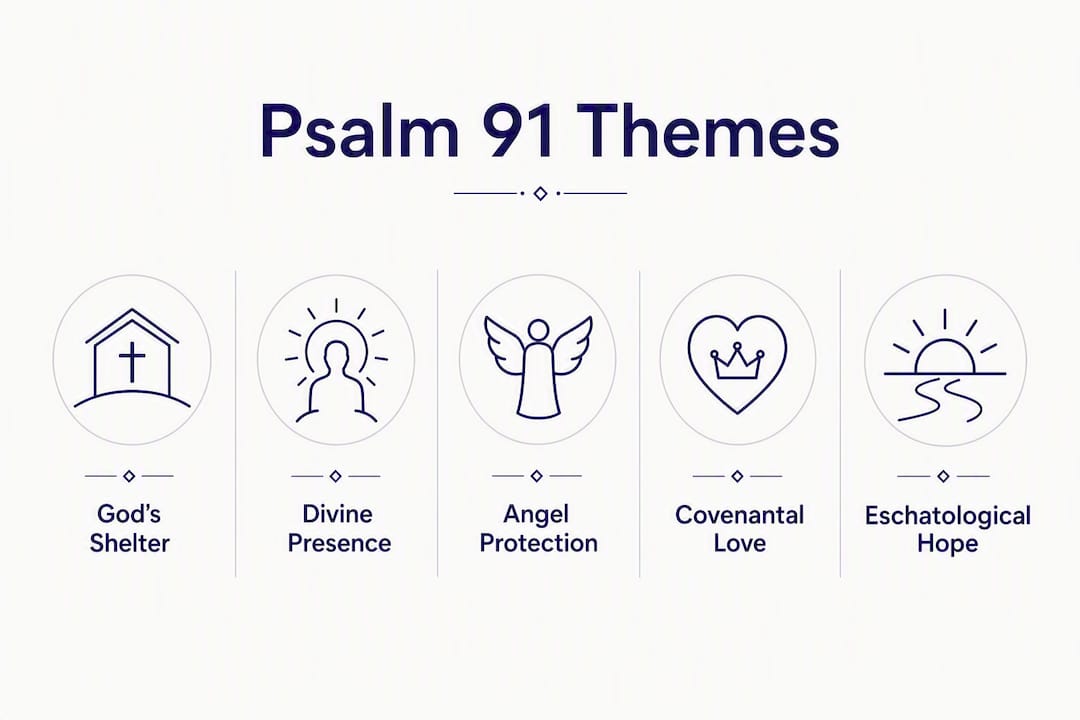
What are the core theological themes of Psalm 91?
The psalm’s theology is richer than a simple “God protects his people” summary. Several interlocking themes run through it.
Dwelling as the condition, not the reward. The protection described in Psalm 91 is not distributed randomly or earned by moral performance. It flows from a specific posture: dwelling, resting, making God your habitation. This is covenantal language. The psalm’s promises are founded in relationship (“because he loves me”) rather than entitlement, which means they cannot be claimed by someone who treats God as a vending machine.
Divine presence in trouble, not absence of trouble. Verse 15 is the theological center of gravity. God’s promise is companionship through suffering, not exemption from it. This aligns Psalm 91 with the broader biblical witness: Joseph in the pit, Daniel in the lions’ den, Paul in prison. The pattern is not “God’s people avoid danger” but “God’s people are not abandoned in it.”
Protection language as covenantal poetry. The psalm uses the full range of ancient Near Eastern protection imagery — fortress, wings, shield, angels, trampling enemies — because it is making a comprehensive claim about God’s sovereignty. None of these images are meant to be read as a literal insurance policy. They are the language of trust, the vocabulary of a person who has staked their life on God’s faithfulness.
Angelic ministry as real but not manipulable. Hebrews 1:14 gives the angel promise a firm New Testament grounding. Angels are real agents of God’s care. But as the Matthew 4 episode shows, claiming angelic protection as a right to be tested is a distortion, not a faith statement.
An eschatological horizon. “Long life” and “salvation” in verse 16 point beyond mere longevity. The Hebrew yeshua (salvation) carries the full weight of God’s ultimate rescue — a word that echoes forward to the name of Jesus. No danger, however real, has the final word over a life hidden in God.
Pro Tip: When teaching Psalm 91 in a small group, pair it with Psalm 23 — both psalms trace the same arc of trust through danger, and reading them together prevents either from being flattened into a simple “everything will be fine” message.
How is Psalm 91 commonly misread, and what should you watch for?
The most persistent misreading treats Psalm 91 as a charm — a text to recite before surgery, before a flight, before battle — with the expectation that the words themselves create a protective field. This is not faith; it is magic. And the Bible’s own narrative corrects it.
Pastoral guides consistently warn against treating Psalm 91 as a guaranteed removal of hardship, and the reasons are both theological and pastoral. Theologically, the psalm’s promises are relational, not mechanical. Pastorally, a congregation that has been taught to expect physical immunity will be devastated when a faithful member gets cancer or dies in an accident — not because God failed, but because the teaching was wrong.
Common interpretive errors and their corrections:
- Error: “If I have enough faith, no harm will come to me.” Correction: Verse 15 explicitly says God will be with the believer in trouble, not that trouble will be removed.
- Error: Reciting the psalm as a protective incantation. Correction: The psalm calls for dwelling — a relational posture — not a verbal formula.
- Error: Reading “a thousand fall at your side” as a literal promise of physical survival. Correction: This is hyperbolic poetry, not a statistical guarantee.
- Error: Ignoring the psalm’s conditional framing (“because he loves me,” “because he acknowledges my name”). Correction: The promises are grounded in relationship, not available on demand.
The psalm also needs to be read alongside Job, Psalm 90, and 2 Corinthians 12 (Paul’s thorn in the flesh). Job was a man who feared God and acknowledged his name — and he suffered catastrophically. Paul prayed three times for his thorn to be removed, and God said no. Neither of these stories contradicts Psalm 91; they clarify what “protection” actually means in the biblical framework. God’s protection is real, but it operates on a larger canvas than physical safety in this life.
Pro Tip: If you are preaching Psalm 91, open with a lament — read Psalm 90 first, or read a passage from Job. Let the congregation sit with human fragility before you bring in the psalm’s confidence. That sequence is more honest and more powerful than jumping straight to the promises.
How to apply Psalm 91 in your daily life
Moving from understanding the psalm to actually living it requires more than reading it once — creating a dedicated prayer room can help establish a consistent, faith-focused devotional space. The key shift is from occasional prayer to a permanent state of dwelling — making God’s presence the habitual environment of your life, not a resource you access in emergencies.
Here are concrete practices that help make that shift real:
-
Morning confession (verses 1–2). Begin each day by reading verses 1–2 aloud and personalizing them: “You are my refuge and my fortress; my God, in whom I trust.” This is not a magic formula — it is a deliberate reorientation of your attention before the day’s pressures arrive.
-
Name your fears (verses 3–8). The psalm catalogs specific dangers: snares, pestilence, terror, arrows, plague. Write your own list. What are the specific fears you are carrying today — a health diagnosis, a financial threat, a broken relationship? Naming them concretely, then handing them to God by name, is the psalm’s own method.
-
Midday anchor (verses 9–13). When anxiety spikes during the day, return to the angel promise: “He will command his angels concerning you.” Not as a charm, but as a reminder that God’s care is not suspended because you are busy or afraid.
-
Evening reflection (verses 14–16). At night, read God’s direct speech in verses 14–16 slowly. Ask: where did I see God’s presence today, even in difficulty? Journaling one specific answer builds the habit of noticing God’s faithfulness rather than only his absence.
-
Scripture memorization. Memorizing verses 1–2 and 14–16 gives you something to hold onto when anxiety or grief hits too hard for structured prayer. The Bible verses about trusting God collected at Biblemanna can supplement this practice with related scriptures that reinforce the same covenantal trust.
Additional practices worth building into your week:
- Read Psalm 91 alongside scriptures about protection to see how the theme runs through the whole Bible
- Use a translation comparison tool to notice how different versions render “dwells” and “shelter” — the word choices reveal interpretive decisions
- In community settings, read the psalm responsively: congregation reads verses 1–13, a leader reads verses 14–16 in God’s voice. The voice shift becomes visceral and memorable.
A pastoral note: if anxiety or trauma is severe, Psalm 91 is a companion, not a cure. Seeking a counselor, pastor, or mental health professional is not a failure of faith — it is wisdom, and the psalm’s own emphasis on God’s care includes the human instruments through which that care often arrives.
Key Takeaways
Psalm 91 promises God’s covenantal presence through every danger, grounded in relationship and love, not a mechanical formula for physical immunity.
| Point | Details |
|---|---|
| Core message | Psalm 91 offers God’s protective presence to those who dwell with him, not guaranteed exemption from hardship. |
| Conditional framing | Every promise is grounded in relationship: “because he loves me, because he acknowledges my name” (v. 14). |
| “Thousand fall” is poetry | The hyperbolic language of verse 7 emphasizes God’s preserving power, not a literal survival statistic. |
| Verse 15 is the key | God promises to be with the believer in trouble, not to remove the trouble — this shapes every other promise. |
| Biblemanna for application | Biblemanna’s topical verse collections on protection and trust help readers build the devotional habits Psalm 91 calls for. |
The psalm that doesn’t flinch
Most comfort texts soften the edges. Psalm 91 does not. It names pestilence, terror, arrows, plague, lions, and cobras — and then says: none of these have the final word. That combination of unflinching honesty about danger and unshaken confidence in God is what makes the psalm so durable across centuries of human suffering.
What strikes me most, reading it carefully, is verse 15. God does not say “I will prevent trouble.” He says “I will be with him in trouble.” That is a harder promise to receive, because it does not remove the pain. But it is also a more honest one — and ultimately a more sustaining one. A God who promises to keep you from all suffering is a God whose promises collapse the first time you get a difficult diagnosis. A God who promises to be present in the suffering is a God you can actually trust when the diagnosis comes.
The psalm is also doing something structurally that most readers miss: it moves you from talking about God, to talking to God, to hearing God talk to you. That movement is a complete prayer. And the fact that God gets the last word — that the final verses are his direct speech, not the psalmist’s claims — is itself a theological statement. Our confidence is not in our own declarations of faith. It is in what God has said.
Where I see this psalm misused most often is in communities facing real trauma: illness, violence, loss. The instinct to quote verse 7 (“a thousand may fall at your side, but it will not come near you”) to someone who just lost a child is not pastoral care — it is a theological error delivered at the worst possible moment. The psalm is better used as a companion for the long walk through suffering than as a promise that the suffering will not happen.
Teach it that way, and it becomes one of the most honest, most comforting texts in the entire Psalter.
Biblemanna helps you study and live Psalm 91
Reading Psalm 91 once is easy. Building the devotional habits it calls for — dwelling, naming fears, returning to God’s promises daily — takes the kind of sustained, organized scripture engagement that most readers struggle to maintain on their own.

Biblemanna’s topical verse collections give you exactly that structure. The Bible verses by topic library organizes scripture around the themes Psalm 91 raises: protection, trust, strength, encouragement, and hard times — each verse presented with context so you understand not just what the text says but what it means for your situation. Whether you are building a morning confession routine, looking for cross-references to deepen your study, or searching for verses about strength to pair with Psalm 91 in a difficult season, Biblemanna’s collections are organized to get you to the right scripture fast. Start with the topical library and build the dwelling habit one verse at a time.
Further reading and authoritative sources
These resources represent the strongest available commentary and pastoral reflection on Psalm 91, from technical exegesis to devotional application:
- Working Preacher — Commentary on Psalm 91: Scholarly analysis of the Psalm 90/91 dialogue, the voice shift in verses 14–16, and the psalm’s use in lectionary preaching.
- Calvin Institute of Christian Worship — “The Wings of God: Psalm 91”: Liturgical and worship-focused reflection on the psalm’s imagery and its use in congregational settings.
- The Gospel Coalition — “Does Psalm 91 Belong to Me?”: Theological essay on who the psalm’s promises are addressed to and how to apply them responsibly.
FAQ
What is the main message of Psalm 91?
The main message is that those who make God their dwelling place find his covenantal protection through every danger — not a guarantee of physical immunity, but the assurance of God’s presence, deliverance, and ultimate salvation grounded in love and relationship.
How do you apply Psalm 91 in daily life?
Move beyond crisis-only prayer to a habit of dwelling: personalize verses 1–2 each morning, name specific fears and hand them to God, and read God’s direct promises in verses 14–16 each evening as a closing reflection.
What does “a thousand fall at your side” mean in Psalm 91?
It is hyperbolic poetry, not a literal survival statistic. Commentators read it as figurative language emphasizing God’s preserving power amid catastrophic circumstances — the point is comprehensive protection, not a body count.
What are the key promises in Psalm 91?
The psalm lists God’s presence as refuge (v. 2), deliverance from hidden and open dangers (vv. 3–6), angelic protection (vv. 11–12), answered prayer (v. 15), and ultimate salvation with long life (v. 16) — all grounded in the relational condition of verse 14: “because he loves me.”
Does Psalm 91 promise that believers will never suffer?
No. Verse 15 explicitly says God will be with the believer in trouble, not that trouble will be removed. Read alongside Job and Paul’s thorn in the flesh (2 Corinthians 12), the psalm offers companionship through suffering and ultimate vindication, not exemption from hardship.