Romans 8:28 Meaning: Hope, Not a Platitude

Romans 8:28 is one of the most quoted verses in the Bible, and one of the most misunderstood. Not comfort on demand. Not the removal of suffering. A sovereign, purposeful God directing all of life toward something far deeper than your current circumstances.
A plain paraphrase: God uses everything, including the hard things, to accomplish his redemptive purpose in the lives of believers.
Pro Tip: Read “good” here as God’s definition, not yours. The next verse (Romans 8:29) tells you exactly what that good is: being conformed to the image of Christ. That reframe changes everything about how you hold this promise.
Key Takeaways
| Point | Details |
|---|---|
| The core promise | God works all things toward ultimate good for believers who love him and are called to his purpose. |
| “Good” means Christlikeness | Romans 8:29 defines “good” as conformity to Christ, not comfort, prosperity, or resolved circumstances. |
| Who the promise applies to | The verse is covenantal, specifically for those who love God and are called according to his purpose. |
| Pastoral caution | Never use the verse to dismiss grief; it was written to suffering people, not against them. |
| Biblemanna for deeper study | Biblemanna’s topical verse collections on comfort, hope, and encouragement pair directly with Romans 8:28 themes. |
Table of Contents
- What does Romans 8:28 mean in its chapter context?
- A phrase-by-phrase reading of Romans 8:28
- What does “good” actually mean here — and what it doesn’t
- What Romans 8:28 does not mean — and how to avoid misuse
- How believers can live in light of Romans 8:28
- How is Romans 8:28 translated across major Bible versions?
- Key related passages to study alongside Romans 8:28
- Biblemanna’s curated resources for studying Romans 8:28
- Why Romans 8:28 still catches me off guard
- Biblemanna’s topical collections for deeper study
- Sources
- FAQ
What does Romans 8:28 mean in its chapter context?
Paul did not drop this verse into a pep talk. He placed it at the center of one of the most honest chapters in the New Testament about suffering, groaning, and the agonizing gap between present pain and future glory.
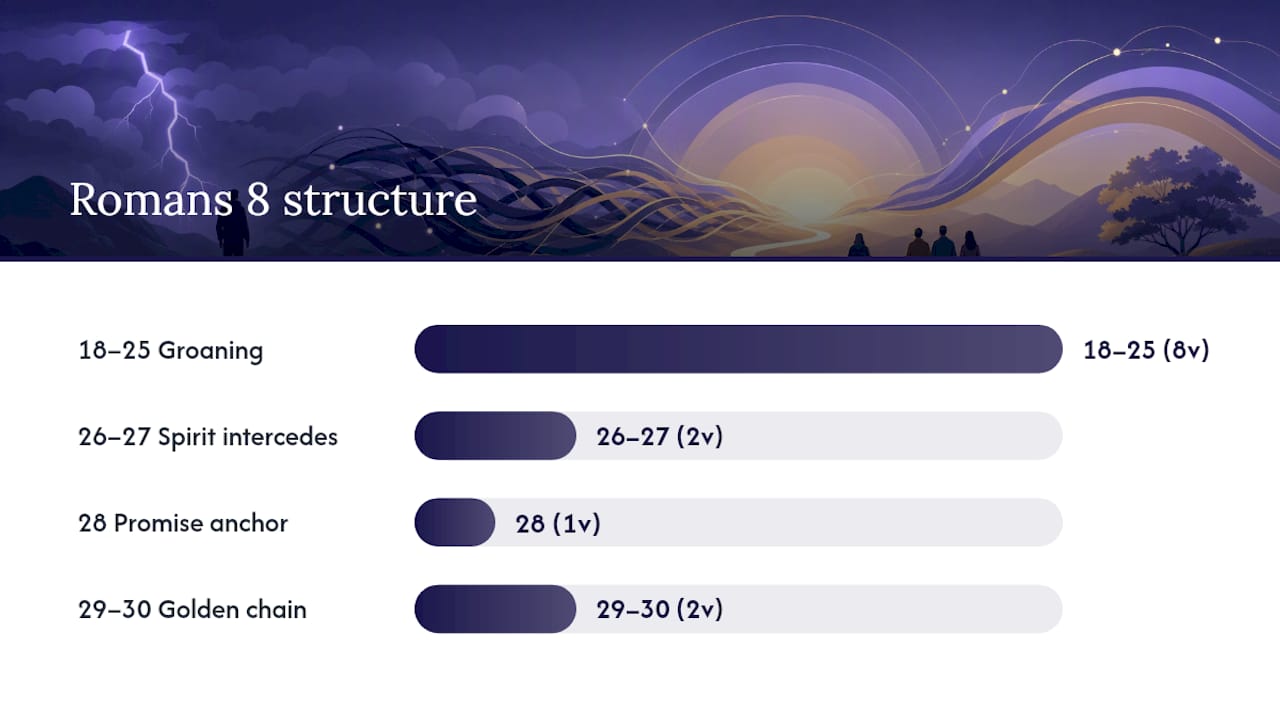
Romans 8 moves in a clear arc:
- Verses 18–25: Creation and believers groan together, waiting for a redemption not yet fully visible. Paul names the suffering plainly: “our present sufferings are not worth comparing with the glory that will be revealed in us” (Romans 8:18).
- Verses 26–27: The Spirit intercedes for believers when they cannot find words, praying according to God’s will.
- Verse 28: The promise lands here, not as a greeting-card sentiment but as a theological anchor for people in the middle of real groaning.
- Verses 29–30: The “golden chain” — foreknown, predestined, called, justified, glorified — shows where God’s working is headed.
Ligonier Ministries makes the point plainly: Paul wrote verse 28 to address believers who are groaning and waiting for redemption, not to offer a quick comfort phrase. The verse answers a specific question: what is God doing while we suffer? The answer is that he is working, purposefully, toward an end that suffering cannot derail.
Reading verse 28 in isolation from Romans 8:35–39, where Paul asks who can separate us from the love of Christ and lists tribulation, distress, and persecution, strips the verse of its actual weight. The promise is not that life will get easier. It is that nothing in life falls outside God’s purposive reach.
A phrase-by-phrase reading of Romans 8:28
Every clause in this verse carries interpretive weight. Reading it slowly is worth the effort.
“And we know”
Paul opens with shared conviction, not speculation. This is not “we hope” or “we suspect.” The knowledge he points to is grounded in the Spirit’s intercession (vv. 26–27) and in God’s revealed character. It is a settled, communal confidence.
“In all things” / “all things”
The scope is total. Not “in most things” or “in the things that feel spiritual.” Tragedy, betrayal, illness, loss — all of it falls within the claim. Some translations render this as the subject (“all things work together”), while others make God the explicit actor (“God works in all things”). The Greek supports both readings, but the theological weight of the chapter points to God as the active agent.
“God works / causes all things to work together” — sunergeo
The Greek verb here is sunergeo, from which we get the English word “synergy.” Berean Bible Church explains that sunergeo implies cooperative, purposeful agency: God brings all elements, including suffering and evil, into a cooperative working toward an intended result. Nothing is wasted. Nothing is random. Even what is genuinely bad is not outside God’s ability to direct toward his purpose.
Sunergeo does not mean every event is good. It means God works them together — the way a skilled craftsman uses broken pieces to make something whole.
“For good”
This is the phrase most people read through their own lens. The “good” here is not your preferred outcome. Verse 29 defines it precisely: conformity to the image of Christ. The good is moral, spiritual, and eternal. Berean Bible Church stresses that this good refers to God’s ultimate redemptive plan, not immediate worldly comfort.
“For those who love God”
The promise is qualified. It is not a universal guarantee for every human being in every situation. It is covenantal language for those in a relationship of love and trust with God.
“Called according to his purpose”
This phrase ties the promise to God’s initiative, not human achievement. The calling is his. The purpose is his. The “good” being worked toward is his. Bibleref notes that many commentators emphasize these qualifiers as evidence that the promise is specifically covenantal, applying to believers rather than functioning as a general life principle.
What does “good” actually mean here — and what it doesn’t
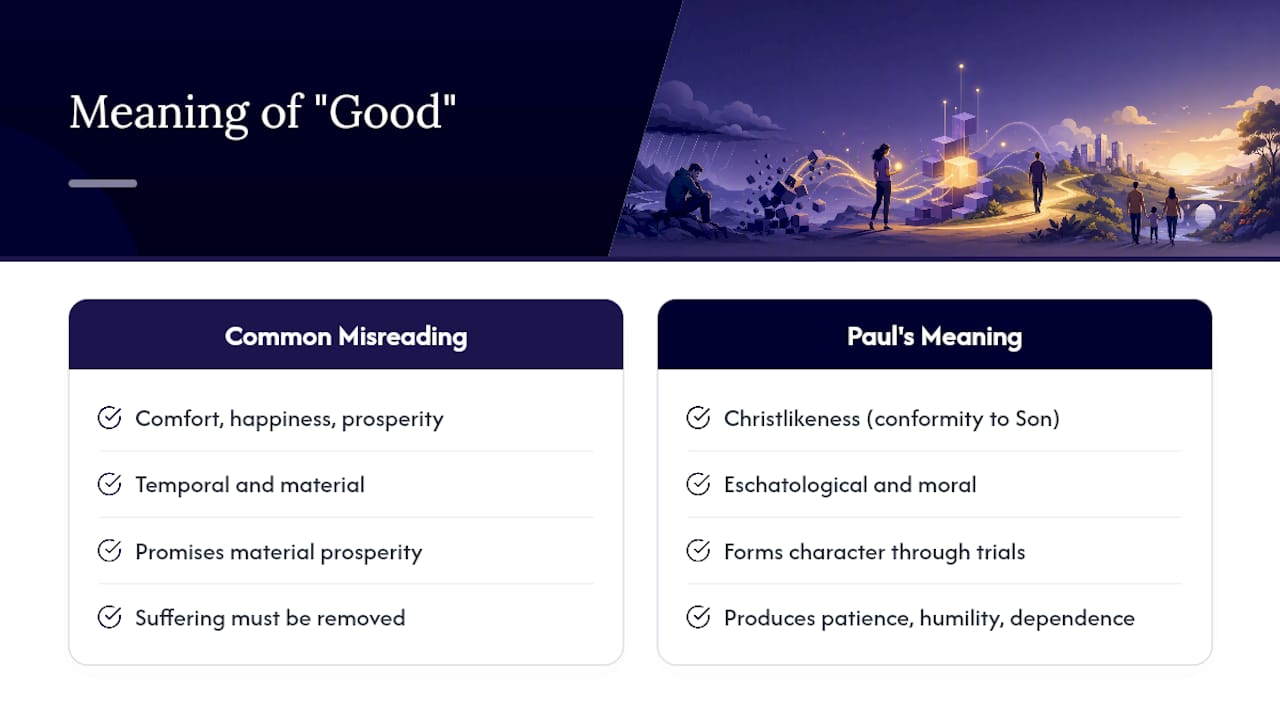
The most common misreading of Romans 8:28 is treating “good” as a synonym for “comfortable,” “happy,” or “prosperous.” Paul meant none of those things.
Romans 8:29 is the interpretive key: “For those God foreknew he also predestined to be conformed to the image of his Son.” The good is Christlikeness. It is eschatological and moral, not temporal and material. Savage Mercies argues that verse 29 explicitly defines the “good” of verse 28 as conformity to Christ, pointing to an eschatological transformation rather than guaranteed earthly comfort.
That reframe is significant. A painful season that produces patience, humility, or deeper dependence on God is, by Paul’s definition, working “for good,” even when it feels like anything but. The promise is not that God will fix your circumstances. It is that he is forming your character through them.
Logos frames the verse as theological rather than therapeutic: it does not promise material prosperity, does not make all things intrinsically good, and does not guarantee instant removal of sorrow. The comfort is knowing who is working, not knowing how the circumstances will resolve.
Pro Tip: When speaking this verse to someone in grief, try: “God hasn’t abandoned what’s happening to you. He’s at work in it.” That phrasing honors the pain while holding the promise, without flattening either one.
What Romans 8:28 does not mean — and how to avoid misuse
Ligonier Ministries cautions that using this verse as a platitude to minimize pain misses Paul’s intent entirely. Here are the three most common misuses and a better pastoral alternative for each:
- Misuse 1: Using it to dismiss grief. Saying “Well, Romans 8:28!” to someone in acute pain suggests their grief is a failure of faith. A better response: “I don’t know what God is doing in this, but I believe he hasn’t left you in it alone.”
- Misuse 2: Treating it as a prosperity promise. The verse says nothing about financial restoration, physical healing on demand, or circumstances improving. A better framing: “This promise is about God’s purpose, not your comfort level.”
- Misuse 3: Implying someone lacks faith if they’re still suffering. The verse was written to suffering people, not against them. A better pastoral move: sit with the person in their pain before reaching for a verse at all.
Logos identifies these misunderstandings specifically, noting that the verse is often weaponized against grief rather than offered as genuine hope. Careful teachers point out that using the verse to “fix” grief strips its context and frequently harms the grieving person. Good pastoral practice acknowledges pain while pointing to God’s purpose, not past it.
How believers can live in light of Romans 8:28
Holding this promise well is a practice, not a one-time decision. Four daily postures help:
Scripture-centered lament. The Psalms model honest grief directed at God. Lament is not faithlessness; it is faith that believes God can handle your honesty. Pair Romans 8:28 with Psalm 22 or Psalm 88 to see how suffering and trust coexist in Scripture.
Prayer that aligns desires to God’s purposes. Rather than asking God to change circumstances, try praying: “God, what are you forming in me through this?” That question does not minimize pain. It opens a different kind of conversation.
Remembering the Spirit’s intercession. Romans 8:26–27 sits directly before verse 28 for a reason. The promise of verse 28 is not yours to sustain by willpower.
Community lament and support. Suffering in isolation makes it harder to hold any theological promise. Sharing grief with other believers who can speak truth and sit with pain together is itself a form of living out Romans 8.
Pro Tip: When ministering to others, lead with presence before you lead with the verse. Sitting with someone in their grief for five minutes builds more trust than quoting Romans 8:28 in the first sentence. The verse lands differently when the person already knows you’re not trying to end the conversation.
How is Romans 8:28 translated across major Bible versions?
A plain paraphrase: God is actively at work in every part of your life, including the painful parts, to accomplish his purpose of making you more like Christ.
BibleRef.com lists multiple English translations and notes that translation differences shift emphasis between divine agency and cooperative working. The ESV and NASB make God the explicit subject; the KJV leaves “all things” as the grammatical subject.
The NASB rendering (“God causes all things to work together”) most directly emphasizes divine agency. The ESV’s phrasing (“all things work together for good”) can sound more passive, as if circumstances cooperate on their own. The NASB and NIV make clear that God is the one doing the working.
Key related passages to study alongside Romans 8:28
Reading verse 28 in conversation with surrounding Scripture deepens its meaning considerably. These passages connect directly to its core themes:
- Romans 8:18 — “Present sufferings are not worth comparing with the glory that will be revealed.” Frames the time horizon of the promise.
- Romans 8:22–25 — Creation and believers groan together in hope. Shows that waiting and suffering are the normal Christian experience, not a sign of God’s absence.
- Romans 8:29–30 — The golden chain: foreknown, predestined, called, justified, glorified. Defines the “good” and shows its endpoint. Study prompt: Read 8:28 and 8:29 together. How does verse 29 change what you hear in verse 28?
- Romans 8:35–39 — Nothing can separate believers from God’s love. Confirms the promise’s permanence.
- 2 Corinthians 4:17 — “Light and momentary troubles are achieving for us an eternal glory.” Paul’s own experience of suffering as purposive.
- Philippians 1:6 — “He who began a good work in you will carry it on to completion.” God’s faithfulness to finish what he started. Study prompt: Pair with Romans 8:28. What does “completion” look like in light of verse 29?
- Romans 5:3–5 — Suffering produces perseverance, character, and hope. The mechanism Paul elsewhere describes for how God uses hardship.
- Psalm 139:16 — “All the days ordained for me were written in your book before one of them came to be.” God’s sovereign knowledge of every day of your life.
For devotional study resources that pair well with these passages, Spirit of His Mouth offers scriptural studies and devotional materials suited for small-group leaders and individual study.
Biblemanna’s curated resources for studying Romans 8:28
Biblemanna organizes Scripture by theme so you can find verses that speak directly to what you’re facing, with context and background for each one. For readers going deeper on Romans 8:28, these collections are worth bookmarking:
- Bible verses about comfort — 43 passages curated for seasons of grief and uncertainty, with explanatory notes.
- Bible verses about hope — 71 verses on future glory and present endurance, directly relevant to Romans 8’s themes.
- Bible verses about trusting God — 32 passages for readers working through what it means to trust God’s purpose in hard circumstances.
- Bible verses about encouragement — 39 verses that pair naturally with Romans 8:28 for personal devotion or ministry to others.
- Paul the Apostle on Biblemanna — Background on Paul’s theology and the major themes running through his letters, including Romans.
- What does the Bible say? — Editorial explainers on key biblical questions, written with the same depth and pastoral care as this article.
Biblemanna’s topical structure means you are never searching through a generic list. Every collection is organized around a specific emotional or spiritual need, with the verse text and its meaning together on the same page.
Why Romans 8:28 still catches me off guard
There is a version of this verse I grew up hearing that functioned as a theological conversation-ender: someone mentions suffering, someone else quotes Romans 8:28, and the subject closes. That use of the verse has always troubled me, and the more carefully I read Paul, the more I think it should trouble anyone who takes the text seriously.
Paul wrote this promise from inside suffering, to people inside suffering. The verse is not a lid on grief. It is a foundation under it. The difference is pastoral and practical: a foundation lets you stand in the middle of pain without being swept away; a lid just tells you to stop feeling what you feel.
Holding Romans 8:28 well means holding it humbly, especially when speaking it to others. The promise is real. The comfort is genuine. But it lands best when the person hearing it already knows you are not trying to rush them past their pain.
Biblemanna’s topical collections for deeper study
When Romans 8:28 sends you looking for more Scripture on suffering, hope, or God’s faithfulness, Biblemanna’s curated collections give you exactly that: the verses themselves, with context, organized around what you’re actually going through.

The Bible verses by topic hub covers more than 50 themes, from comfort and hope to faith and strength. Every collection includes the verse text, its meaning, and background notes so you are not just reading words in isolation. For readers who want to sit with the themes of Romans 8 specifically, the encouragement collection is a natural next step. Browse the full topic library and find the passages that speak to where you are right now.
Sources
- What does Romans 8 mean? | Ligonier Ministries
- All Things for Good? 6 Things Romans 8:28 Doesn’t Mean | Logos Grow
- Bibleref
- Is This Promise For Us? (Romans 8:28): Berean Bible Church
- Romans 8:28: What This Verse Actually Means (Explained) | Savage Mercies
FAQ
What does Romans 8:28 mean in plain terms?
The “good” he works toward is conformity to Christ, not guaranteed comfort or prosperity.
What does “called according to his purpose” mean in Romans 8:28?
The calling is his, the purpose is his, and the “good” being worked toward flows from his redemptive plan, not from individual effort or desire.
What is an easy translation of Romans 8:28?
A plain paraphrase: God uses everything in your life, including the painful parts, to accomplish his purpose of making you more like Christ. The NASB renders it most directly: “God causes all things to work together for good to those who love God.”
How can I apply Romans 8:28 in daily life?
Practice honest lament in prayer rather than suppressing grief, ask God what he is forming in you through hard seasons, and lean on the Spirit’s intercession (Romans 8:26–27) when words fail. Biblemanna’s trusting God verse collection offers 32 passages that support this daily posture.
Does Romans 8:28 apply to everyone?
No. The verse is explicitly qualified: it applies to “those who love God” and “those who are called according to his purpose.” BibleRef.com notes that many commentators treat these qualifiers as covenantal markers, meaning the promise is specifically for believers, not a universal guarantee for every human situation.