Sermon on the Mount Meaning: What Jesus Really Taught
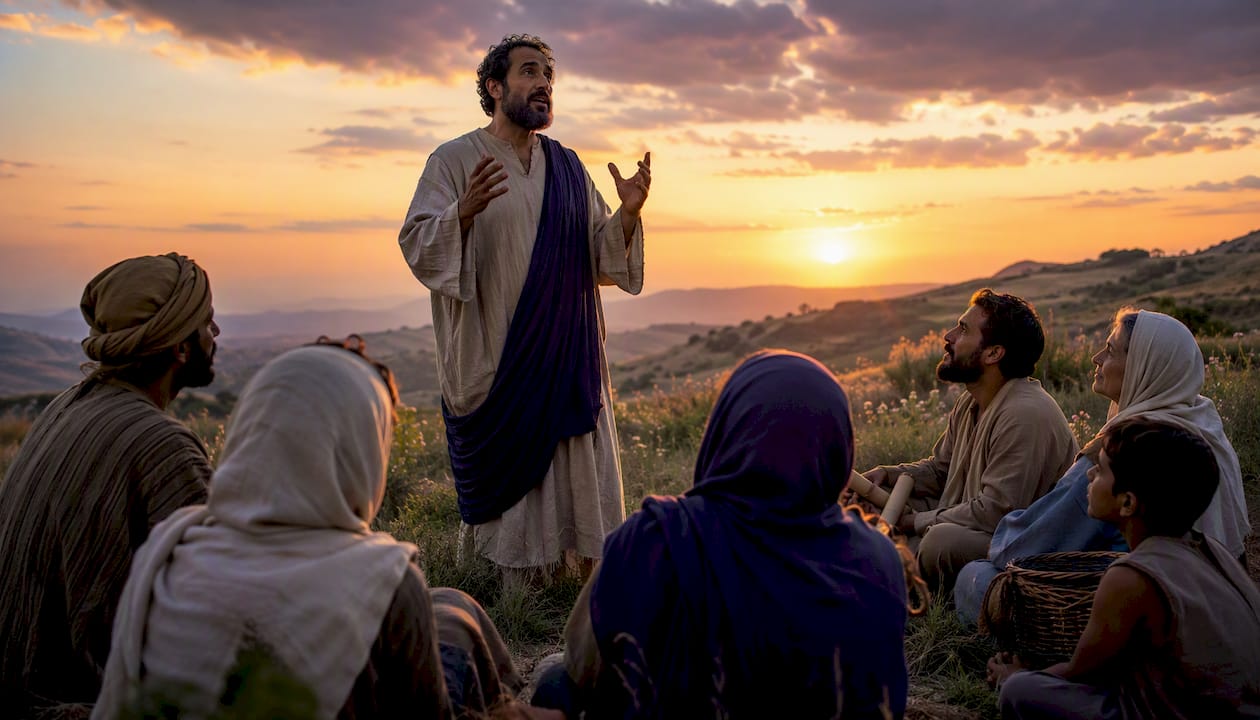
The Sermon on the Mount is Jesus’ foundational declaration of Kingdom ethics — a sustained call to inward righteousness, radical love, and a way of life that fulfills rather than discards the Torah. Recorded in Matthew 5–7, it opens with Jesus ascending a hillside, sitting down in the posture of a Jewish teacher, and beginning: “Blessed are the poor in spirit, for theirs is the kingdom of heaven” (Matthew 5:3). That first line sets the entire sermon’s direction.

Two features anchor everything that follows. The Beatitudes (Matthew 5:3–12) open with a portrait of Kingdom character so countercultural it still startles readers today. The Lord’s Prayer (Matthew 6:9–13) sits at the sermon’s literary center, functioning as the sustaining practice for the life Jesus describes. Between those two poles, Matthew 5:17 states the sermon’s governing claim: “Do not think that I have come to abolish the Law or the Prophets; I have not come to abolish them but to fulfill them.”
Table of Contents
- What is the Sermon on the Mount and how is it structured?
- What do the Beatitudes actually mean?
- What are the major themes running through Matthew 5–7?
- Why does Jesus teach from a mountain?
- What does Jesus mean when he says he “fulfills” the Law?
- How have Christians applied the Sermon on the Mount?
- What are the main interpretive approaches scholars use?
- How can you study the Sermon on the Mount systematically?
- What does the Sermon on the Mount ultimately call you to do?
- Key Takeaways
- The sermon rewards slow reading
- Biblemanna helps you go deeper into the sermon’s themes
- Useful sources for further study
- FAQ
What is the Sermon on the Mount and how is it structured?
Matthew 5–7 places the sermon immediately after Jesus’ baptism, wilderness temptation, and the calling of his first disciples. The crowd and the disciples both hear it, a detail Matthew emphasizes to signal that this teaching is simultaneously an invitation to outsiders and a formation document for followers.
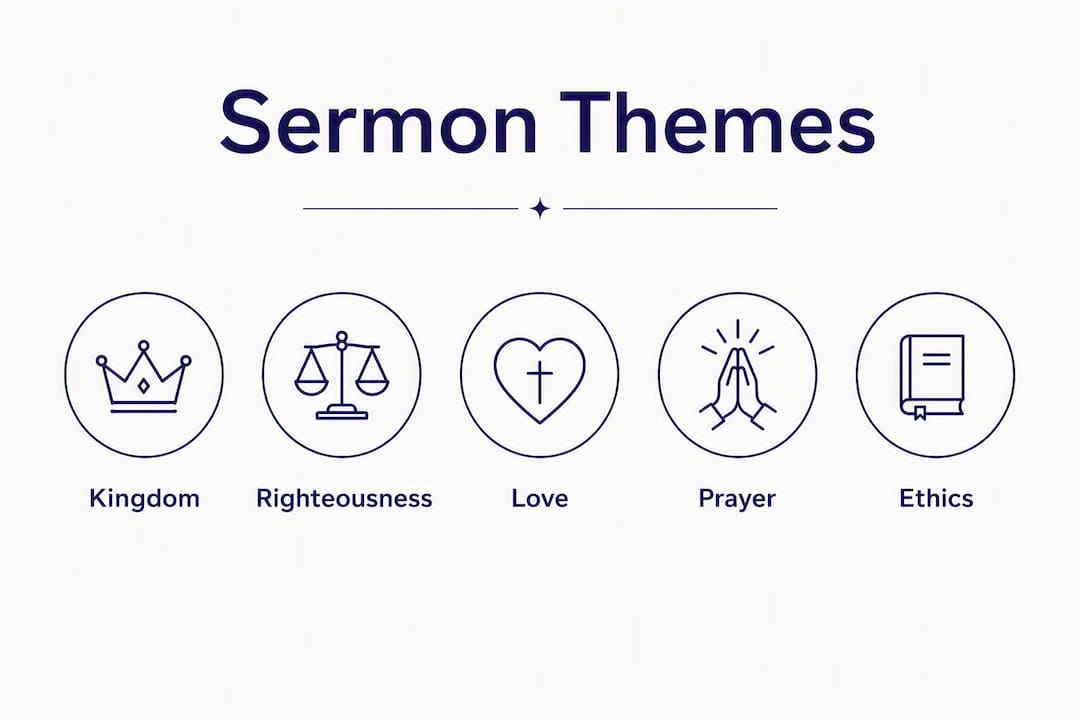
Scholars note that Matthew organizes the sermon in three major sections with embedded triads — a structure that mirrors oral-instruction techniques designed to help non-literate listeners memorize and internalize the material. The Crossway exposition of the sermon identifies this triadic pattern as a deliberate literary design, not an accident of compilation.
| Section | Content | Key Verses |
|---|---|---|
| Opening: Kingdom character | Beatitudes; salt and light | Matthew 5:3–16 |
| Body: Kingdom ethics and piety | Law, anger, lust, oaths, retaliation, enemy love, almsgiving, prayer, fasting, treasure, anxiety, judging | Matthew 5:17–7:12 |
| Conclusion: Call to decision | Narrow gate, false prophets, wise and foolish builders | Matthew 7:13–27 |
A fair question is whether Matthew 5–7 records a single sermon Jesus delivered on one occasion or whether Matthew compiled teachings from multiple settings into a unified discourse. Most scholars lean toward the latter — Matthew’s literary framing shapes the material into a coherent whole. That does not diminish its authority; it means reading it as a carefully crafted theological document rewards more than reading it as a transcript.
What do the Beatitudes actually mean?
The word “Beatitudes” comes from the Latin beatitudo, which translates the Greek makarioi — a term that signals a state of divine favor, not merely a feeling of happiness. Matthew lists eight or nine beatitudes (Matthew 5:3–12), and Bible Gateway’s analysis of the term notes that makarioi describes people who are already recipients of God’s blessing, not people who are trying to earn it.
Here is each beatitude with a plain-language reading:
- “Blessed are the poor in spirit” (5:3) — Those who recognize their spiritual bankruptcy before God are already inside the Kingdom.
- “Blessed are those who mourn” (5:4) — Grief over sin and suffering is not a sign of weakness; it is the posture God meets with comfort.
- “Blessed are the meek” (5:5) — Meekness is not passivity; it is strength held under control, and it inherits the earth.
- “Blessed are those who hunger and thirst for righteousness” (5:6) — The appetite for right-relating to God and neighbor will be satisfied.
- “Blessed are the merciful” (5:7) — Mercy given flows back; the logic is relational, not transactional.
- “Blessed are the pure in heart” (5:8) — Undivided inner loyalty to God is what enables seeing him.
- “Blessed are the peacemakers” (5:9) — Active reconcilers bear a family resemblance to God himself.
- “Blessed are those who are persecuted for righteousness” (5:10–12) — Suffering for Kingdom values places a person in the company of the prophets.
The beatitudes cluster thematically. The first four (poverty of spirit, mourning, meekness, hunger for righteousness) describe the inner orientation of a Kingdom person. The next four (mercy, purity, peacemaking, persecution) describe how that orientation plays out in community. Together they form a portrait, not a checklist.
Pro Tip: Read the Beatitudes against first-century Greco-Roman honor culture, where status, wealth, and power determined divine favor. Blessing the poor, the grieving, and the persecuted was not just countercultural — it was a direct challenge to the entire social architecture of the ancient world. That context, explored in Wikipedia’s entry on the Beatitudes, makes the sermon’s opening feel less like gentle inspiration and more like a manifesto.
For readers who want to sit with the Beatitudes’ promise of flourishing, Biblemanna’s collection of Bible verses about happiness gathers related scripture with context that deepens the study.
What are the major themes running through Matthew 5–7?
The Kingdom of God as the sermon’s organizing center
Every ethical command in the sermon is grounded in one reality: the Kingdom of God has arrived in Jesus. The sermon does not present rules for earning entry into the Kingdom; it describes what life looks like for people already living under God’s rule. Crossway’s exposition frames it precisely: the sermon shows how believers enact Kingdom realities now through justice, mercy, and peacemaking, while pointing toward eschatological fulfillment. That dual horizon — present ethics, future completion — keeps the sermon from collapsing into either pure moralism or pure futurism.
Internalized righteousness vs. external performance
The Greek word dikaiosune (righteousness) appears seven times in Matthew 5–7. In the sermon, it consistently means right-relating — ethical conduct that repairs relationships and reflects God’s character — rather than external compliance with rules. Jesus makes this explicit in the antitheses of Matthew 5:21–48: “You have heard it said… but I say to you.” Anger is the seed of murder. Lust is the seed of adultery. The Pharisaic focus on visible compliance misses the heart-level demand entirely.
Radical love and its social weight
Enemy love (Matthew 5:44) is the sermon’s most demanding ethical claim. Loving those who benefit you is ordinary; loving those who oppose you is the mark of a Kingdom community. This is not sentimental advice. In a first-century context of Roman occupation and factional religious conflict, it was a concrete social posture. Forgiveness, non-retaliation, and reconciliation before worship (Matthew 5:23–24) all flow from the same logic: relationships matter more than reputation.
Prayer, fasting, almsgiving, and the teaching on anxiety
The sermon’s body gives sustained attention to three piety practices: almsgiving (Matthew 6:1–4), prayer (6:5–15), and fasting (6:16–18). In each case, Jesus’ concern is the same — do not perform for human approval. The Lord’s Prayer sits at the center of this section and of the entire sermon, functioning as its rhetorical summit. Its placement makes prayer the sustaining practice for the life Jesus describes. Matthew 6:19–34 then extends the logic to treasure and anxiety: where your treasure is, your heart follows. Readers wrestling with worry and trust in God will find Biblemanna’s Bible verses about trusting God a useful companion passage.
Why does Jesus teach from a mountain?
The mountain is not incidental. Matthew 5:1–2 records that Jesus “went up on a mountainside and sat down” before teaching — a scene that would have immediately recalled Sinai to any Jewish reader. Moses ascended the mountain to receive Torah from God; Jesus ascends the mountain to deliver Torah with his own authority. The parallel is deliberate.
BibleProject identifies this as Matthew’s central theological claim: Jesus is the new Moses, delivering a renewed instruction that completes and reframes Torah for a worldwide community. A few direct comparisons make the typology clear:
- Moses received the Law on Sinai; Jesus delivers the Law’s fulfillment from a hillside in Galilee.
- Moses spoke as a mediator (“Thus says the Lord”); Jesus speaks on his own authority (“But I say to you”).
- Moses’ covenant was with Israel; Jesus’ teaching is addressed to disciples from all nations (Matthew 28:19).
- Moses’ Torah organized a national community; Jesus’ sermon forms a countercultural community within any nation.
The shift in authority is the key point. Jesus does not say “God told me to tell you.” He says “I say to you” — a claim that places him above the prophetic tradition and alongside the divine lawgiver himself.
What does Jesus mean when he says he “fulfills” the Law?
Matthew 5:17–20 is the sermon’s interpretive hinge: “Do not think that I have come to abolish the Law or the Prophets; I have not come to abolish them but to fulfill them. For truly I tell you, until heaven and earth disappear, not the smallest letter, not the least stroke of a pen, will by any means disappear from the Law until everything is accomplished.”
The Greek verb plēroō (fulfill) carries more weight than simple continuation. Three readings dominate scholarly discussion. First, fulfillment as completion: Jesus brings the Law to its intended end, the way a story reaches its conclusion. Second, fulfillment as intensification: Jesus drives the Law’s demands deeper, from external act to internal motive. Third, fulfillment as reinterpretation: Jesus reads the Law through the lens of his own person and mission, so that Torah’s meaning is now inseparable from him.
The antitheses that follow in Matthew 5:21–48 support all three readings simultaneously. The anger/murder teaching (5:21–22) does not cancel the prohibition on murder; it internalizes it. The same pattern holds for lust, divorce, oaths, retaliation, and enemy love. Jesus is not loosening the Law’s demands. He is pressing them inward, to the level of desire, intention, and disposition. For readers exploring how Torah themes connect to Jesus’ teaching, this study on Torah meaning offers useful background on the Law’s original scope and purpose.
The practical implication for reading the Old Testament today is this: the Law does not disappear, but it is now read through Jesus. Dietary laws, temple rituals, and civil codes find their fulfillment in him; the moral core — love God, love neighbor — is intensified, not relaxed.
How have Christians applied the Sermon on the Mount?
The sermon has never been easy to apply, and the history of Christian ethics is partly a history of wrestling with it. A few concrete practices that communities have drawn from it:
- Peacemaking and conflict resolution — Matthew 5:9 and 5:23–24 have shaped Christian mediation traditions, from early church discipline to contemporary restorative justice programs.
- Sacrificial generosity — Matthew 6:1–4’s teaching on almsgiving without public display has grounded traditions of anonymous giving and anti-poverty work.
- Prayer patterns — The Lord’s Prayer (Matthew 6:9–13) has structured Christian liturgy across Catholic, Orthodox, and Protestant traditions for two millennia.
- Non-retaliation in personal ethics — Matthew 5:38–42 has been read literally by Anabaptist and Quaker traditions as a call to nonviolence; mainstream Protestant and Catholic readings tend to apply it to personal relationships while allowing for just-war reasoning in public life.
- Social justice applications — Liberation theology and progressive Christian ethics read the Beatitudes’ blessing of the poor as a mandate for structural change, not merely personal virtue.
Denominational readings genuinely differ here, and that is worth naming honestly. Pacifist traditions (Mennonites, Church of the Brethren) treat the sermon as a literal social program. Mainstream evangelical and Catholic traditions tend to read it as an ideal that shapes personal ethics while allowing for prudential compromise in public life. Neither reading is dishonest; they reflect different convictions about the sermon’s genre and scope.
Pro Tip: For small-group study, try this three-part structure: (1) Read one section of Matthew 5–7 aloud together. (2) Ask: “Which verse is hardest to apply this week, and why?” (3) Assign one small practice — a specific act of forgiveness, a day of simplified prayer, or an anonymous gift — and report back the following week. Journaling the gap between what the sermon demands and what you actually did is more formative than discussing it abstractly. Biblemanna’s Bible verses about kindness and verses about humility make useful companion reading for those sessions.
What are the main interpretive approaches scholars use?
Three broad frameworks shape how scholars and traditions read the sermon.
Eschatological reading — Associated with Johannes Weiss and Albert Schweitzer, this view holds that Jesus expected the Kingdom to arrive imminently and that the sermon’s demands are an “interim ethic” for the brief period before that arrival. Because the Kingdom did not arrive on that timetable, the sermon’s demands are seen as aspirational rather than directly applicable. Most contemporary scholars find this reading too limiting.
Ethical/transformative reading — The sermon describes life under God’s rule as it can be lived now, in the present. Kingdom ethics are not waiting for a future event; they are the shape of Christian community today. Crossway’s framing leans this direction: the sermon shows how believers enact Kingdom realities through justice, mercy, and peacemaking in the present, while the full consummation remains future.
Continuity/discontinuity debate — How much does the sermon continue Torah, and how much does it break from it? High-continuity readings (common in Reformed theology) emphasize that Jesus intensifies but does not replace the Mosaic covenant. High-discontinuity readings (common in dispensationalism) argue that the sermon belongs to a distinct covenantal era. Most ecumenical scholarship lands somewhere between those poles.
The Sermon on the Mount also has a parallel in Luke 6:17–49, known as the Sermon on the Plain. BibleProject’s comparative guide notes that Luke places Jesus on a level place rather than a mountain, pairs blessings with woes (not just blessings), and frames the audience differently. The variations matter for historical reconstruction and for understanding each evangelist’s theological emphasis. Matthew’s mountain scene uses Sinai imagery more overtly; Luke’s plain setting emphasizes accessibility and social reversal.
For further reading, three resources stand out: the BibleProject Sermon on the Mount guide for accessible theological framing; the Ligonier Ministries guide for a Reformed perspective; and the Thinking Faith analysis for a Catholic scholarly reading. Denominational perspectives will vary, and knowing which tradition a commentator writes from helps you read their interpretation with appropriate context.
How can you study the Sermon on the Mount systematically?
A structured approach covers the sermon’s depth without getting lost in it. Here is a four-week micro-plan:
- Week 1 — Read Matthew 5–7 straight through in two or three translations (NIV, NASB, ESV). Note every verse that surprises or unsettles you. Do not explain it yet; just mark it.
- Week 2 — Study the Beatitudes (Matthew 5:3–12) using cross-references to Old Testament promises (Psalm 37 for “inherit the earth”; Isaiah 61 for “mourn” and “poor in spirit”). Use Biblemanna’s topical verse collections to find related scripture on happiness, joy, and encouragement.
- Week 3 — Work through the antitheses and piety section (Matthew 5:17–6:18). Focus on one antithesis per day. For each one, ask: what external behavior does Jesus address, and what internal disposition does he require?
- Week 4 — Study the conclusion (Matthew 7:1–27). The narrow gate, the false prophets, and the wise builder all press the same question: are you hearing and doing, or only hearing? Close with a written response to Matthew 7:24–27.
For group study, Spirit of His Mouth offers scriptural study materials that pair well with this kind of structured reading plan. Biblemanna’s Bible verses about wisdom and verses about encouragement serve as useful topical companions throughout the four weeks.
What does the Sermon on the Mount ultimately call you to do?
The sermon ends with a binary: two gates, two trees, two builders. Jesus does not leave room for admiration without response. The person who hears these words and acts on them builds on rock; the person who hears and does not act builds on sand (Matthew 7:24–27). That conclusion is the sermon’s sharpest edge.
Kingdom ethics, inward righteousness, and the fulfillment of Torah are not abstract theological categories. They are a call to a specific kind of life — one shaped by the Beatitudes’ character, sustained by the Lord’s Prayer, and expressed in enemy love, sacrificial generosity, and undivided trust in God. Read Matthew 5–7 this week. Then pick one practice from the study plan above and try it before you read it again.
Key Takeaways
The Sermon on the Mount presents Jesus’ core vision of Kingdom ethics — a call to inward righteousness, radical love, and a way of life that fulfills the Torah rather than replacing it.
| Point | Details |
|---|---|
| Kingdom ethics as the frame | Every command in Matthew 5–7 describes life under God’s rule, not a checklist for earning entry into it. |
| Beatitudes open the portrait | The eight beatitudes describe the inner character and community conduct of Kingdom people, inverting first-century social hierarchies. |
| Fulfillment, not abolition | Matthew 5:17 establishes that Jesus intensifies and completes Torah at the heart level, pressing demands inward to motive and desire. |
| Lord’s Prayer at the center | Matthew 6:9–13 sits at the sermon’s rhetorical heart, making prayer the sustaining practice for the life Jesus describes. |
| Biblemanna for ongoing study | Biblemanna’s topical verse collections on happiness, humility, kindness, and wisdom extend the sermon’s themes into daily scripture reading. |
The sermon rewards slow reading
The conventional approach to the Sermon on the Mount treats it as a collection of memorable sayings — the Beatitudes on a poster, the Lord’s Prayer in a liturgy, “turn the other cheek” in a conflict-resolution seminar. That approach is not wrong, exactly, but it misses what makes the sermon structurally powerful.
The sermon is a unified argument. The Beatitudes are not a warm-up; they are the thesis. The antitheses are not a list of rules; they are a demonstration of what fulfilling Torah actually looks like when you press it to the level of desire. The Lord’s Prayer is not an interruption; it is the pivot on which the whole discourse turns, placed at the center because prayer is what makes the rest possible. And the conclusion is not a gentle encouragement; it is a demand for a verdict.
Reading it slowly, in sequence, with attention to how each section builds on the last, changes what you see. The “new Moses” framing that BibleProject and others emphasize is not a scholarly abstraction. It is Matthew’s way of saying that what happened at Sinai is happening again, and the stakes are at least as high.
The sermon also resists the temptation to make Christianity primarily about interior experience. Enemy love, reconciliation before worship, anonymous generosity, and peacemaking are all public, relational, and costly. The Kingdom Jesus describes is not a private spiritual state; it is a community with a distinctive social shape. That is the part most readers underestimate.
Biblemanna helps you go deeper into the sermon’s themes
Scripture study works best when you can follow a theme across the whole Bible, not just one passage. Biblemanna’s Bible verses by topic gives you exactly that: curated collections of scripture organized by theme, each verse presented with context so you understand what it means, not just what it says.

For readers working through the Sermon on the Mount, two pages are worth bookmarking. The topics and concepts hub covers Kingdom themes, faith, and the fruits of the Spirit — all of which connect directly to the sermon’s ethical demands. The verse collections on happiness, humility, and wisdom give you cross-references that extend the Beatitudes and the antitheses into the rest of Scripture. Start with the topic that hit you hardest in Matthew 5–7, and let the curated verses take the study further.
Useful sources for further study
These resources represent a range of scholarly depth and accessibility. Use them in the order that fits your current level of familiarity with the text.
| Resource | Type | Best for | Trust note |
|---|---|---|---|
| BibleProject: What Is the Sermon on the Mount? | Guide / video | General readers, visual learners | Academically informed, accessible, evangelical-leaning |
| Crossway: Breaking Down Jesus’s Sermon on the Mount | Article | Structure and literary analysis | Reformed perspective; strong on triadic design |
| Ligonier Ministries: The Sermon on the Mount | Study guide | Reformed / Presbyterian readers | R.C. Sproul tradition; doctrinally careful |
| Thinking Faith: The Meaning of the Sermon on the Mount | Scholarly article | Catholic and ecumenical readers | Jesuit publication; engages historical-critical method |
| Bible Gateway: Matthew 5–7 (NIV) | Primary text | All readers | Multiple translations; essential starting point |
| Greek Orthodox Archdiocese: The Sermon on the Mount | Theological essay | Eastern Orthodox perspective | Patristic framing; different from Western Protestant readings |
When evaluating any commentary or guide, check three things: the author’s denominational tradition (it shapes interpretive choices), whether they engage the Greek text or work only from translation, and whether they distinguish between what the text meant in its original context and what it means for application today. A resource that collapses those two questions tends to produce either antiquarianism or anachronism. The best commentaries hold both in tension.
FAQ
What is the main message of the Sermon on the Mount?
The sermon’s core message is that life under God’s Kingdom requires inward righteousness, radical love, and wholehearted trust in God — not merely external religious compliance. Jesus presents this as the fulfillment of Torah, not its replacement.
Why is it called the Sermon on the Mount?
Matthew 5:1 records that Jesus “went up on a mountainside” before teaching, deliberately echoing Moses receiving the Law on Mount Sinai. The mountain setting signals Jesus’ authority as the new Moses delivering a renewed covenant instruction.
What are the three major sections of the Sermon on the Mount?
The sermon opens with the Beatitudes and salt-and-light sayings (Matthew 5:3–16), moves into a body covering Kingdom ethics and piety practices (Matthew 5:17–7:12), and closes with a call to decisive response through the narrow gate, false prophets, and the wise builder (Matthew 7:13–27).
How long did the Sermon on the Mount last?
The text gives no duration. Matthew 5–7 as written takes roughly 15–20 minutes to read aloud, but scholars generally hold that Matthew compiled and shaped the material literarily, so the original teaching event may have been longer or structured differently across multiple occasions.
How does the Sermon on the Plain in Luke compare to Matthew’s version?
Luke 6:17–49 contains parallel material but places Jesus on a level plain rather than a mountain, pairs blessings with woes, and frames the audience differently. Matthew’s version uses Sinai imagery more overtly and includes more teaching material, reflecting each evangelist’s distinct theological emphasis.