What Does It Mean to Take Up Your Cross?

To “take up your cross” means surrendering your right to self-rule and following Jesus even when obedience costs you something real. Jesus commands it three times: in Matthew 16:24, Mark 8:34, and Luke 9:23. Luke’s version adds one word that changes everything: “daily.” This is not a single heroic act. It is a repeated, ordinary decision to put Christ’s will above your own.
TL;DR:
- Taking up your cross involves daily surrender of self-rule through small, consistent choices that reflect obedience to Christ’s priorities.
- The phrase originally referred to Roman crucifixion, meaning active sacrifice and public shame, not symbolic hardship or general suffering.
- Dying to self means transferring authority from personal plans to Christ’s lordship, often demonstrated through acts like forgiveness, dependence on prayer, and accountability.
- Wearing your cross does not justify passivity or enduring abuse; boundaries and seeking support are essential distinctions in biblical discipleship.
- Using scripture tools and topical verse collections helps embed daily surrender practices into routine habits and strengthens ongoing obedience.
Table of Contents
- The Gospel Passages Behind Take Up Your Cross Meaning
- What Denying Yourself and Dying to Self Really Requires
- How to Carry Your Cross in Ordinary Daily Life
- What Taking Up Your Cross Does Not Mean
- Scripture Tools to Practice Daily Surrender
- Small Crosses, Real Practice
- Where to Find Verses for Daily Discipleship
- Sources
- FAQ
The Gospel Passages Behind Take Up Your Cross Meaning
Three Gospel writers record this command, and the small differences between them matter. Matthew and Mark record Jesus saying, “If anyone would come after me, let him deny himself and take up his cross and follow me.” Luke’s account in Luke 9:23 matches that wording, then adds “daily,” a detail preserved in the Vulgate and several Oriental manuscript traditions.
That word choice was not decorative. To a first-century audience, a cross meant one thing: Roman execution, reserved for the condemned and designed for maximum public shame. Carrying it was not a metaphor for hardship in general. It meant carrying the patibulum, the horizontal beam, on the walk toward your own death.
A few facts anchor the phrase in its original setting:
- Jesus first predicted his own death in each Gospel immediately before giving this command, so the disciples heard “take up your cross” moments after hearing that he would be killed.
- Crucifixion executions were public and common enough under Roman rule that the image needed no explanation.
- Luke’s added word “daily” is attested across multiple ancient textual traditions, according to commentary compiled by BibleHub.
- The command follows Jesus’ identity as the suffering Messiah, not a general call to endure life’s difficulties.
Understood this way, the command was startling. Jesus was not offering an inspirational metaphor. He was describing what following him would actually require.
What Denying Yourself and Dying to Self Really Requires
“Deny yourself” does not mean despising who you are. It means giving up the right to run your own life on your own terms. Crossway’s commentary on Luke 9:23 frames this as a transfer of authority: your plans, ambitions, and self-protective instincts step aside so Christ’s lordship takes the lead.
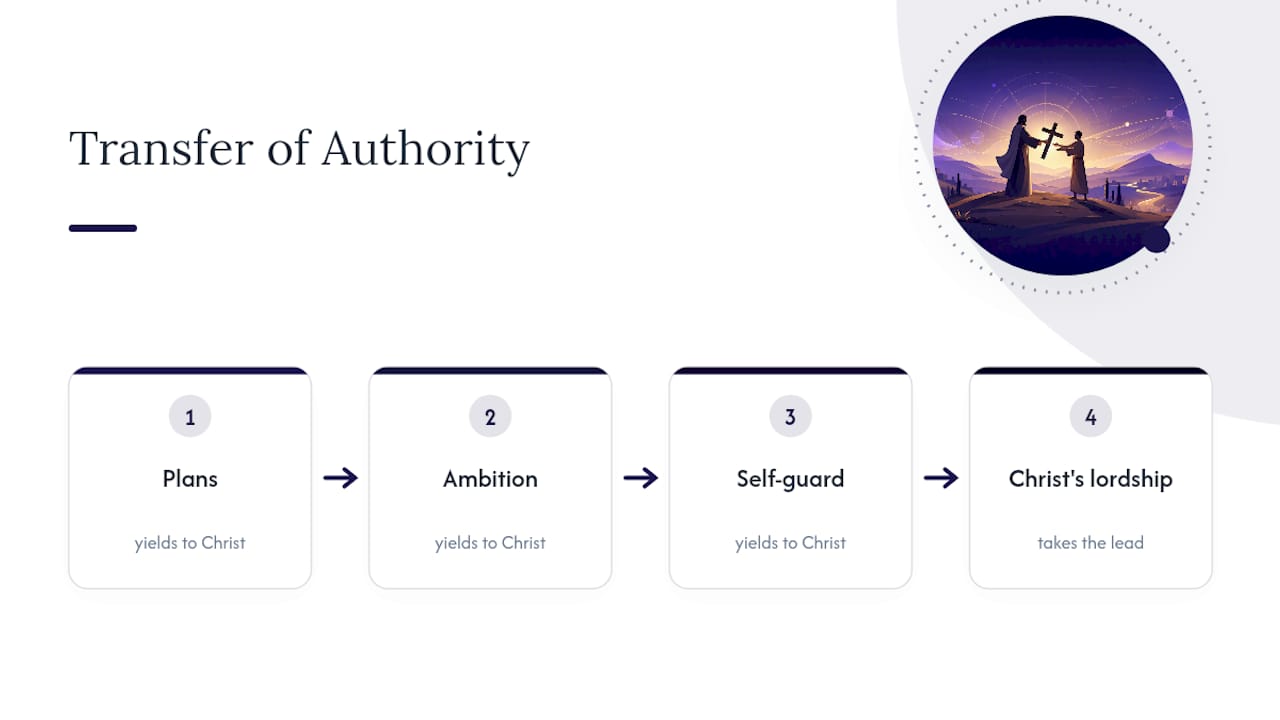
Paul lived this out in his own writing. He describes dying daily in his letters and tells the Galatians, “I have been crucified with Christ” (Galatians 2:20). Romans 6 develops the same idea: baptism unites believers with Christ’s death so they can walk in newness of life. None of this is self-hatred. It is a redirection of loyalty.
The paradox sits at the center of Mark’s Gospel:
“For whoever would save his life will lose it, but whoever loses his life for my sake and the gospel’s will save it.” (Mark 8:35)
That single sentence reframes the entire command. Losing your grip on self-direction is not a loss at all. It is the doorway to resurrection life, the same pattern Christ himself walked: death first, then new life on the other side.
Reflections from the CS Lewis Institute connect this to how the earliest disciples actually lived it out: not through dramatic martyrdom alone, but through a daily discipline of choosing Christ’s priorities over self-preservation, meal by meal, decision by decision.

How to Carry Your Cross in Ordinary Daily Life
Luke’s “daily” turns this from a theological idea into a habit. Discipleship built this way doesn’t wait for a crisis. It shows up in small, repeatable choices that most people barely notice making.
- Forgive before you feel like it. Holding a grudge protects self-interest; letting it go dies to it.
- Choose the smaller, harder good over the easier convenience. A sacrificial choice at work or at home, made quietly, is cross-bearing in miniature.
- Depend on prayer instead of your own competence. Asking for help admits you are not the final authority over the outcome.
- Stay accountable to other believers. Isolation lets self-rule hide; community exposes it.
- Treat ordinary tasks as obedience. Washing dishes, showing up on time, and finishing unglamorous work can all be done as an offering rather than an obligation.
Each of these dies to something. Forgiveness kills the demand for fairness. Small sacrifices kill the demand for comfort. Prayerful dependence kills the illusion of control. None of it looks dramatic, but that is the point Luke’s “daily” is making.
Pro Tip: Pair one cross-bearing practice with an existing habit, like reciting a memorized verse while making coffee. Habit stacking turns “daily” from a nice idea into something your schedule actually protects.
What Taking Up Your Cross Does Not Mean
“This is just my cross to bear” gets misused constantly, usually to justify staying passive in a bad situation rather than doing anything about it. That phrase was never meant as a license for enduring abuse, ignoring a treatable illness, or excusing neglect. Jesus was describing willing surrender to God’s purposes, not resignation to whatever harm comes your way.
There’s a real difference between ordinary hardship and the specific call to die to self for Christ’s sake. A difficult boss, a chronic illness, or a hard season of parenting is genuine suffering, but it is not automatically “your cross” in the biblical sense unless it involves a choice to follow Christ at personal cost.
Healthier responses exist:
- Bring hard circumstances to God honestly through lament instead of silent endurance.
- Seek counsel from trusted, mature believers before assuming a hardship is something you must simply accept.
- Set boundaries when a relationship or situation is harmful. Boundaries are not a failure of faith.
Cross-bearing is about surrendered loyalty to Christ, never a reason to tolerate what should be confronted.
Scripture Tools to Practice Daily Surrender
Living this out daily is easier with the right anchors in front of you, such as reflections from Grace Notes - The Broken Seam that complement theological discussion and devotional perspective. Curated verse collections on topics like humility and obedience give you scripture already grouped around the exact postures Luke 9:23 calls for, each with context so you understand what you’re reading and why it fits. Tools like a translation comparison feature help you see how “daily” and “deny himself” render across versions, adding texture to a phrase easy to skim past.
Small Crosses, Real Practice
I once let a minor slight go unanswered rather than defending myself, and it cost me nothing but pride. That is the whole practice in miniature. Pick one small surrender this week and see what it costs you.
— Nkosi
Where to Find Verses for Daily Discipleship
Biblemanna is built for exactly this kind of daily practice, not a one-time read-through. Instead of hunting through an entire Bible for verses on surrender or perseverance, you get them already grouped, explained, and ready to return to tomorrow.

Start with the full Bible Verses by Topic index, then go straight to collections built for this exact command: verses on obedience for the daily choices, and passages on strength for the days that discipline feels heavy. Each verse comes with background context, so you’re not just reading words, you understand what they meant when they were written. Pick one topical list and read a single verse from it tomorrow morning before your day starts.
Sources
- What Does Luke 9:23 Mean? | Crossway
- ESV Scripture references: Matthew 16:24; Mark 8:34; Luke 9:23
- Luke 9:23 Commentaries | BibleHub
FAQ
What Does “Taking Up the Cross” Mean?
It means surrendering your right to self-direction and following Jesus even when that obedience costs comfort, reputation, or security, grounded in Matthew 16:24, Mark 8:34, and Luke 9:23.
What Does It Mean to Take Up Your Cross in Luke 9:23?
Luke’s version adds “daily,” framing cross-bearing as a repeated, ongoing habit of surrender rather than a single dramatic moment.
What Did Jesus Mean by “Take Up Your Cross Daily”?
He meant discipleship happens through small, everyday choices to put his priorities above your own comfort and control, not through one big sacrificial gesture.
Does the Bible Say “Take Up Your Cross”?
Yes. The exact command appears in Matthew 16:24, Mark 8:34, and Luke 9:23, with Luke’s account uniquely adding the word “daily.”
How Do I Start Living Out This Command Today?
Pick one small act of surrender, such as forgiving quickly or choosing a harder right choice over an easier convenience, and pair it with a scripture reminder from a resource like Biblemanna’s topical verse collections.