Tithing in the Bible: What Christians Should Know

The Bible presents tithing as an Old Testament, covenantal practice rooted in Mosaic law. The New Testament does not impose a new 10% legal requirement on Christians. Instead, apostolic teaching shifts the emphasis toward proportionate, cheerful, and willing giving, as Paul states plainly in 2 Corinthians 9:6–7: “Each one must give as he has decided in his heart, not reluctantly or under compulsion, for God loves a cheerful giver.”
Four passages anchor this conversation:
- Malachi 3:8–10 — God’s rebuke to Israel for withholding tithes from the temple storehouse, addressed to a covenant community under Mosaic obligation.
- Matthew 23:23 — Jesus acknowledges the Pharisees’ tithing of herbs while rebuking their neglect of justice, mercy, and faithfulness.
- Hebrews 7 — Abraham’s tithe to Melchizedek is used to argue for Christ’s superior priesthood, not to establish a tithing law.
- 2 Corinthians 9:6–7 — Paul’s clearest instruction on Christian giving: proportionate, intentional, and motivated by grace rather than legal duty.
The practical verdict: modern Christians are not under the Mosaic tithe as a binding law, but the principle of generous, firstfruits giving runs through both Testaments and remains a compelling model for discipleship.
Pro Tip: When studying tithing, always note the genre and audience of each passage. A prophetic rebuke to ancient Israel (Malachi) carries different weight than apostolic instruction to a Gentile church (2 Corinthians). Genre shapes application.
Key Takeaways
The Old Testament tithe was a multi-part, covenant-specific system; the New Testament calls Christians to proportionate, cheerful generosity rather than a binding 10% law.
| Point | Details |
|---|---|
| OT tithe was multi-part | Israel’s system included three distinct tithes; the aggregate burden could reach roughly 20–23% of produce annually. |
| NT shifts the frame | Paul’s instruction in 2 Corinthians 9:6–7 emphasizes proportion and motive, not a fixed legal percentage. |
| Malachi 3 has a context | God’s rebuke was addressed to Israel’s covenant community, not issued as a universal financial promise for individuals. |
| Posture matters more than percentage | Generous, cheerful, and proportionate giving aligns with NT teaching better than mechanical compliance with a number. |
| Biblemanna for further study | Biblemanna’s curated topical pages on money and giving gather the key scriptures with context for personal study and application. |
Table of Contents
- What does “tithe” mean, and where does it start in the Bible?
- How did tithing work under the Mosaic Law?
- What does the New Testament actually say about tithing?
- Why do Christians disagree about whether tithing is required?
- How can you apply biblical giving principles today?
- Where to find the scriptures and study resources used here
- What giving actually asks of you
- Sources
- FAQ
What does “tithe” mean, and where does it start in the Bible?
The word “tithe” simply means a tenth. In Hebrew, the root ma’aser carries the same meaning, and the Holman Bible Dictionary confirms this basic definition while noting that the term appears across Numbers, Deuteronomy, and Leviticus with distinct regulations for each context.
What surprises many readers is that tithing appears in Genesis, long before Moses. Two examples stand out.
Abraham and Melchizedek (Genesis 14:18–20). After defeating a coalition of kings and rescuing his nephew Lot, Abraham gave a tenth of the war spoils to Melchizedek, the priest-king of Salem. No law commanded this. It reads as a spontaneous act of honor and gratitude toward a priest of God Most High.
Jacob’s vow (Genesis 28:22). Fleeing from Esau and sleeping at Bethel, Jacob woke from his dream of a heavenly ladder and made a vow: “Of all that you give me I will give a full tenth to you.” Again, no statute required it. Jacob was bargaining with God in a moment of vulnerability and awe.
Both examples are voluntary responses to divine encounter, not legal obligations. The Easton’s Bible Dictionary notes that tithing as a recognized practice predates the Mosaic code and has parallels in other ancient Near Eastern cultures, where a tenth was commonly offered to temples or kings as an acknowledgment of sovereignty.
Early functions of the tithe in these pre-Mosaic examples:
- Gratitude and honor — a response to God’s provision or protection.
- Vow fulfillment — a pledge made in a moment of dependence.
- Priestly support — recognizing the role of a mediating priest.
- Firstfruits devotion — setting apart the best portion as belonging to God.
These early examples matter theologically because Hebrews 7 later uses Abraham’s tithe to argue for Christ’s priesthood surpassing the Levitical order. The argument is about priesthood, not about establishing a tithing law for Christians.
How did tithing work under the Mosaic Law?
The Mosaic tithe system was not a single 10% tax. It was a multi-part structure tied to Israel’s theocratic land tenure, and understanding it changes how you read the familiar “10%” assumption. As the Westminster Theological Seminary analysis explains, the tithe served three distinct purposes: supporting temple personnel, funding communal festival celebration, and caring for the poor.

When historians count all the required tithes together, the aggregate annual giving burden for an Israelite farmer could approach roughly 20–23% of agricultural produce, not a single 10% payment. That figure reframes the common assumption that “biblical tithing” means 10%.
The three main tithes described in the Pentateuch:
| Tithe Type | Primary Recipient | Scriptural Reference | Main Purpose |
|---|---|---|---|
| Levitical tithe | Levites (who then gave a tenth to priests) | Numbers 18; Leviticus 27 | Support for those with no land inheritance |
| Festival tithe | The giver’s own household at the sanctuary | Deuteronomy 14:22–26 | Communal celebration and worship |
| Third-year tithe | Levites, foreigners, orphans, widows | Deuteronomy 14:28; 26:12–15 | Social welfare for the vulnerable |
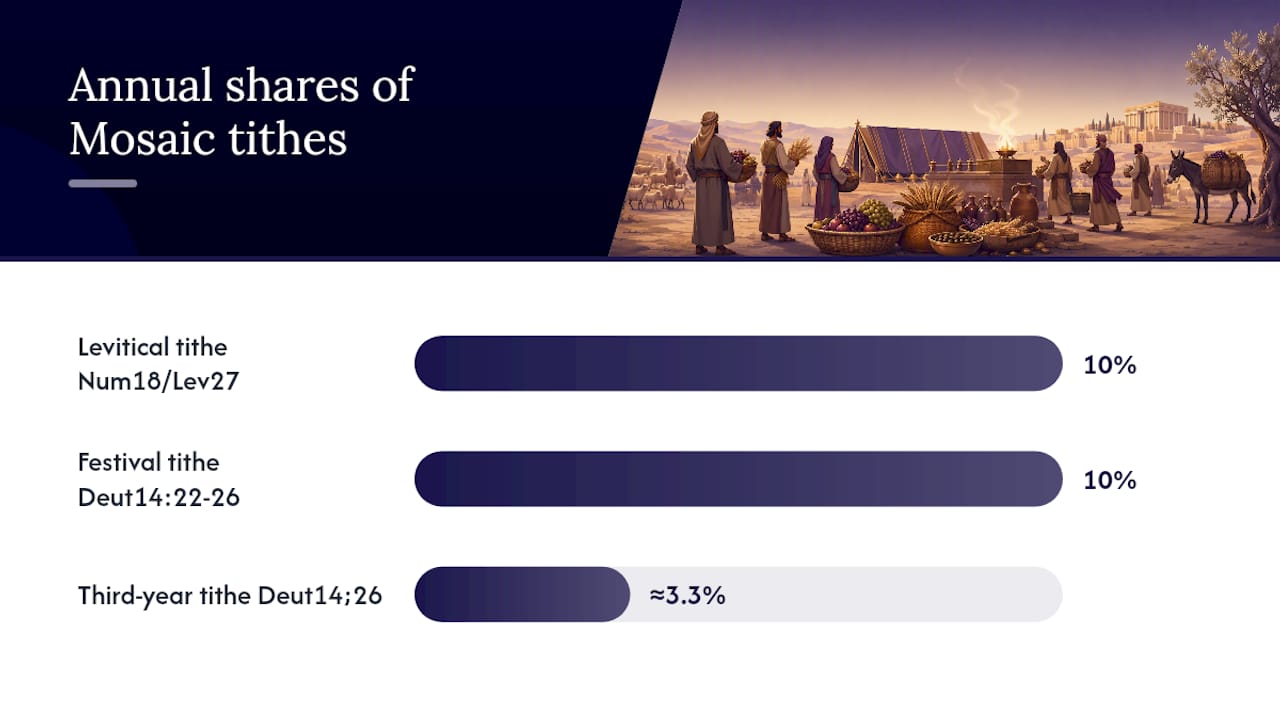
The Levites received the Levitical tithe because they held no tribal land allotment in Canaan. Their entire livelihood depended on Israel’s faithfulness to bring the tithe. In turn, Levites gave a tenth of what they received to the Aaronic priests (Numbers 18:26–28), creating a tithe-on-the-tithe structure.
The festival tithe is often overlooked. Deuteronomy 14 instructs Israelites to set aside a tenth each year, travel to the central sanctuary, and eat it there in celebration before God. If the journey was too far, they could convert it to silver, travel, and spend it on “whatever you desire — oxen or sheep or wine or strong drink” (Deuteronomy 14:26). This was a feast, not an austerity measure.
The third-year tithe, collected every three years, stayed local. It went into a communal storehouse for Levites, resident aliens, orphans, and widows. This is the closest the Mosaic system comes to a structured social safety net.
Pro Tip: The “storehouse” in Malachi 3:10 refers to this temple/communal storehouse, not a modern church building. Reading it as a direct command to deposit 10% of your paycheck into a local congregation requires a significant interpretive leap.
What does the New Testament actually say about tithing?
Fewer passages than most people expect, and none of them establish a new 10% law. As Christian Research Institute’s summary notes, tithing appears only a handful of times in the New Testament, and apostolic instruction consistently emphasizes proportion and motive over a fixed percentage.
Matthew 23:23 and Luke 11:42
Jesus tells the Pharisees: “Woe to you, scribes and Pharisees, hypocrites! For you tithe mint and dill and cumin, and have neglected the weightier matters of the law: justice and mercy and faithfulness. These you ought to have done, without neglecting the others.”
The audience matters here. Jesus is speaking to Jewish religious leaders who are under the Mosaic covenant. He affirms their tithing of garden herbs while condemning their moral failures. This passage does not address Gentile Christians or post-resurrection church practice. It is a rebuke about misplaced priorities, not a universal tithing mandate.
Luke 18:12
The Pharisee in Jesus’ parable boasts, “I fast twice a week; I give tithes of all that I get.” Jesus uses this character to illustrate self-righteousness, not to endorse his tithing as a model for others.
Hebrews 7
The author uses Abraham’s tithe to Melchizedek to argue that Christ’s priesthood is superior to the Levitical order. The logic runs: Levi was “in the loins of Abraham” when Abraham paid the tithe, so in a sense Levi paid tithes to Melchizedek, acknowledging a greater priesthood. The point is Christological, not prescriptive.
This verse actually undercuts a simple continuity argument: Christ came from Judah, not Levi, which means the Levitical system has been superseded. Tithing to support a Levitical priesthood no longer applies in the same way.
2 Corinthians 9:6–7 and 1 Corinthians 16:2
Paul’s clearest giving instructions say nothing about 10%. In 2 Corinthians 9, he urges the Corinthians to give “as he has decided in his heart, not reluctantly or under compulsion.” In 1 Corinthians 16:2, he asks each person to set aside a sum “as he may prosper” on the first day of the week. Both passages emphasize regularity, intentionality, and proportion to income, not a fixed legal percentage.
Why do Christians disagree about whether tithing is required?
Three main positions dominate evangelical and Protestant discussion, and each draws on real scriptural and theological reasoning.
The continuationist view
This position holds that the tithe is a moral principle that predates Moses (Abraham, Jacob), was codified in the law, and carries forward into the new covenant as a minimum standard. Proponents argue that if Abraham tithed before the law, the practice transcends the Mosaic code. Some faith communities formalize this: The Church of Jesus Christ of Latter-day Saints, for instance, defines tithing as one-tenth of income and treats it as a binding commandment for members. The limitation of this view is that it tends to flatten the distinction between Israel’s theocratic covenant and the new covenant community, and it can struggle to explain why only the tithe carries forward while other Mosaic obligations do not.
The stewardship/grace view
This position, held by many Reformed and evangelical scholars, argues that the Mosaic tithe was part of Israel’s civil and ceremonial law, which Christ has fulfilled. Christians are not under that law. Instead, they are called to generous, proportionate, cheerful giving shaped by the gospel. The Easton’s Bible Dictionary notes that while the Mosaic tithe is not simply binding law for Christians, its principle is incorporated into Christian teaching about consecration and generosity. The limitation: without a concrete benchmark, some Christians give far less than 10%, using “grace giving” as cover for minimal generosity.
The hybrid/benchmark view
A practical middle position recommends 10% as a helpful, historically grounded starting point without treating it as a legal requirement. Many pastors teach it as a floor, not a ceiling, and a useful discipline for forming giving habits. This view acknowledges the NT’s silence on a fixed percentage while recognizing that a concrete number helps people move from intention to action.
One position that deserves pastoral caution: the prosperity-teaching stream, represented by ministries like Kenneth Copeland Ministries, which presents tithing as a mechanism for guaranteed material blessing. This reading treats Malachi 3:10 as a transactional promise, but Ligonier Ministries argues that Malachi’s rebuke was addressed to Israel’s covenant community for failing to bring required tithes to the temple storehouse, not as a universal financial formula for individuals.
Key scriptural and theological claims for each position:
- Continuationist: Pre-Mosaic examples (Genesis 14, 28); moral law continuity; Matthew 23:23 as implicit endorsement.
- Stewardship/grace: 2 Corinthians 9:6–7; Mosaic law as fulfilled in Christ; NT emphasis on motive over percentage.
- Hybrid/benchmark: Practical discipleship formation; 10% as a historically grounded starting point; avoids both legalism and minimal giving.
Pro Tip: When teaching Malachi 3 in a church context, always contextualize it within Israel’s covenant obligations first. Presenting it as a direct, universal promise of financial return can create transactional faith and genuine harm when the promised blessing does not materialize for struggling givers.
How can you apply biblical giving principles today?
The New Testament does not hand you a formula, but it does give you a framework. Here is a practical sequence for working through your own giving posture.
-
Settle your posture first. Are you giving out of obligation, fear, or gratitude? Paul’s instruction in 2 Corinthians 9 begins with the heart. Giving that flows from gratitude for the gospel is categorically different from giving to avoid divine punishment or earn blessing. Start there, not with a percentage.
-
Set a giving method. First Corinthians 16:2 suggests regularity: “on the first day of every week, each of you is to put something aside and store it up.” Automatic transfers, a dedicated giving account, or a monthly budget line all serve this purpose. The mechanism matters less than the consistency.
-
Choose recipients thoughtfully. The New Testament supports giving to local church ministry (1 Corinthians 9:14; Galatians 6:6), to the poor and vulnerable (Galatians 2:10; James 2:14–17), and to those in acute need (Acts 2:44–45; 2 Corinthians 8–9). A giving plan that includes all three mirrors the Mosaic system’s own threefold purpose. Biblemanna’s curated Bible verses about money can help you trace these themes across both Testaments.
-
Review annually. Life circumstances change. A percentage that was generous at one income level may become minimal at another, or genuinely impossible during a season of hardship. Build in a yearly review of both amount and recipients.
Recommended recipient types and their rationale:
- Local church — sustains ongoing ministry, preaching, pastoral care, and community.
- Local charity or food bank — mirrors the third-year tithe’s social welfare function.
- Direct aid to individuals in need — the most immediate form of the NT’s “care for the poor” ethic.
- Parachurch ministries and missions — extends the reach of the gospel beyond the local congregation.
Red flags to watch for in giving contexts:
- Pressure tactics that tie giving to membership status or spiritual standing.
- Promises of specific financial return tied to a giving amount.
- Lack of financial transparency from the receiving organization.
- Guilt-based appeals that exploit economic hardship.
The percentage vs. posture question comes down to this: a person giving 5% with genuine sacrifice and joy may be more aligned with the NT’s vision than someone giving 15% out of habit or social pressure. Conscience and accountability matter more than hitting a number.
Where to find the scriptures and study resources used here
Studying tithing well means reading the primary texts in context, not just collecting proof texts. Biblemanna’s topical collections make that easier by gathering the relevant verses with brief explanations in one place.
Useful Biblemanna pages for this study:
- Bible verses about money — 56 curated scriptures covering wealth, generosity, and stewardship across both Testaments, each with context and meaning.
- Bible verses about thankfulness — helpful for exploring the firstfruits and gratitude angle that underlies both Abraham’s tithe and Paul’s giving theology.
- Bible verses about work — useful when thinking about how income is earned and how vocation connects to giving.
- Biblemanna topics index — a broader hub for exploring adjacent themes like stewardship, covenant, and generosity.
For deeper study, the Vyrse biblical glossary decodes over 70 biblical terms, including covenant language that shapes how Malachi and Deuteronomy should be read.
A simple study workflow for Malachi 3:
- Read Malachi 3:6–12 in full in two translations (ESV and NIV work well together).
- Note the audience: God is speaking to “the sons of Jacob” — Israel’s covenant community.
- Check the cross-references to Deuteronomy 14 and Numbers 18 to see what “the full tithe” referred to.
- Read Malachi 3:1–5 for context: the rebuke about tithes sits inside a broader indictment of covenant unfaithfulness.
- Journal one application question: what does faithful stewardship look like for me, given my actual circumstances?
Pro Tip: Comparing translations is one of the fastest ways to catch interpretive nuance. The phrase “storehouse” in Malachi 3:10 translates a Hebrew word for a temple treasury room. Seeing that detail in a study Bible or lexicon immediately clarifies what the original audience heard.
What giving actually asks of you
The tithing debate can become an intellectual exercise that keeps you at a safe distance from the actual question the Bible is asking: what does your relationship with money reveal about your trust in God?
That question is harder than calculating a percentage. It is also more honest. The Mosaic tithe was embedded in a system where God literally owned the land, the Levites had no inheritance, and the poor had no safety net beyond communal obligation. Transplanting that system directly into a modern American context, where church staff receive salaries and government programs exist, requires careful thought, not a simple formula.
What the New Testament consistently asks is not “did you hit 10%?” but “are you giving generously, proportionately, and cheerfully?” Those three words from Paul’s instruction carry more weight than any percentage. Generously means it costs you something. Proportionately means it scales with what you actually have. Cheerfully means it comes from a place of trust, not fear.
If you are in a season of financial hardship, the NT also has something to say to you: the widow’s two coins (Mark 12:41–44) are praised precisely because they represent everything she had, not because they hit a threshold. Small, faithful giving in hard seasons is not a consolation prize. It is the real thing.
Seek counsel from a trusted pastor or church leader as you work through your own giving plan. Discuss it openly. The Bible verses about encouragement on Biblemanna can also ground you when the conversation feels heavy.
Scripture and study resources on giving are closer than you think
Biblemanna’s topical scripture collections give you the full text of relevant passages alongside context and meaning, organized by theme so you can move from question to scripture without wading through a search engine. The Bible verses by topic hub covers money, generosity, thankfulness, and stewardship, with each verse presented in a way that supports both personal devotion and serious study.

Whether you are working through your first giving plan or revisiting a long-held practice, start with the primary texts. Visit Biblemanna’s topical collections to read the key scriptures on money and giving with their full context, then bring what you find to your church community.
Sources
- Biblical Teaching About the Tithe
- Stealing from God (Malachi) — Ligonier
- Tithing: Is it New Testament? (Revisited)
- 20 Tithing Verses in the Bible (Old & New Testament) | Pushpay
- What Is Tithing? | Come unto Christ
- Tithe - Holman Bible Dictionary
- Tithe - Easton’s Bible Dictionary
- 10 Scriptures About Tithing – Kenneth Copeland Ministries
Recommended further reading:
FAQ
What does Jesus say about tithing?
Jesus acknowledges tithing in Matthew 23:23 but uses it to rebuke the Pharisees for prioritizing minor religious duties over justice, mercy, and faithfulness. He does not establish tithing as a new covenant requirement for his followers.
Is 2 Corinthians 9:7 about tithing?
Not directly. Paul instructs each person to give “as he has decided in his heart, not reluctantly or under compulsion,” which emphasizes voluntary, proportionate generosity rather than a fixed 10% legal obligation. It is the New Testament’s clearest giving principle, but it does not mention a tithe.
Is tithing 10% a biblical requirement for Christians?
The Mosaic tithe was 10% of agricultural produce, but the full Israelite giving system included multiple tithes that could total roughly 20–23% annually. The New Testament does not impose a 10% law on Christians; it calls for proportionate, cheerful giving calibrated to what each person has.
What were the three reasons Israel tithed?
The Mosaic tithe system served three purposes: supporting the Levites who had no land inheritance, funding communal festival worship at the sanctuary, and providing for the poor, foreigners, orphans, and widows through the third-year tithe, as described in Deuteronomy 14 and Numbers 18.
How should a Christian decide how much to give?
Start with posture: 2 Corinthians 9:6–7 asks that giving be intentional, proportionate to income, and motivated by gratitude rather than compulsion. Many pastors recommend 10% as a practical starting benchmark, but the NT’s emphasis is on generosity and cheerfulness, not legal compliance with a percentage.